
Summarize with AI
Key Takeaways
- QuantumDesk is the best overall pick for startups, resolving tickets automatically across channels without an enterprise seat-based tool you don't need yet.
- Intercom's Fin AI Agent leads for product-led SaaS, resolving complex in-app issues with startup discounts of up to 93% off.
- Plain is the strongest pick for technical B2B startups, with Slack- and Linear-native AI routing built for engineering-led support teams.
- Gorgias remains the top choice for ecommerce and D2C startups, automating Shopify tracking and instant refunds on ticket-volume-based pricing.
- The most important buying consideration is matching your AI tier and pricing model to your business model, whether that's B2B SaaS or ecommerce.
Startups juggle a tight budget and an even tighter timeline, and the wrong tool means overpaying for capabilities you won't use for years. I tested 10 options built for early-stage teams.
It's built for product-led SaaS, technical B2B, and ecommerce founders who need AI resolving tickets from day one instead of a seat-based helpdesk that outpaces revenue. See our best AI help desk software for startups guide for more.
This guide breaks down what each tool resolves versus deflects, where AI-native platforms like QuantumDesk outperform legacy helpdesks, and how to pick the right fit for your stage and business model.
Quick Tabular Comparison of the Top AI Customer Service Software for Startups in 2026
How Did We Choose These 10 AI Customer Service Software for Startups?
I shortlisted these 10 tools by testing each one against real startup workflows instead of relying on vendor claims about startup discounts or resolution rates. This complements our broader best AI agents for customer support research.
- Verified startup pricing programs by checking actual discount terms and eligibility instead of trusting marketing claims.
- Evaluated AI accuracy by testing policy and account-specific queries to check for hallucination risk on real conversations.
- Reviewed verified ratings on G2 and Capterra, filtering specifically for startup and early-stage team feedback rather than enterprise reviews.
- Read Reddit and founder community threads to see which tools early-stage teams actually kept running past the free trial.
- Compared channel coverage across chat, email, Slack, and WhatsApp, since startup support rarely runs through one channel alone.
- Benchmarked pricing models against typical early-stage ticket volume to flag tools that get expensive fast as usage grows.
In-Depth Review of the Best 10 AI Customer Service Software for Startups in 2026
1. QuantumDesk – Best AI-Native Customer Service Platform for Startups

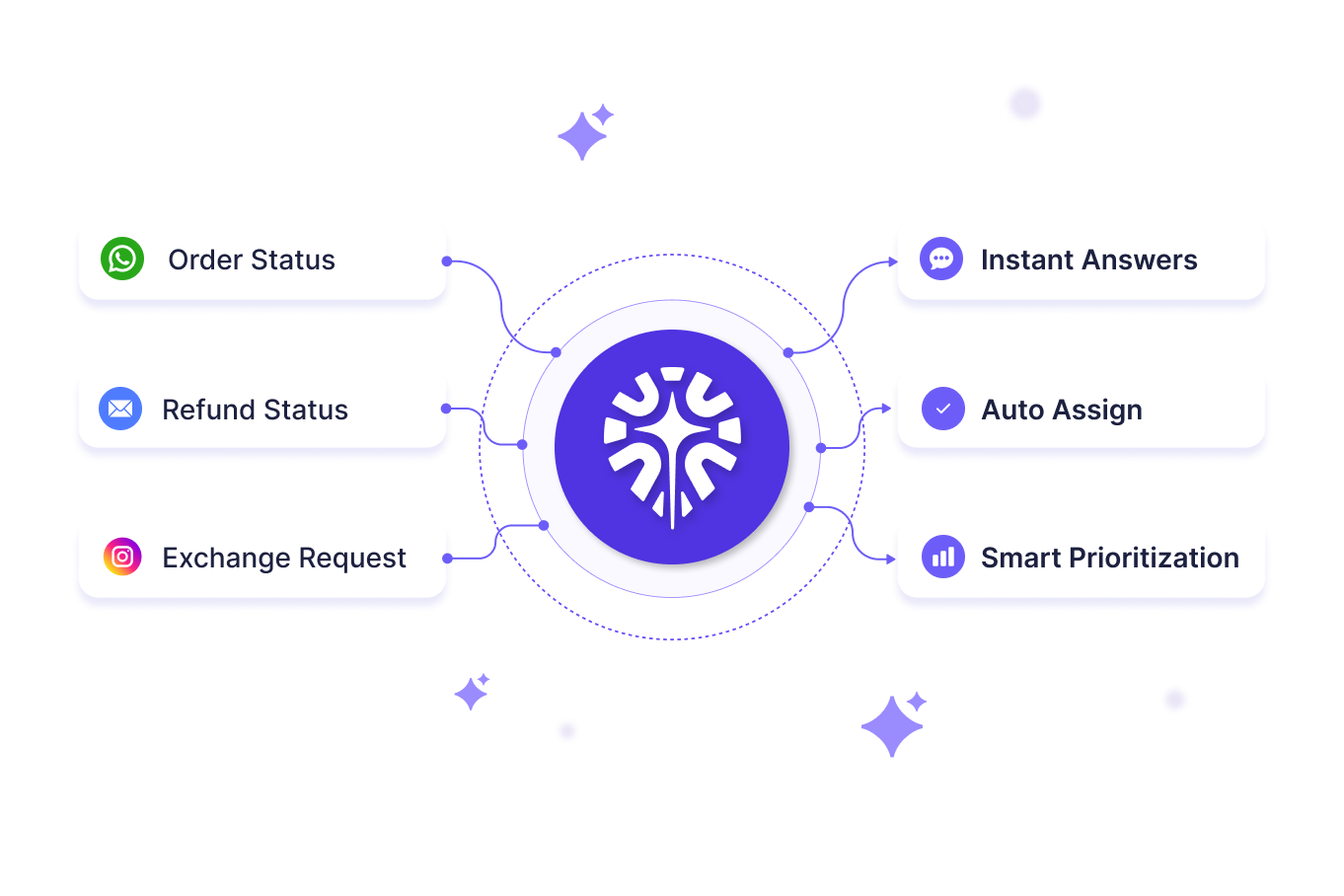
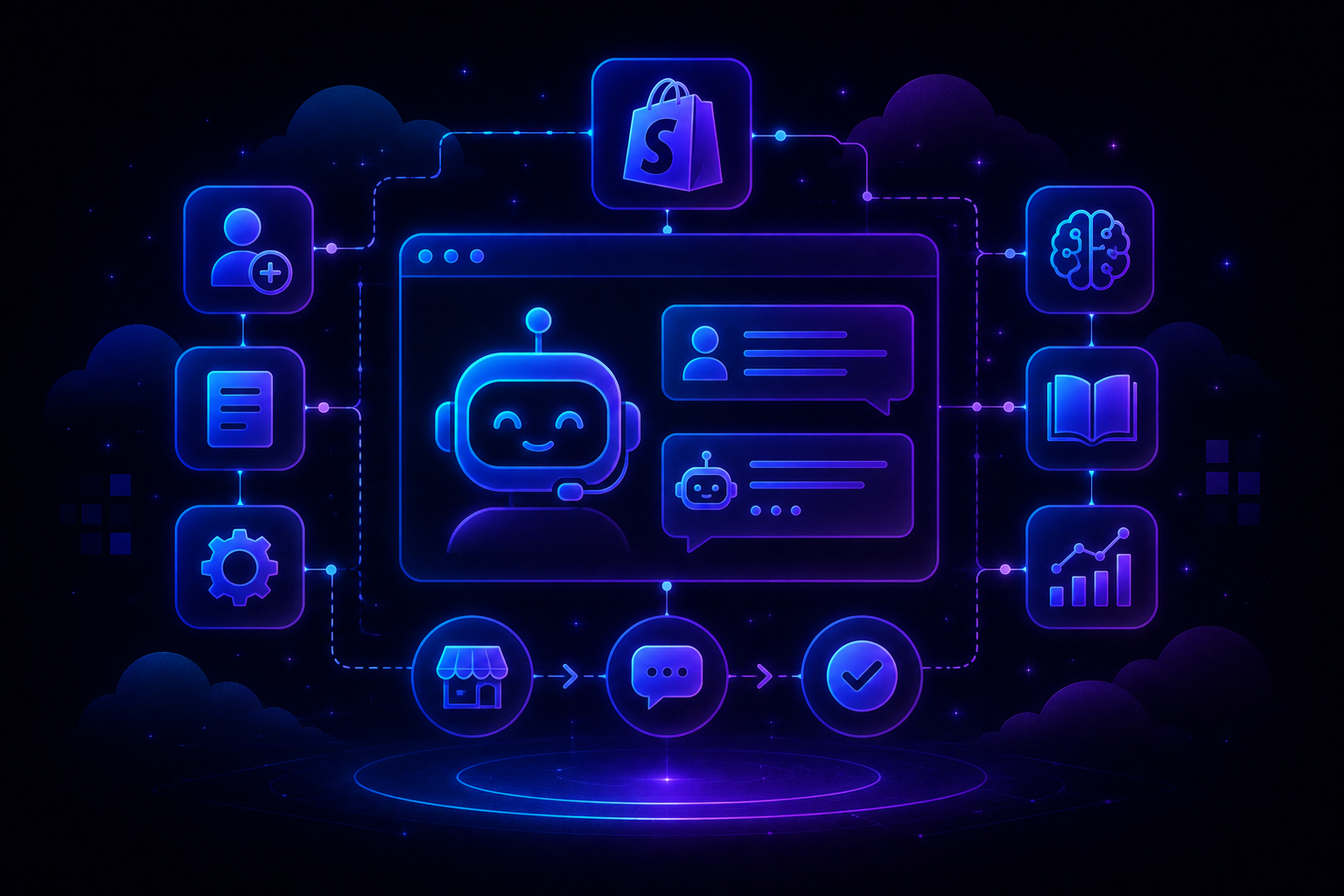
QuantumDesk is an AI-native customer support platform built for startups that want AI resolving tickets from day one instead of paying for a seat-based helpdesk that scales cost faster than headcount.
Quantum AI handles repetitive queries automatically across order status, billing, and account questions, while the Unified Inbox centralizes every channel into one workspace for lean teams.
What sets it apart is native Shopify order data inside every conversation, paired with resolution-based pricing instead of the per-seat licenses that punish early growth.
Key Features
- Quantum AI resolves repetitive queries automatically across order status, billing, refunds, and account questions, without an agent touching the ticket.
- Native Shopify integration surfaces live order data, tracking, and purchase history directly into every conversation for ecommerce startups.
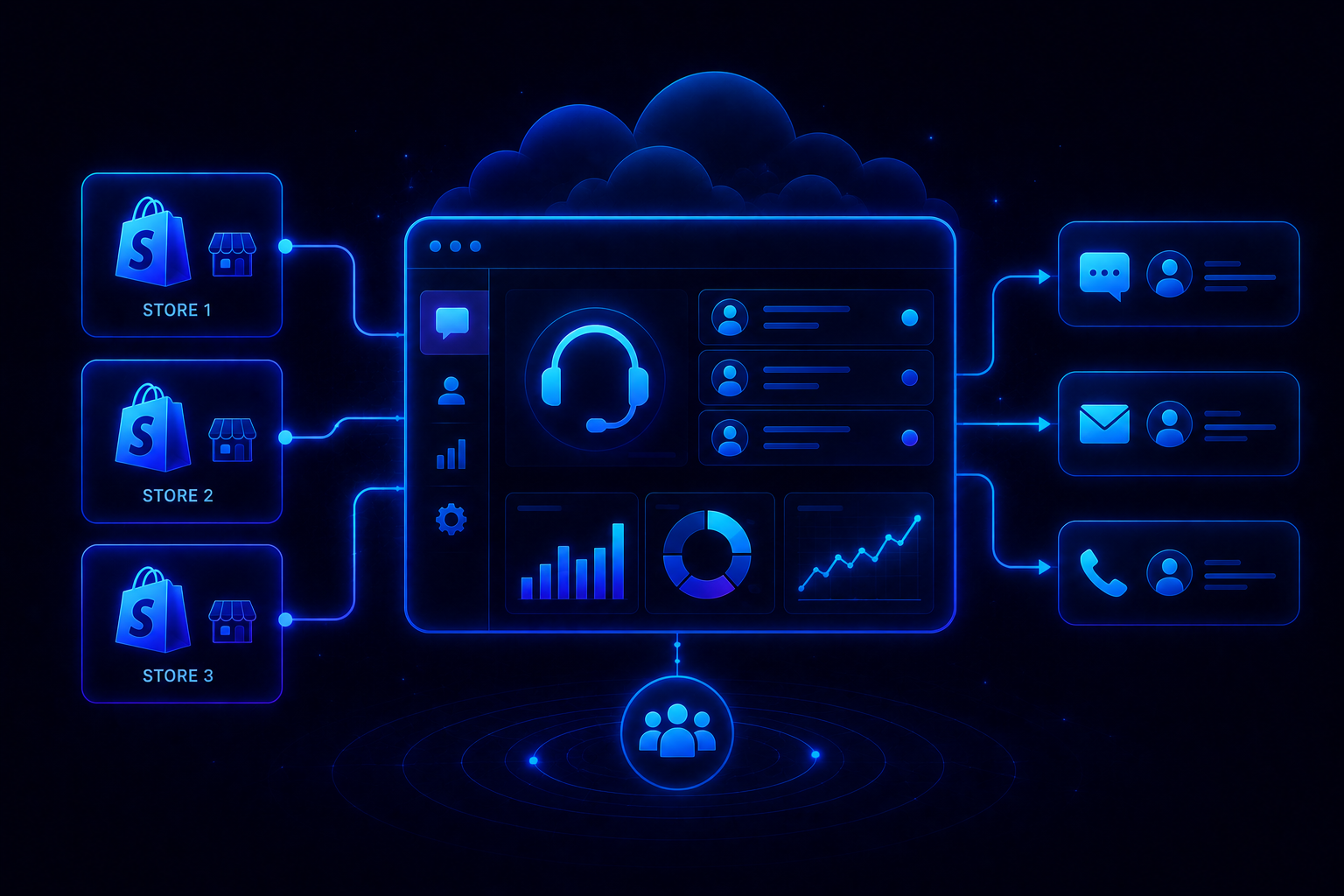
- Unified Inbox centralizes WhatsApp, email, Instagram, and live chat into one workspace, useful for lean teams without dedicated channel owners.
- AI-Curated Inbox prioritizes incoming tickets by urgency, sentiment, and customer value so small teams handle the highest-impact conversations first.
- Quantum AI Copilot drafts replies and summarizes conversations in real time, cutting onboarding time for new support hires.
Pros
- AI is embedded into the workflow from day one, removing the need to budget separately for a standalone AI add-on.
- Resolution-based pricing keeps costs aligned with ticket volume instead of per-seat licenses that scale faster than early revenue.
- Native Shopify integration ships built in, giving ecommerce startups live order data without third-party connector delays.
Cons
- Fewer established startup case studies compared to incumbents that have served early-stage teams for years.
- Deepest native integration currently centers on Shopify, so non-ecommerce startups get a more general feature set.
Best Use Case
Early-stage startups, especially Shopify sellers, that need AI resolving tickets automatically without an enterprise-level budget.
When to Choose QuantumDesk
Choose QuantumDesk when your startup needs AI-native automation and outcome-based pricing that scales with ticket volume, not headcount.
Pricing
QuantumDesk follows a resolution-based pricing model where startups pay for AI-resolved tickets rather than per-seat licenses. Visit the QuantumDesk pricing page for a tailored quote.
2. Intercom (Fin AI) – Best for Product-Led SaaS Startups
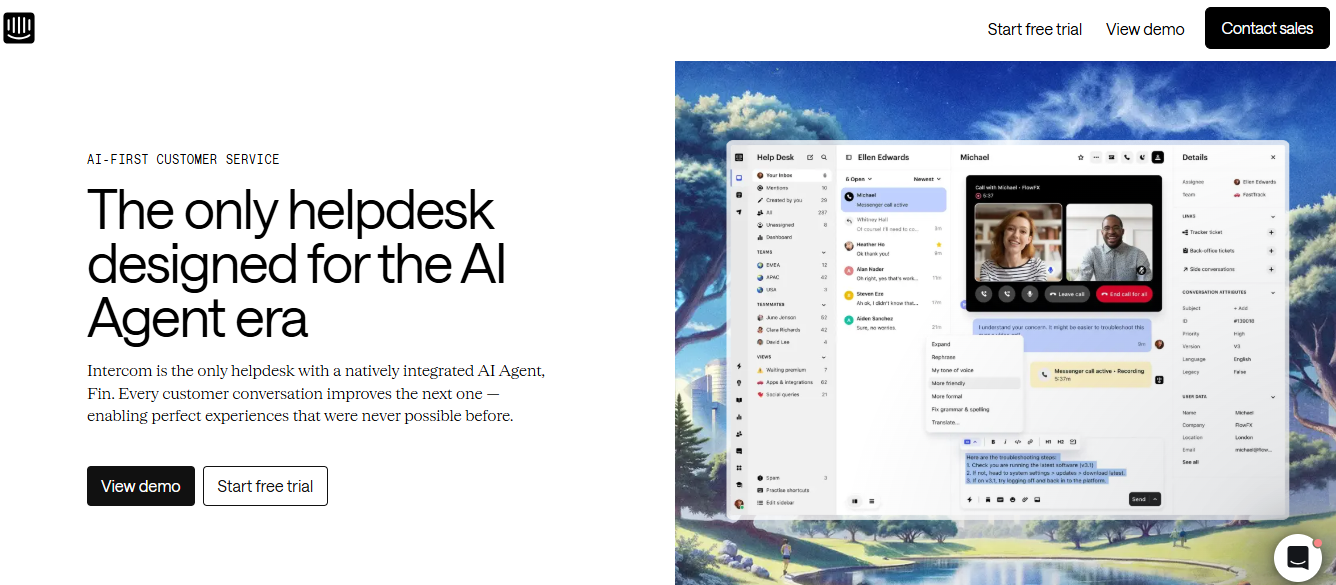
If you run a software startup where users need help directly inside your application, Intercom is the market leader, with Fin AI Agent reading your public docs to answer queries instantly inside a slick chat widget.
Their startup program slashes prices by up to 93% for early-stage companies, making enterprise-grade AI accessible before you have enterprise-grade revenue.
Key Features
- Fin AI Agent resolves complex in-app issues by reading your public docs and product content directly.
- Proactive Business Messenger captures and qualifies leads based on in-app behavior before routing to sales.
- Context-rich conversations carry previous interaction history so agents never ask customers to repeat themselves.
Pros
- Startup program discounts of up to 93% off make enterprise-grade AI accessible pre-revenue.
- Highly accurate resolution with seamless handoff to human agents when a query gets complex.
- Proactive messaging reduces frustration and improves feature adoption for product-led startups.
Cons
- Pay-per-resolution pricing outside the startup program can get expensive quickly at scale.
- Less suited to ecommerce-specific transactional queries like order tracking without added connectors.
- Discount eligibility and terms vary, so confirm your startup actually qualifies before committing.
Best Use Case
Product-led SaaS and app startups that want in-app resolution with steep early-stage pricing discounts.
Pricing
Intercom Fin is priced per resolution, on top of seat-based plans, with the Intercom for Startups program offering up to 93% off. See Intercom's official pricing page for current rates. Compare Intercom alternatives built AI-first from day one.
3. Plain – Best for Technical B2B and API-First Startups
If your customers are engineers who submit technical queries or prefer talking over Slack, Plain is heavily favoured by modern B2B teams, built API-first with an interface that feels more like a developer tool than a legacy helpdesk.
It includes native AI capabilities on all tiers without locking features behind expensive enterprise packages, with Slack Connect, Microsoft Teams, and Discord support built in.
Key Features
- Native AI routing and triage work directly inside Slack Connect, Microsoft Teams, email, and Discord.
- GraphQL API with no rate limits lets technical teams build fully custom support workflows.
- AI capabilities ship on every tier instead of being locked behind an enterprise package.
Pros
- Native AI on all tiers avoids the enterprise-package lock other helpdesks impose.
- Slack- and Teams-native support fits how technical B2B customers actually reach out.
- API-first, developer-friendly interface suits engineering-led support teams over generic ticketing.
Cons
- Less suited to consumer or ecommerce support outside technical B2B workflows.
- Smaller brand recognition and ecosystem than legacy helpdesk incumbents.
- Best value depends on a startup's engineering resources to configure custom workflows.
Best Use Case
Technical B2B startups whose customers reach out over Slack, Teams, or Discord with engineering-heavy queries.
Pricing
Plain starts around $35 per seat monthly, with startup discounts of around 50% available.
4. Zendesk – Best for Startups Selling to the Enterprise
If your startup targets banks, healthcare, or Fortune 500 companies, you will eventually need the rigorous compliance features of Zendesk, whose built-in AI handles ticket sorting, auto-summarization, and sentiment analysis out of the box.
Eligible VC-backed startups get 6 months completely free, letting you build enterprise-grade operations before paying a dime.
Key Features
- Advanced intent and sentiment classification runs natively inside the agent workspace.
- Ticket sorting and auto-summarization reduce manual triage as ticket volume grows.
- Broad compliance certifications including SOC 2, ISO 27001, and HIPAA suit enterprise-bound startups.
Pros
- 6 months free for VC-backed startups removes the upfront cost of enterprise-grade tooling.
- Compliance certifications make Zendesk a stronger fit when selling into regulated industries.
- Mature platform with a long enterprise track record across industries.
Cons
- Workflows get increasingly complex and clunky as the startup scales past its free period.
- Early-stage startups often pay for capabilities they won't use for years once the credit ends.
- AI capabilities are billed as an add-on layered onto core ticketing plans.
Best Use Case
Startups selling to enterprise buyers that need compliance-ready infrastructure before scaling revenue.
Pricing
Zendesk pricing starts around $25 per agent monthly, with AI capabilities added at roughly $50 per agent, or free for 6 months under the VC-backed startup program. See the official Zendesk pricing page for full tiers.
5. Gorgias – Best for Ecommerce and D2C Startups
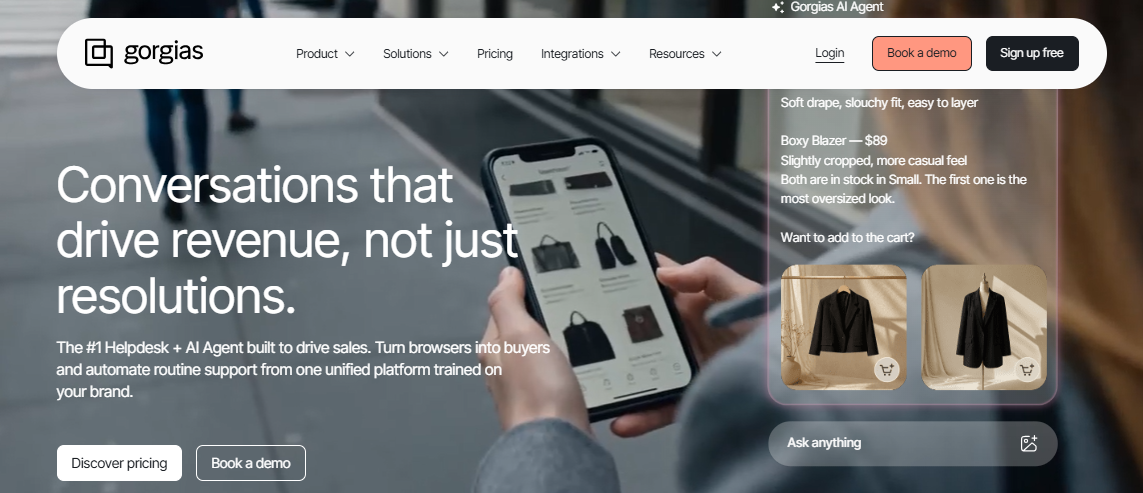
If you are building a consumer brand, do not use a SaaS helpdesk. Gorgias integrates deeply with Shopify, BigCommerce, and social channels, with AI handling the repetitive 70% of ecommerce tickets like "Where is my order?" without human intervention.
Pricing is ticket-volume-based rather than seat-based, making it affordable for tiny teams experiencing seasonal sales spikes.
Key Features
- AI Agent handles order tracking, returns, and refunds automatically inside the native ticket view.
- Native Shopify, BigCommerce, and social integrations connect order data without third-party workarounds.
- Ticket-volume-based pricing scales with sales activity instead of a fixed per-seat cost.
Pros
- Deepest ecommerce-native integration on this list, purpose-built for Shopify and D2C startups.
- Ticket-volume pricing suits tiny teams facing seasonal spikes better than rigid seat pricing.
- Automates roughly 70% of repetitive ecommerce tickets without human intervention.
Cons
- Not suited for software-as-a-service or service-based startups outside ecommerce.
- AI resolution costs stack on top of ticket-based pricing as a separate add-on.
- Per-ticket and per-resolution costs escalate quickly during high-volume sales events.
Best Use Case
Ecommerce and D2C startups on Shopify or BigCommerce that need order actions handled automatically.
Pricing
Gorgias starts around $40 a month, which includes AI agent tickets. Compare Gorgias alternatives built AI-first from day one.
6. Tidio (Lyro AI) – Best for Bootstrapped, Zero-Budget Startups
If you are pre-revenue or self-funded, Tidio offers a great free tier to deflect common questions with its Lyro AI chatbot, trained on your site content in minutes.
The free tier includes 50 AI chats, giving bootstrapped founders a genuine way to test AI support before committing any budget.
Key Features
- Lyro AI trains directly on your website and FAQ content, skipping manual knowledge-base setup.
- Free tier includes 50 AI conversations, enough for early-stage teams to test before paying.
- Automatic human handoff transfers conversations to a founder or agent when a query gets complex.
Pros
- Free tier gives pre-revenue startups a genuine way to test AI support without spending anything.
- Hyper-simple setup gets a working chatbot live in minutes, not days or weeks.
- Lyro reduces routine ticket volume effectively where most queries are repetitive FAQs.
Cons
- Lacks the deep multi-system automated workflows found in higher-end, enterprise-grade tools.
- AI resolution depth is shallower than platforms built for complex, multi-step disputes.
- Less suited to high-volume teams needing enterprise-grade routing as the startup scales.
Best Use Case
Pre-revenue and self-funded startups that need a working AI chatbot live in minutes at zero cost.
Pricing
Tidio offers a free plan with 50 AI conversations, plus paid tiers starting around $24 to $39 a month. Compare Tidio alternatives with deeper automation.
7. Botpress – Best for Highly Custom Technical Stacks
For technical founders wanting to build hyper-custom, complex AI workflows without paying "per-seat" software taxes, Botpress lets you deploy robust AI agents entirely for free, passing through basic LLM token costs without markups.
Autonomous multi-step actions and hot human handoff keep the AI active even during escalation, built for startups with unique internal APIs.
Key Features
- Free tier at $0 per seat, with startups only paying underlying LLM provider costs directly.
- Autonomous multi-step actions let technical founders orchestrate complex workflows against internal APIs.
- Hot human handoff keeps AI active alongside a founder or agent during escalation.
Pros
- No seat-based pricing keeps costs at zero beyond pass-through LLM usage.
- Full control over automation logic suits startups with unique, non-standard support workflows.
- Hot handoff design avoids a jarring bot-to-human transition mid-conversation.
Cons
- Requires engineering resources, so it's not plug-and-play for non-technical founders.
- Slower time-to-value than no-code tools built for immediate deployment.
- Best value depends on conversation volume, harder to forecast pre-launch than seat pricing.
Best Use Case
Technical founders building hyper-custom AI workflows who want to avoid per-seat software costs entirely.
Pricing
Botpress offers a free tier at $0 per seat, with startups paying only pass-through LLM provider costs.
8. Pylon – Best for B2B Startups Needing Omnichannel Support
Pylon is the support platform built for B2B, offering omnichannel support across Slack, Teams, WhatsApp, Telegram, Discord, email, in-app chat, and ticket forms.
Its AI agents categorize issues, draft responses, and automatically update your knowledge base, while Account Intelligence spots churn risk and upsell signals from support interactions.
Key Features
- Omnichannel support tracks every conversation as an issue across Slack, Teams, WhatsApp, Telegram, Discord, and email.
- AI agents categorize issues, draft responses, and route conversations to the right person automatically.
- Account Intelligence surfaces custom health scores and churn risk directly from support interactions.
Pros
- Purpose-built for B2B workflows rather than adapted from a general-purpose helpdesk.
- Slack- and Teams-native support fits how modern B2B customers actually reach out.
- Account Intelligence adds revenue-relevant insight beyond pure ticket resolution.
Cons
- Less suited to B2C or high-volume ecommerce support than B2B account-based workflows.
- Smaller ecosystem and brand recognition than legacy helpdesk incumbents.
- Pricing is quoted by contacting sales rather than published transparently.
Best Use Case
B2B startups that need omnichannel support across Slack, Teams, and WhatsApp with account-level insight.
Pricing
Pylon pricing is quoted based on team size and channel mix; contact their team for a startup-specific quote.
9. HubSpot Service Hub – Best for Startups Already Running HubSpot
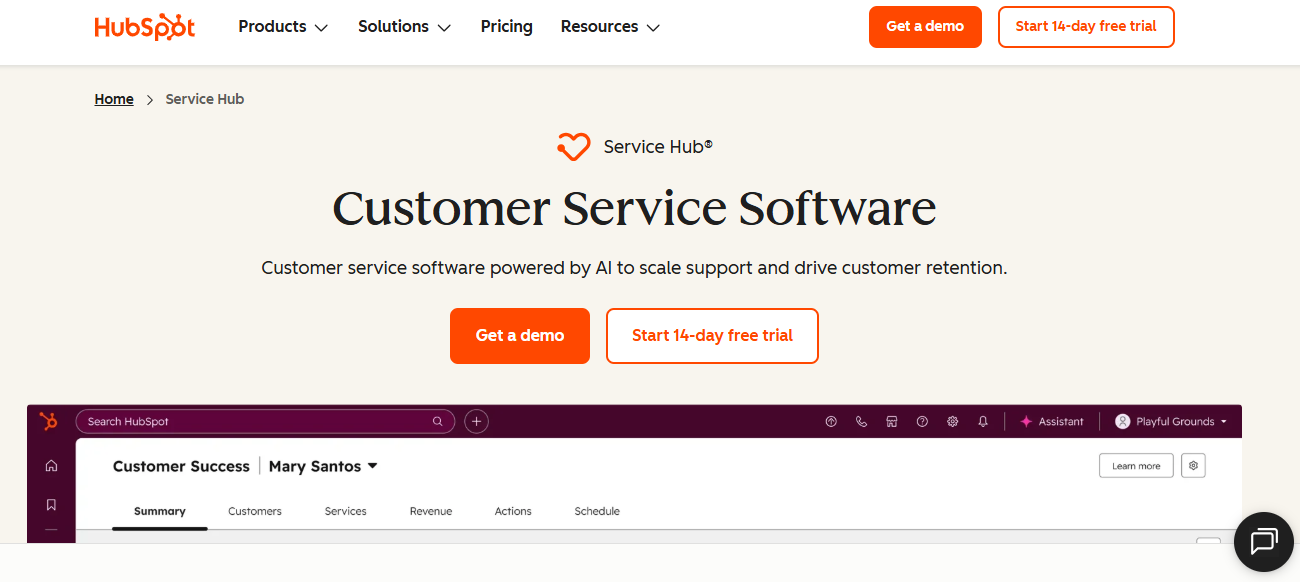
HubSpot Service Hub makes sense if you're already using HubSpot for marketing or sales, tying support tickets to the same CRM record.
Its free tier includes basic ticketing and email support, while paid plans add live chat, knowledge base, and AI-assisted resolution through its Customer Agent.
Key Features
- Native ticketing ties every support conversation to the same CRM record used by sales and marketing.
- Free tier includes basic ticketing and email support before a startup needs to pay.
- Customer Agent AI surfaces suggested replies drawn from existing knowledge base content.
Pros
- Unified customer data across marketing, sales, and service is powerful for HubSpot-committed startups.
- Free entry tier lowers the barrier for pre-revenue teams testing a support workflow.
- Familiar interface reduces onboarding time for teams already using HubSpot daily.
Cons
- Value depends heavily on existing HubSpot investment; standalone, better options likely exist.
- AI resolution depth is shallower than platforms built AI-first for autonomous support.
- Pricing climbs quickly once a startup needs the higher-tier plans for full features.
Best Use Case
Startups already committed to HubSpot for marketing or sales that want unified customer data.
Pricing
HubSpot Service Hub pricing starts around $20 per seat monthly, with a free tier available, rising toward $150 per seat on higher tiers. See the official HubSpot pricing page for current tiers.
10. Freshdesk – Best for Budget-Conscious Startups Needing Quick Setup
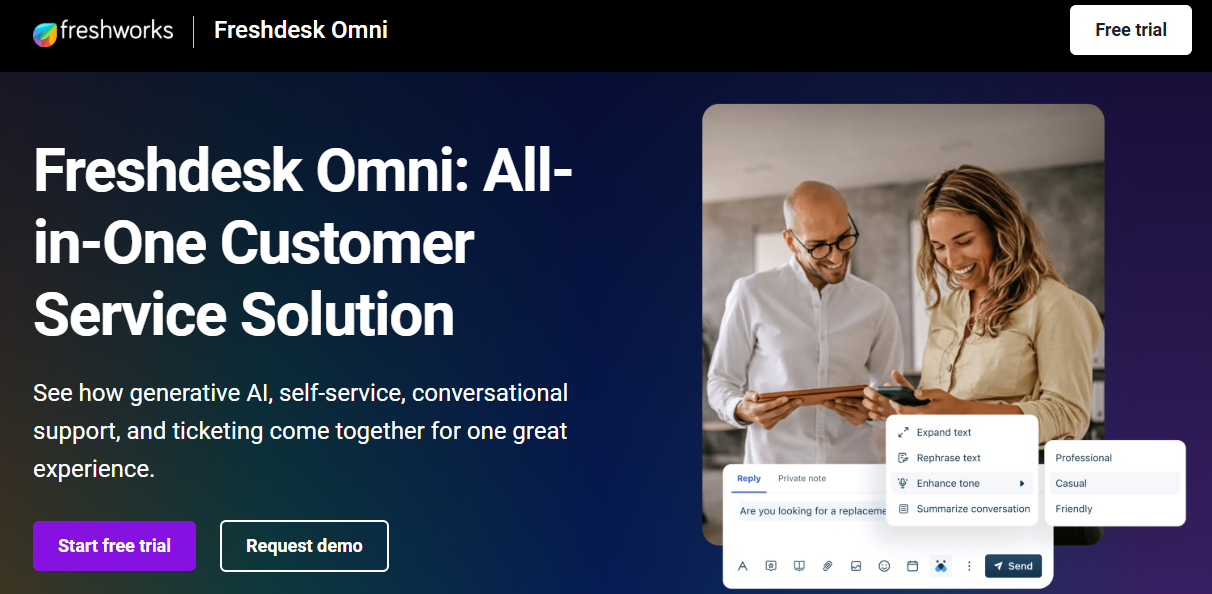
Freshdesk offers a user-friendly ticketing system with a free tier that includes email support, ticket management, and basic reporting for up to 10 team members.
Freddy AI auto-triages tickets and suggests responses, though native Slack or Teams support isn't included, limiting fit for startups fielding requests beyond email.
Key Features
- Free tier covers email support, ticketing, and basic reporting for up to 10 team members.
- Freddy AI auto-triages incoming tickets and suggests canned responses to speed up replies.
- Quick, no-code setup gets a working helpdesk live without engineering support.
Pros
- Free tier gives pre-revenue startups a practical starting point for email support.
- Fast deployment suits startups that need a working helpdesk without lengthy configuration.
- Predictable, low-cost pricing keeps budgeting simple for early-stage teams.
Cons
- No native Slack or Teams support limits fit for startups using those channels.
- Limited automation capabilities compared to AI-native platforms built for full resolution.
- Freddy AI features are priced separately from core ticketing plans as usage grows.
Best Use Case
Budget-conscious startups primarily handling email support that want a free entry point with AI added on.
Pricing
Freshdesk pricing starts around $18 per agent monthly, with Freddy AI features priced separately based on usage. See the official Freshdesk pricing page for current tiers. Compare Freshdesk alternatives built AI-first.
How to Choose the Best AI Customer Service Software for Startups?
Startups face a different buying decision than enterprises: budget is tighter, the team is smaller, and overbuying wastes runway. These five factors help you shortlist the right AI tier before committing to a contract.
1. Evaluate AI Capabilities
Decide which AI tier you actually need: deflection, ai copilot vs ai agent customer support that drafts replies for a human, or full autonomous resolution, since overbuying wastes early-stage budget your startup needs elsewhere.
2. Check Automation Workflows
Confirm the tool can execute actions like refunds or account changes automatically rather than only deflecting to a founder acting as first-line support, since manual triage doesn't scale past the first hundred customers.
3. Verify Integrations
Check whether the platform matches your business model, whether that's Shopify for ecommerce or Slack and Linear for technical B2B, since switching later costs more than choosing well now.
4. Assess Scalability
Evaluate whether pricing scales with revenue rather than headcount, since a per-seat model can become unaffordable long before hiring more agents not fixing support even becomes the actual bottleneck.
5. Compare Pricing and ROI
Compare startup discount programs, free tiers, and per-resolution pricing against your realistic ticket volume for the next 12 months, and confirm your startup actually qualifies before assuming a discount applies.
Why is QuantumDesk the Best AI Customer Service Software for Startups?
QuantumDesk is built for startups that need AI resolving tickets automatically from day one, without paying enterprise prices for capabilities a five-person support team won't use for years.
Every other platform on this list asks startups to choose between a cheap chatbot, an enterprise helpdesk with a startup discount, or ecommerce-specific automation. QuantumDesk does not force that trade-off.
Key Capabilities of QuantumDesk
- Quantum AI resolves repetitive queries automatically, eliminating ticket volume across support, billing, and order questions without agent involvement.
- Unified Inbox centralizes WhatsApp, email, Instagram, and live chat, useful for lean teams without dedicated channel owners.
- Native Shopify integration surfaces live order and purchase history for ecommerce startups without third-party connectors.
- Real-time admin dashboard gives founders visibility into AI resolution rates and CSAT trends without a dedicated ops hire.
- Resolution-based pricing keeps costs aligned with ticket volume instead of charging per seat as the team grows.
This is exactly the case for how to scale D2C customer support without increasing headcount: ticket volume outpaces founder bandwidth long before revenue catches up, and QuantumDesk is built to close that gap with automation instead of a bigger team.
Pick the platform that fits your startup's stage, business model, and budget. See how QuantumDesk handles support for your team → Book a Demo
Frequently Asked Questions About AI Customer Service Software for Startups
What are the best AI customer service software for startups?
In my testing, the best AI customer service software for startups in 2026 are QuantumDesk, Intercom Fin AI, Plain, Gorgias, and Tidio.
QuantumDesk leads for AI-native automation on startup-friendly pricing, Intercom leads for product-led SaaS, and Plain leads for technical B2B teams.
Which AI customer service software is best for bootstrapped startups?
Tidio and QuantumDesk are the best options for bootstrapped startups that want low-cost entry and fast setup without complex configuration.
Tidio's free tier covers 50 AI conversations for testing, while QuantumDesk's resolution-based pricing keeps costs aligned with actual ticket volume as revenue grows.
How do I choose the right AI customer service software for my startup?
Start with your business model, whether B2B SaaS or ecommerce, before comparing AI accuracy, since the right tool depends on how your customers reach out.
Ecommerce startups should evaluate QuantumDesk or Gorgias, technical B2B teams should look at Plain, and enterprise-bound startups should consider Zendesk's free program.
Is there a free AI customer service software for startups?
Yes, Tidio offers a free plan with 50 AI conversations, Botpress offers a $0 per-seat tier, and Freshdesk offers a free tier for up to 10 team members.
Free tiers suit pre-revenue startups testing AI support, though most teams outgrow them once ticket volume and channel needs expand.
What features should I look for in AI customer service software for startups?
Prioritize pricing that scales with ticket volume rather than headcount, plus native integration with your business model, whether that's Shopify or Slack.
AI that only deflects to FAQ links does little to reduce founder time spent on support during the busiest early growth months.




.avif)