Summarize with AI
Key Takeaways
- QuantumDesk is the best overall pick for ecommerce brands, resolving order, refund, and return queries automatically using live store data across channels.
- Gorgias remains the strongest Shopify-native pick for order actions, though its AI Agent still runs as a metered add-on on ticket-based pricing.
- Fini AI leads on reasoning accuracy, built specifically to verify refund amounts and shipping details before responding, reducing hallucination risk significantly.
- Tidio (Lyro AI) is the most budget-friendly option for small ecommerce teams that want fast deployment over deep automation depth.
- The biggest shift in this category is the move from deflection bots toward agentic AI that writes refunds directly into backend systems.
Ecommerce support teams field the same order-status, refund, and return questions hundreds of times a week, and the wrong AI tool just routes tickets back to an agent. I tested 10 AI customer support tools against real ecommerce workflows.
It's built for Shopify D2C brands, multi-marketplace sellers, and growing ecommerce teams juggling WhatsApp, email, and live chat who need AI that resolves tickets instead of just deflecting them.
This guide breaks down what each tool does inside a live store, where AI-native platforms like QuantumDesk outperform helpdesks with AI bolted on afterward, and how to shortlist the right fit for your order volume, channel mix, and growth stage.
Quick Tabular Comparison of the Top AI Customer Support Tools for Ecommerce in 2026
How Did We Choose These 10 AI Customer Support Tools for Ecommerce?
I shortlisted these 10 tools by testing each one inside real ecommerce customer service scenarios instead of relying on vendor claims about resolution rates or connectivity.
- Verified native store integration by testing live order lookups, refund actions, and shipping updates directly inside each tool.
- Evaluated AI accuracy by testing return-policy reasoning and multi-step order queries to check for hallucination risk.
- Reviewed verified ratings on G2 and Capterra, filtering specifically for ecommerce and D2C merchant feedback rather than general B2B reviews.
- Read Reddit and community threads to see which tools store owners actually kept running past the free trial period.
- Compared channel coverage across WhatsApp, Instagram, email, and live chat, since ecommerce support rarely runs through one channel alone.
- Benchmarked pricing models for stores handling 500 to 10,000 monthly conversations against per-seat, per-ticket, and per-resolution structures.
In-Depth Review of the Best 10 AI Customer Support Tools for Ecommerce in 2026
1. QuantumDesk – Best AI-Native Customer Support Platform for Ecommerce Brands

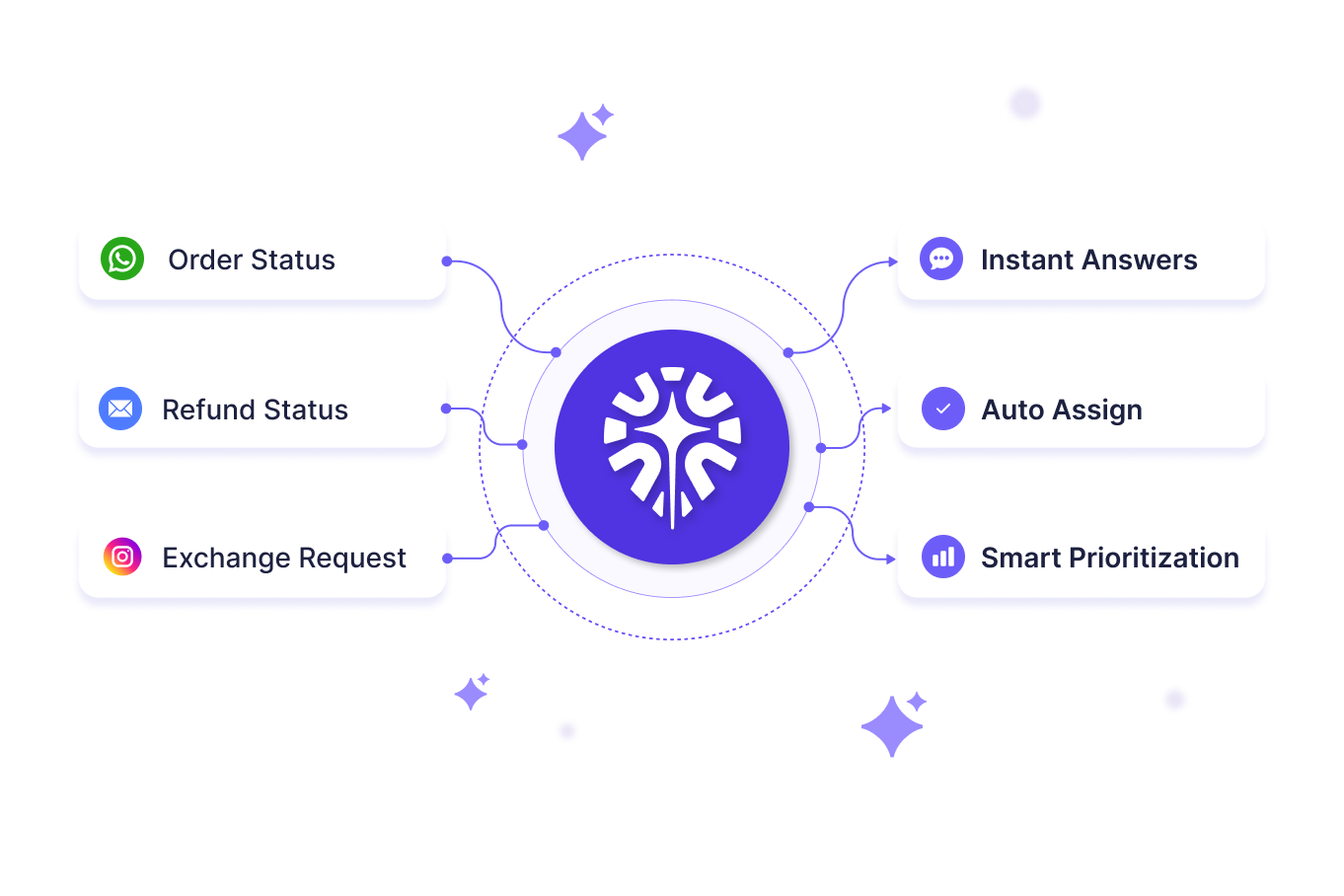
QuantumDesk is an AI-native customer support platform built for ecommerce D2C brands that want to automate order queries, unify WhatsApp, email, and Instagram conversations, and resolve tickets using live store data without adding headcount.
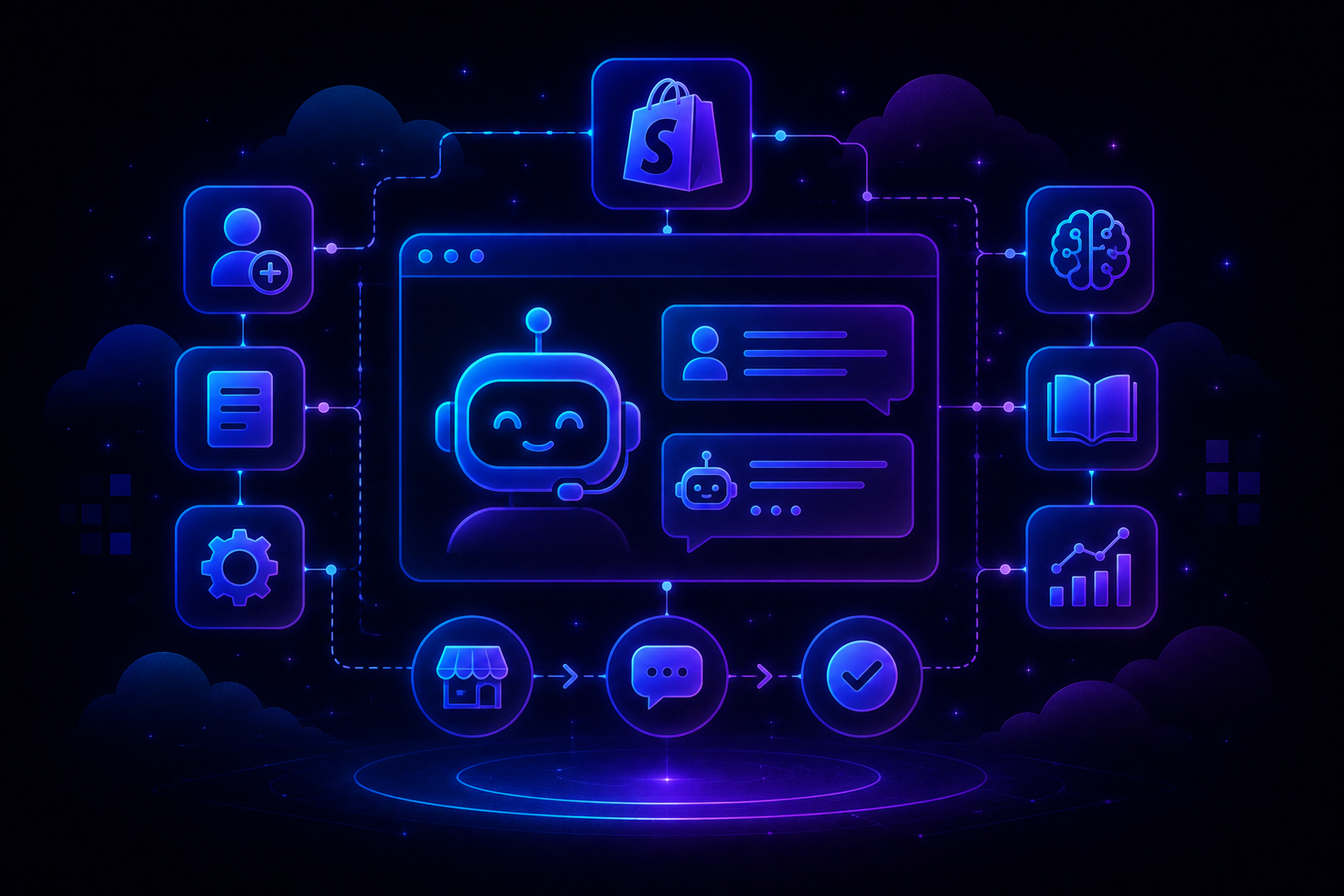
Quantum AI handles repetitive queries automatically, from order status to refund requests, while the Unified Inbox centralizes every channel into one workspace for agents.
What sets it apart is native Shopify order data inside every conversation, paired with resolution-based pricing instead of per-seat licenses.
Key Features
- Quantum AI resolves repetitive queries like order status, tracking, refunds, and return policy questions automatically, without an agent touching the ticket.
- Native Shopify integration surfaces live order data, tracking, and purchase history directly into every conversation so agents never switch tabs.
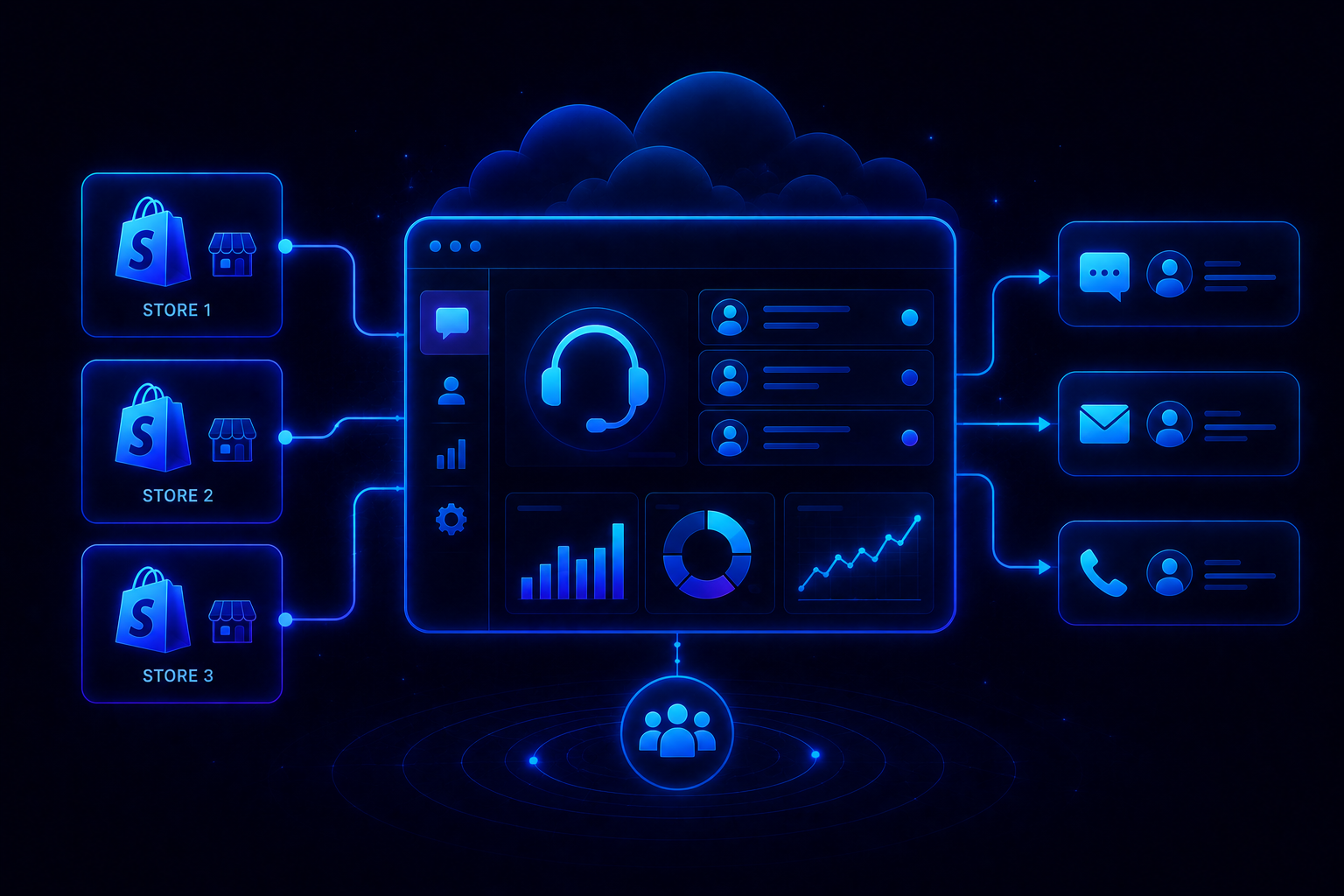
- Unified Inbox centralizes WhatsApp, email, Instagram, and live chat into one workspace with full conversation history preserved across every interaction.
- AI-Curated Inbox prioritizes incoming tickets by urgency, sentiment, and customer value so agents handle the highest-impact conversations first.
- Quantum AI Copilot drafts replies and summarizes order history in real time, cutting the time agents spend reading context before responding.
Pros
- AI is embedded into the workflow from day one, removing the need to budget separately for a standalone AI add-on.
- Native Shopify integration ships built in, so live order data flows into conversations without third-party connector delays.
- Resolution-based pricing keeps support costs aligned with outcomes instead of per-seat licenses that scale regardless of AI performance.
Cons
- Fewer established ecommerce case studies compared to incumbents that have served online retailers for a decade with documented deployments.
- Multi-marketplace coverage beyond Shopify is still developing, so sellers active on Amazon or eBay may need to wait.
Best Use Case
Ecommerce D2C brands that need AI resolving order and return queries automatically using live store data while agents handle disputes.
When to Choose QuantumDesk
Choose QuantumDesk when your ecommerce brand needs live order data inside every conversation, multichannel coverage, and store-native automation built in from day one.
Pricing
QuantumDesk follows a resolution-based pricing model where ecommerce teams pay for AI-resolved tickets rather than per-seat licenses. Visit the QuantumDesk pricing page for a tailored quote.
2. Gorgias – Best Shopify-Native Order Execution for Ecommerce
Gorgias is an ecommerce-native helpdesk built for Shopify and Magento stores that want order tracking, refund processing, and return workflows handled directly inside the support dashboard.
Its AI Agent automates up to 60% of repetitive tickets, though the automation still runs as a metered add-on layered onto ticket-based helpdesk pricing.
Key Features
- AI Agent automates order tracking, returns, and shipping updates across email, chat, SMS, and social without agent involvement for common queries.
- Native Shopify and Magento order actions let agents issue refunds and process returns directly inside the Gorgias dashboard.
- Revenue statistics track which conversations generate sales, linking support performance directly to conversion outcomes.
Pros
- Deepest Shopify-native integration on this list, with order actions few competitors match as closely.
- Macro library speeds up repetitive replies for order delays and refund status with pre-filled templates.
- Revenue statistics link support to sales, a metric ecommerce brands use to measure service impact.
Cons
- AI resolution costs stack on top of ticket-based pricing at roughly $0.90 to $1.00 per resolution.
- Shopify-centric design limits usefulness for brands selling heavily across non-Shopify marketplaces.
- Per-ticket and per-resolution costs escalate quickly for high-volume stores during flash sales.
Best Use Case
Shopify and Magento brands that need native order actions and refund workflows handled inside one helpdesk.
Pricing
Gorgias starts at $10/month per 50 tickets, with AI resolutions billed separately at roughly $0.90 to $1.00 each. Read what is Gorgias for a full platform breakdown.
3. Fini AI – Best for Zero-Hallucination Accuracy in Ecommerce
Fini AI is a reasoning-first customer support platform built to solve one specific failure mode: ai hallucination in customer support, where bots confidently promise refunds or shipping dates that don't match actual order data.
It verifies every response against store policy and order data before replying, making it a fit for teams prioritizing accuracy over conversational polish.
Key Features
- Reasoning-first verification checks every response against store policy and order data before it reaches the customer, reducing false promises.
- Metered per-resolution pricing ties cost directly to tickets actually resolved rather than seats or conversation volume.
- Enterprise-grade certifications including SOC 2, ISO 27001, ISO 42001, and HIPAA suit regulated and high-trust ecommerce brands.
Pros
- Highest documented accuracy on this list, with reasoning built specifically to avoid hallucinated shipping or refund promises.
- Fast deployment window of roughly 48 hours gets stores live without a lengthy implementation cycle.
- Compliance certifications make it a stronger fit for enterprise procurement than most competitors here.
Cons
- Less natively built as a traditional helpdesk inbox, so teams may still need a separate ticketing layer.
- Per-resolution pricing carries a high monthly minimum that can be steep for smaller ecommerce stores.
- Smaller Shopify-specific case study library compared to platforms built around ecommerce from day one.
Best Use Case
Ecommerce brands that need verified, hallucination-free responses on refunds and shipping without sacrificing resolution accuracy.
Pricing
Fini AI is priced per resolution at roughly $0.69 each, with a monthly minimum near $1,799.
4. Intercom Fin – Best Chat-First Omnichannel Resolution for Ecommerce
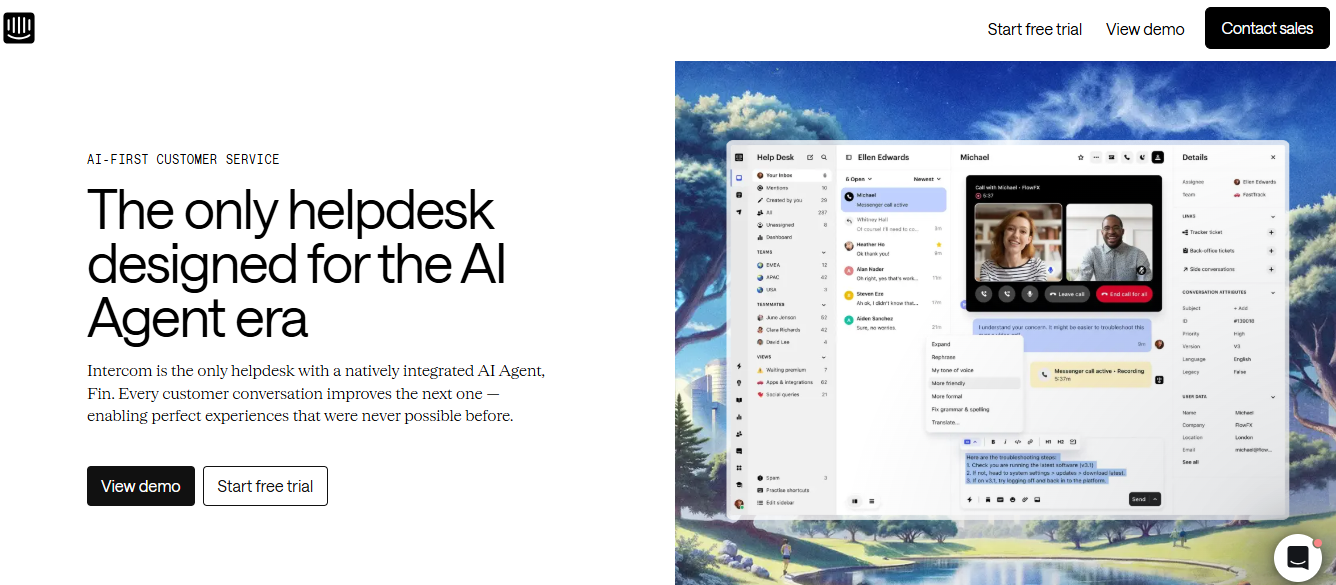
Fin AI Agent is Intercom's resolution layer, built for ecommerce brands that need high resolution rates across chat, email, voice, and social without migrating off an existing helpdesk.
It resolves an average of 51% of conversations in ecommerce use cases, backed by SOC 2, ISO 27001, and HIPAA certifications.
Key Features
- Fin AI Agent resolves queries autonomously from connected knowledge bases across chat, email, voice, and social channels.
- Pre-built store data connectors support order and customer context inside every conversation for connected platforms.
- Enterprise-grade security certifications including SOC 2, ISO 27001, and HIPAA suit regulated or high-trust ecommerce brands.
Pros
- True omnichannel coverage spans chat, email, voice, social, and Slack from one AI resolution layer.
- Compliance certifications make Fin a stronger fit for enterprise procurement than most competitors here.
- Mature messaging platform with a large existing ecosystem of ecommerce and CRM integrations.
Cons
- Per-outcome pricing near $0.99 per resolution adds up quickly for stores with high monthly volume.
- Advanced ecommerce actions like order edits require additional connectors rather than shipping natively built in.
- Higher total cost of ownership than budget-friendly options once seats and resolutions are combined.
Best Use Case
Ecommerce brands needing omnichannel resolution across chat, email, voice, and social from one AI layer.
Pricing
Fin AI Agent is priced per outcome at roughly $0.99 per resolution, on top of seat-based Intercom plan fees. See Intercom's official pricing page for current rates.
5. eDesk – Best for Multi-Marketplace Ecommerce Sellers
eDesk is a unified helpdesk built for ecommerce sellers who operate across Shopify, Amazon, eBay, and other marketplaces, consolidating every channel's order and messaging data into one inbox.
Its cross-channel context pulls marketplace and storefront order data into the same conversation, giving multi-channel sellers one place to manage support.
Key Features
- Unified inbox spans Shopify and marketplaces like Amazon and eBay, consolidating messages from every sales channel into one queue.
- Cross-channel context surfaces order and customer data alongside marketplace order information without manual lookup.
- Outcome-tiered AI resolution handles repetitive order and shipping questions across every connected marketplace.
Pros
- Best fit for sellers beyond Shopify alone, unifying marketplace and direct-to-consumer support in one tool.
- Cross-channel order context avoids manual lookup across separate marketplace and store dashboards.
- Outcome-based AI pricing ties cost to resolutions rather than flat per-agent licensing alone.
Cons
- Dense interface brings a steeper onboarding curve than simpler, single-platform helpdesk tools.
- Less AI-native than purpose-built platforms, with automation still leaning on ticket assist over full resolution.
- Pricing scales with connected channel count, which adds up for sellers active on many marketplaces.
Best Use Case
Multi-marketplace sellers who need Shopify, Amazon, and eBay order data unified into one support inbox.
Pricing
eDesk starts around $39 per agent monthly, plus roughly $0.99 per AI-resolved outcome. Compare eDesk alternatives built specifically for Shopify-first stores.
6. Tidio (Lyro AI) – Best Budget-Friendly AI Chat for Small Ecommerce Teams
Tidio is a live chat and AI chatbot platform built for small to growing ecommerce stores that want a free plan and fast FAQ deflection without heavy configuration.
Lyro AI trains on store pages and policies to handle order status, shipping, and product questions before handing off to a human agent.
Key Features
- Lyro AI pulls answers directly from store pages to handle order status, shipping, and FAQ questions without scripted flows.
- Free plan covers routine chat volume, making Tidio accessible before support volume justifies a paid platform investment.
- Automatic human handoff transfers conversations to an agent the moment a query moves beyond FAQ deflection.
Pros
- Free plan removes the barrier to entry for small ecommerce stores testing AI chat before a paid tier.
- Fastest setup of any tool on this list, useful before a product launch or promotional campaign.
- Lyro reduces routine ticket volume effectively where most queries are repetitive order and shipping questions.
Cons
- AI resolution depth is shallower than AI-native platforms built for complex, multi-step order disputes.
- Limited omnichannel reach compared to platforms that cover WhatsApp and Instagram natively.
- Less suited to high-volume stores needing enterprise-grade routing across thousands of monthly tickets.
Best Use Case
Small ecommerce stores that want free, fast AI chat deployment without heavy configuration.
Pricing
Tidio offers a free plan plus paid AI tiers starting around $39 a month. Stores that outgrow it can compare Tidio alternatives with deeper automation.
7. Zendesk AI – Best for Enterprise Retailers Standardized on Zendesk

Zendesk AI is the resolution layer added to Zendesk's ticketing suite, built for large ecommerce and retail enterprises already running support on Zendesk's core platform.
It resolves queries through triggers, automations, and apps rather than a native store build, backed by broad compliance certifications for regulated environments.
Key Features
- AI resolution and automations handle common queries through triggers and apps before tickets reach the agent queue.
- Enterprise routing and reporting manage complex assignment rules across large, multi-team retail support operations.
- Broad compliance certifications including SOC 2, ISO 27001, and HIPAA suit regulated enterprise environments.
Pros
- Mature enterprise infrastructure suits large retail teams with complex routing and reporting needs.
- Broad omnichannel coverage spans chat, email, phone, and social in one established platform.
- Strong integration ecosystem connects Zendesk AI to ecommerce and CRM tools without custom API work.
Cons
- Pricing runs steep, from roughly $55 to $115 per agent plus AI resolution fees.
- Store integration isn't native, relying on apps and triggers rather than built-in architecture.
- AI resolution depth lags AI-native platforms that resolve full ticket categories without agent handoff.
Best Use Case
Large ecommerce and retail enterprises already standardized on Zendesk's core ticketing platform.
Pricing
Zendesk pricing starts around $55 per agent monthly, with AI capabilities added at roughly $50 per agent. See the official Zendesk pricing page for full tiers.
8. Kustomer – Best CRM-Style Customer Profiles for Subscription and Luxury Retail
Kustomer is a CRM-centric customer service platform built for high-volume ecommerce and retail brands that want unified customer profiles and full order history in one workspace.
Its customer timeline view surfaces every order, interaction, and communication history so agents work from complete context instead of piecing it together.
Key Features
- CRM-style customer timeline shows every past order, interaction, and communication so agents work from complete context.
- AI-assisted routing classifies and resolves simple queries before handing complex issues to the right agent.
- Deep ecommerce integrations pull order data and purchase patterns directly into every customer profile.
Pros
- Richest customer data view on this list, useful for brands using purchase history to prioritize support.
- CRM and support unified in one platform, removing the need to switch tools mid-conversation.
- Strong fit for subscription and luxury retail needing both customer insight and scalable ticketing.
Cons
- Higher implementation complexity than simpler AI chat tools, slowing deployment for smaller teams.
- Less store-native than purpose-built platforms, with weaker order action automation out of the box.
- Pricing runs roughly $89 to $139 per agent monthly, harder to budget for early-stage brands.
Best Use Case
High-volume subscription and luxury retail brands that need CRM-style customer profiles alongside support.
Pricing
Kustomer pricing runs roughly $89 to $139 per agent monthly, quoted based on agent count and data volume. See Kustomer pricing for a full breakdown.
9. Gladly – Best Voice-First Support for Premium Consumer Retail
Gladly is a customer service platform built around a single lifelong customer conversation instead of ticket threads, designed for premium consumer retail brands with high-touch service expectations.
It unifies voice, chat, email, SMS, social, and in-app support into one continuous customer record with no per-channel fees.
Key Features
- Single customer conversation view replaces ticket-based threads with one continuous history across every channel a shopper uses.
- Voice-first support architecture treats phone support as a first-class channel alongside chat and messaging.
- Omnichannel pricing with no per-channel fees keeps costs predictable as brands add new support channels.
Pros
- Highest G2 rating on this list, reflecting strong satisfaction among premium retail support teams.
- Lifelong customer view gives agents complete history without switching tools.
- No per-channel fees make voice and social support cost-predictable as channels expand.
Cons
- Custom pricing makes upfront budgeting harder for early-stage or mid-market ecommerce brands.
- Premium positioning and implementation depth suit larger teams more than lean startups.
- Less AI-native automation depth than platforms built around agentic resolution from day one.
Best Use Case
Premium consumer retail brands that want voice-first, single-conversation support across every channel.
Pricing
Gladly pricing is custom, scaling from self-serve to enterprise with no per-channel fees.
10. Richpanel – Best Self-Service Portal for Ecommerce Stores

Richpanel is a customer self-service platform built for ecommerce stores that want to deflect routine order and return questions through a branded portal before they reach an agent.
Its native store app surfaces order status and return actions directly to customers, cutting ticket volume for common WISMO and return queries.
Key Features
- Self-service portal lets customers track orders, start returns, and check status without contacting an agent.
- Native store app connects order and customer data directly into the self-service and agent experience.
- Automated order actions let customers resolve simple return and exchange requests independently.
Pros
- Strong deflection for routine WISMO and return questions through the self-service portal alone.
- Native app integration keeps setup simple compared to third-party connector-based tools.
- AI included in Pro-tier pricing rather than billed as a separate per-resolution add-on.
Cons
- AI resolution depth is narrower than AI-native platforms handling complex, multi-step conversations.
- Best suited to routine queries, with limited handling of nuanced refund disputes or escalations.
- Annual contract commitment required for Pro-tier pricing, less flexible than month-to-month competitors.
Best Use Case
Ecommerce stores that want to deflect routine WISMO and return questions through self-service.
Pricing
Richpanel's Pro tier starts around $69 per agent monthly billed annually, with AI included. Compare Richpanel alternatives built for multichannel support.
How to Choose the Best AI Customer Support Tools for Ecommerce?
Ecommerce support needs go beyond what most general-purpose AI platforms were built to handle. An order-status message at midnight on Instagram is not the same as a ticket filed through a help desk portal. These five factors help you shortlist the right AI customer support tool before committing to a contract.
1. Evaluate AI Capabilities
Test whether the AI resolves store-specific queries like order status, tracking, and return eligibility using live data, not generic scripts. Reviewing real ai customer support accuracy benchmarks matters, since resolution quality directly affects trust and repeat purchases.
2. Check Automation Workflows
Confirm the tool can execute return, refund, and order-update actions automatically rather than only deflecting questions to an agent. Shallow automation is exactly why so many teams still struggle to reduce WISMO tickets at scale.
3. Verify Integrations
Check whether store order data connects through a native integration or a third-party app, and confirm coverage across WhatsApp, email, and Instagram, since fragmented integrations force agents to switch tabs constantly.
4. Assess Scalability
Evaluate whether the platform handles flash-sale ticket spikes, multi-marketplace setups, and rising conversation volume without requiring new headcount, since ecommerce order volume rarely grows in a predictable, linear pattern.
5. Compare Pricing and ROI
Compare per-seat, per-ticket, and per-resolution pricing models against your actual monthly conversation volume, and factor in AI usage limits, add-on fees, and hidden costs before committing to a long-term contract.
Why is QuantumDesk the Best AI Customer Support Tool for Ecommerce?
QuantumDesk is built for ecommerce D2C brands that need live order data inside every support conversation, AI resolving queries across WhatsApp, email, and Instagram automatically, and pricing tied to outcomes rather than agent seats.
Every other platform on this list asks ecommerce teams to choose between native order data, multichannel coverage, or AI-native pricing. QuantumDesk does not force that trade-off.
Key Capabilities of QuantumDesk:
- Quantum AI resolves order queries automatically, eliminating ticket volume on tracking, refunds, and returns without agent involvement.
- Unified Inbox centralizes WhatsApp, email, Instagram, and live chat with full order context preserved across every interaction.
- Native Shopify integration surfaces live order and purchase history into every conversation without switching tabs or copying data.
- Real-time admin dashboard gives support leaders visibility into AI resolution rates, escalation patterns, and CSAT trends as they happen.
- Resolution-based pricing keeps costs aligned with outcomes instead of charging per seat for AI that resolves only part of daily volume.
For Shopify-specific brands, this native fit is what makes AI customer support for Shopify finally live up to its promise, connecting live order data to the AI resolving it instead of stitching the two together after the fact.
Pick the platform that fits your ecommerce store's channel mix, order volume, and automation depth. See how QuantumDesk handles support for your team → Book a Demo
Frequently Asked Questions About AI Customer Support Tools for Ecommerce
What are the best AI customer support tools for ecommerce?
In my testing, the best AI customer support tools for ecommerce in 2026 are QuantumDesk, Gorgias, Fini AI, Intercom Fin, and Tidio.
QuantumDesk leads for AI-native multichannel support with live order data, Gorgias leads for Shopify-native order actions, and Fini AI leads for hallucination-free accuracy.
Which AI customer support tool is best for SMBs?
Tidio and QuantumDesk are the best AI customer support options for small ecommerce teams that want low-cost entry and fast setup without complex configuration.
Tidio's Lyro AI handles routine order and FAQ questions, while QuantumDesk's resolution-based pricing keeps costs predictable as ticket volume grows.
How do I choose the right AI customer support tool for ecommerce?
Start with your channel mix and order volume before comparing AI accuracy, since the right tool depends on how customers actually contact your store.
WhatsApp-heavy D2C brands should evaluate QuantumDesk, Shopify-only stores should look at Gorgias, and multi-marketplace sellers should consider eDesk.
Is there a free AI customer support tool for ecommerce?
Yes, Tidio offers a free plan with basic Lyro AI chat capabilities built for small stores and early-stage support teams.
Free tiers suit stores testing AI deflection before committing to a paid plan, though most brands outgrow them once order volume and channel needs expand.
What features should I look for in an AI customer support tool for ecommerce?
Prioritize native store order data access, channel coverage across WhatsApp and Instagram, and AI accuracy on refund and return policies.
AI that cannot read your live order data can only answer generic FAQs, which does little to reduce the repetitive tickets filling your queue.




.avif)