
Summarize with AI
Key Takeaways
- AI outperforms humans on speed and scale metrics like first response time and availability but consistently underperforms on nuance, empathy, and complex resolution quality.
- Human agents consistently score higher on resolution quality and relationship metrics including FCR on complex issues, CSAT during escalations, and long-term NPS scores.
- Bot escalation rate and handoff integrity reveal whether AI-to-human transitions preserve full conversation context or force customers to repeat themselves every single time.
- AI and human performance require separate measurement baselines because identical KPIs applied to both will always misrepresent which side is underperforming inside your support model.
- Agent utilization shifting from administrative FAQs to high-value complex work is the clearest signal that AI is performing its intended role inside a blended support model.
Measuring AI and human support performance on the same scorecard produces inaccurate results and worse decisions for both sides of the team.
For D2C brands, B2B SaaS teams, and SMBs running blended support models, incorrect measurement compounds. AI handles 60-80% of tickets at $0.10-$0.22 per interaction. Human agents cost $1.82-$7.50 per ticket. A single benchmark applied to both makes each look broken.
The disconnect between how AI performs and how teams measure it usually surfaces the same way across support teams of every size.
A D2C brand applied one response-time target to both AI and human agents → AI averaged 0.8 seconds → human agents averaged 4.6 minutes handling billing escalations → both flagged red in the monthly report → the manager proposed hiring three agents → AI had already resolved 78% of all incoming tickets before any agent opened the queue.
Zero point eight seconds. Four minutes. The same benchmark flagged both as underperforming.
Support teams running blended AI and human models hit the same measurement problems repeatedly:
- AI and human agents measured on identical KPIs produce scores that mislead every staffing and tool investment decision the support team makes
- No split between AI deflection rate and human FCR hides which ticket types each side handles best and where real performance gaps exist
- Bot escalation rate left unmeasured allows AI-to-human handoff failures to accumulate without any visibility into where context breaks down
- Sentiment data applied uniformly across both ignores how customer perception shifts between AI-handled and human-handled interactions
You will learn how to measure AI vs human performance in customer support by separating speed, resolution, sentiment, and hybrid handoff metrics correctly.
A Quick Comparison: AI Performance vs Human Performance in Customer Support
Why AI and Human Support Performance Cannot Be Measured the Same Way
1. AI and humans handle different ticket types, so identical KPIs produce misleading results
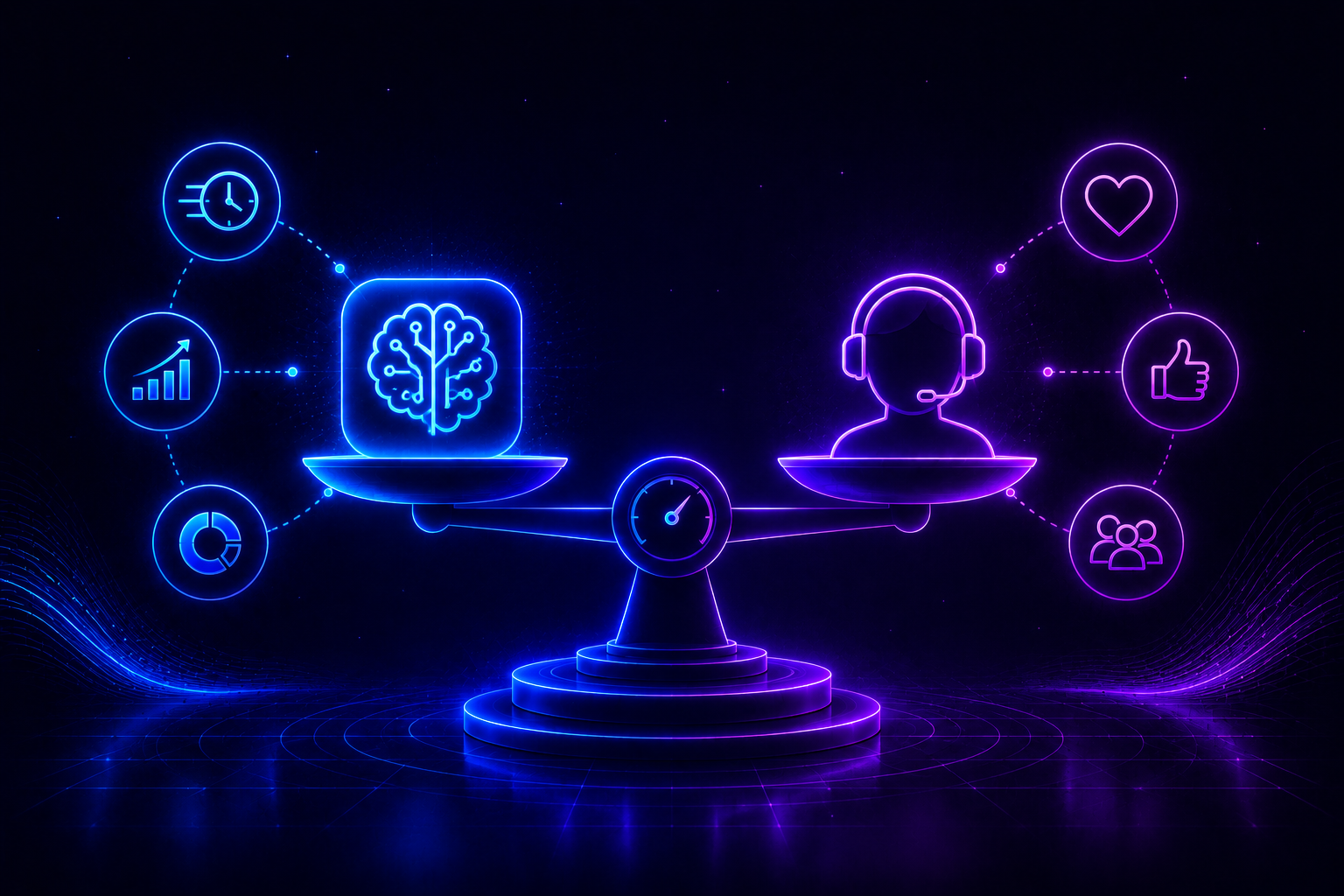
Applying a unified KPI to AI and human agents creates misleading data. AI is built for volume and speed. Humans are built for judgment and empathy.
When both sides are measured by average handle time, AI looks fast and humans look slow regardless of resolution accuracy. Customer service automation performs best when benchmarked against the ticket types it was built to handle.
2. Speed metrics favor AI while resolution quality metrics favor human agents
AI maintains near-zero first response time at unlimited scale. Human agents average 4.2 minutes per first response and manage 2-3 concurrent chats maximum per shift.
Resolution quality reverses the advantage. AI reaches 73% overall resolution while humans reach 86%. On complex cases, humans resolve 92% versus AI's 45%. Customer service metrics must separate by ticket type or both numbers mislead staffing decisions.
3. Sentiment and relationship data require a separate measurement layer from operational metrics
Customer satisfaction scores diverge by interaction type. AI scores 4.2/5 on speed-sensitive queries. Human agents score 4.5/5 on escalations and complaint-driven conversations.
NPS and retention data must be split between AI-handled and human-handled contacts. For ecommerce customer service teams, a fast AI resolution and a trust-restoring human conversation produce identical satisfaction records when not segmented, making long-term loyalty data unreliable.
How to Track Speed, Resolution, and Sentiment Metrics for AI and Human Agents
1. Track speed, scale, and deflection rate as the primary AI performance metrics
Speed and scale are where AI demonstrates its clearest advantage. Measuring these correctly requires separate benchmarks from human improve first contact resolution rate targets to avoid false comparisons.
Speed and scale metrics to track separately for AI agents:
- First Response Time tracking AI's near-zero response average against the human team's shift-dependent first reply baseline
- Automated Resolution Rate measuring the percentage of tickets fully resolved by AI without any human agent involvement
- Concurrency volume comparing how many simultaneous sessions AI handles versus the 2-3 cap per individual human agent
- 24/7 availability rate tracking percentage of incoming tickets handled outside business hours with no staffed human agent present
- Escalation rate showing how often AI transfers to a human, revealing where its resolution boundary consistently sits
2. Track resolution quality and complexity handling as the primary human performance metrics
Human agents should be measured on the metrics where they outperform AI: FCR on complex tickets, CSAT during escalations, and sentiment recovery after difficult customer interactions.
Resolution and quality metrics to track separately for human agents:
- FCR on complex cases only excluding AI-resolved tickets to avoid inflating the human first contact resolution benchmark score
- CSAT on escalated interactions tracking satisfaction specifically for conversations where human agents took over from AI
- Average Handle Time on complex tickets benchmarked separately from AI-handled queries to avoid distorting the human performance baseline
- Sentiment recovery rate showing how frequently agents shift a frustrated customer to a positive or resolved state
- Policy exception rate tracking how often agents apply judgment outside standard rules to retain a high-value customer
3. Track CSAT, NPS, and Customer Effort Score as a separate sentiment measurement layer
Customer satisfaction metrics like CSAT, NPS, and Customer Effort Score must be segmented by interaction type. A CSAT collected after an AI-handled order query is not comparable to one after a human-led billing dispute.
Sentiment and relationship metrics that require AI vs human segmentation:
- CSAT segmented by AI-handled versus human-handled interactions showing whether speed or empathy drove satisfaction in each interaction path
- NPS split by interaction path showing long-term loyalty differences between AI-only customers and those who received human escalation
- Customer Effort Score on AI interactions identifying where unresolved loops force customers to repeat themselves before escalation occurs
- Repeat contact rate by resolution type tracking whether AI resolutions generate follow-up contacts that human resolutions do not
- Churn rate by service path comparing AI-only customers against human-assisted customers to detect retention differences over time
How to Evaluate Hybrid Metrics When AI and Humans Work in the Same Support Queue
1. Track bot escalation rate to find where AI reaches its resolution limit
Bot escalation rate tells you exactly where AI stops performing and human judgment begins. Tracking it across ticket categories shows which issue types AI agents for customer support consistently cannot resolve without human handoff.
What to monitor in your bot escalation data:
- Escalation rate by ticket category showing which issue types AI transfers most frequently, revealing training or policy coverage gaps
- Repeat escalation patterns flagging customers who return to AI after a human handoff and escalate again without final resolution
- Time to escalation measuring how long AI attempts resolution before transferring, revealing whether the handoff threshold is calibrated correctly
- Post-escalation CSAT tracking whether customers who were escalated report higher satisfaction than customers AI resolved entirely
- Escalation volume by channel identifying which support channels produce the highest AI-to-human handoff rates and why
2. Measure handoff integrity to ensure context survives the transfer to a human agent
Handoff integrity measures whether AI passes full context to the human agent or forces the customer to repeat the problem. Poor handoffs are where goals to reduce repetitive support questions break down most consistently at scale.
Handoff integrity indicators that reveal context quality at the escalation point:
- Context completeness score measuring whether human agents receive full conversation history, customer sentiment, and prior resolution attempts before responding
- Customer repeat rate tracking how often escalated customers restate their issue, signaling the AI passed incomplete handoff context
- First response accuracy after handoff showing whether the agent's opening reply demonstrates understanding of the prior AI conversation
- Agent review time measuring seconds spent on AI handoff context before the agent composes the first post-escalation response
- Effort score on escalated tickets measuring friction at the handoff point rather than at the final resolution moment
3. Track agent utilization shift to measure AI's operational impact on human work
When hiring more agents is no longer the default response to volume growth, agent utilization data reveals whether AI is absorbing the right ticket types and freeing human agents for complex interactions.
Agent utilization metrics that show AI's real impact on human support work:
- FAQ resolution share measuring how much agent time is still spent on repetitive queries AI was configured to deflect
- Complex ticket share per agent showing whether agents handle a higher proportion of judgment-required contacts since AI deployment
- Idle time per agent comparing queue gap durations before and after AI deployment to identify workload distribution changes
- Tickets per agent per shift showing whether AI reduced total volume or increased the complexity of remaining contacts
- New agent ramp time measuring whether AI copilot assistance reduces training hours required before agents resolve tickets independently
How QuantumDesk Helps You Measure AI and Human Support Performance
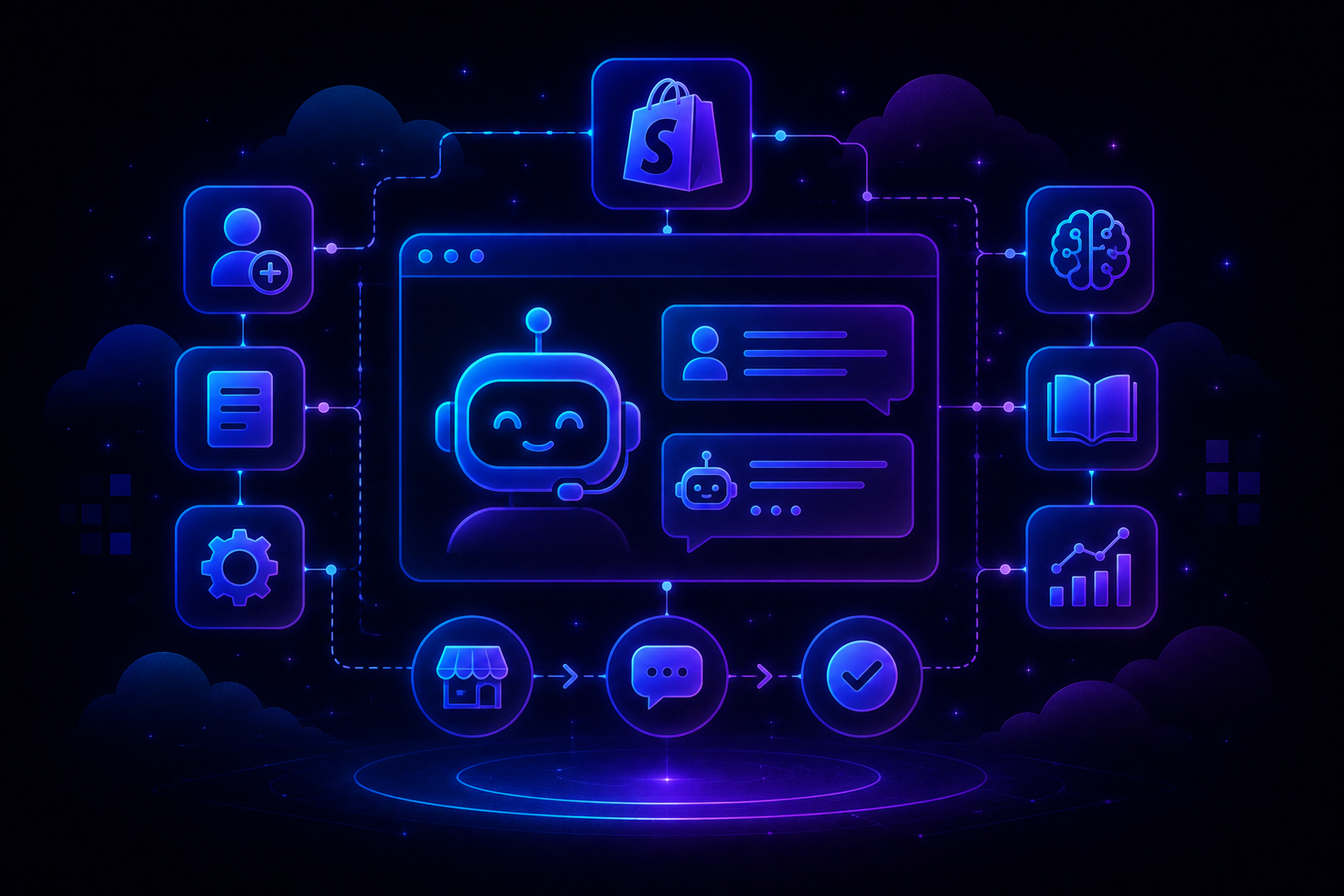
QuantumDesk is an AI-native customer service platform built for D2C brands, Shopify merchants, B2B SaaS teams, and SMBs managing high-volume support across email, WhatsApp, chat, and social.
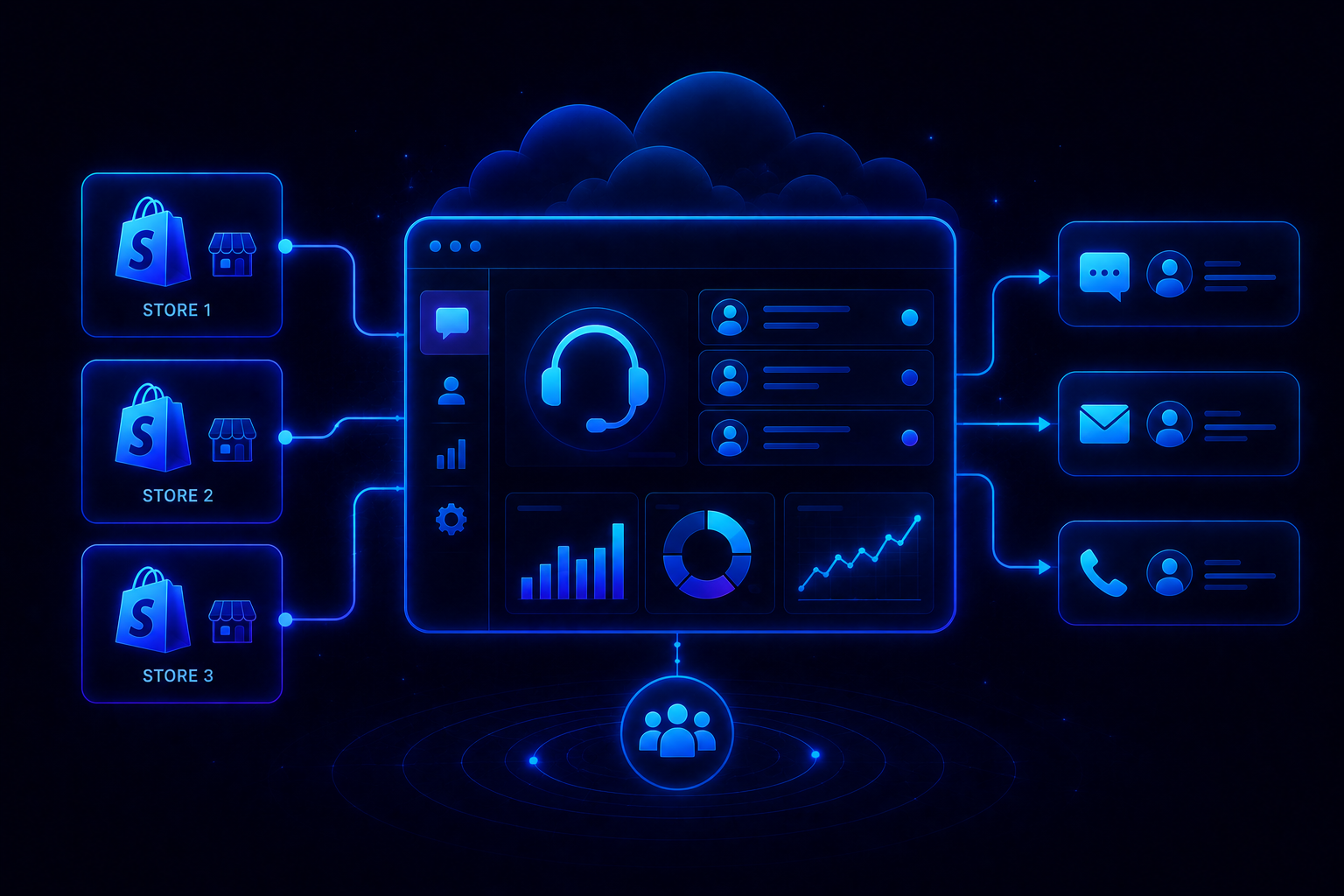
Rather than connecting separate analytics tools, QuantumDesk surfaces resolution rates, AI deflection data, and agent performance inside Admin Analytics. Support managers see both AI and human performance across every channel without switching platforms or exporting reports.
This is where ai native customer service benefits are most visible. Quantum AI deflects repetitive volume while Admin Analytics tracks where AI resolution ends and human judgment begins, helping teams scale D2C customer support without increasing headcount.
Key Capabilities of QuantumDesk
- Quantum AI resolves repetitive queries using live data, reducing cost per ticket without adding agent headcount
- Admin Analytics tracks AI resolution rate, escalation rate, agent FCR, and handoff quality across all channels
- Quantum AI Copilot drafts inline replies so agents spend less time composing and more time resolving complex contacts
- AI-curated inbox organizes tickets by urgency and sentiment so human agents start each shift on interactions requiring judgment
- Native Shopify integration surfaces customer and order context inside each ticket so both AI and agents resolve accurately
Ready to see how it works? Book a demo to explore QuantumDesk for your team.
Frequently Asked Questions
1. What is the difference between AI and human performance metrics in customer support?
AI performance metrics measure speed, scale, and deflection rate. Human performance metrics measure resolution quality, FCR on complex cases, and sentiment recovery. Both require separate baselines to produce accurate data.
2. What is bot escalation rate and why does it matter?
Bot escalation rate measures the percentage of conversations AI could not resolve and transferred to a human agent. It reveals where AI training gaps exist and where unresolved queries enter the human queue.
3. How do you measure handoff integrity in a blended support model?
Handoff integrity is measured by context completeness, customer repeat rate, and agent review time at the AI-to-human transition. High repeat rates signal the AI passed incomplete or unusable context to the human agent.
4. Should CSAT be tracked separately for AI and human agents?
Yes. CSAT from AI-handled speed queries is not comparable to scores from human-led escalations. Splitting CSAT by interaction type shows whether speed or empathy is driving satisfaction inside your support model.
5. How do you know if AI is improving human agent performance?
Track agent utilization shift. If human agents handle more complex tickets and fewer repetitive FAQs after AI deployment, the AI is performing its intended role inside the blended support model.




.avif)