
Summarize with AI
Key Takeaways
- Top Relevance AI alternatives include QuantumDesk, Lindy, n8n, Gumloop, and Relay.app, each suited to different team sizes, technical profiles, and automation use cases.
- QuantumDesk is the strongest alternative for support teams needing purpose-built AI for customer service without Relevance AI's dual-meter billing complexity.
- Relevance AI's dual-meter model combining Actions and Vendor Credits makes monthly costs harder to forecast, particularly when automation volume scales unexpectedly during campaigns.
- Pro and Team plan pricing requires a sales conversation, adding friction for teams that prefer self-serve evaluation before committing to a platform.
- Overage rates of approximately $80 per 1,000 Actions accumulate quickly during high-volume workflows, creating billing spikes with no built-in cap or warning mechanism.
Relevance AI has earned a strong reputation among enterprise GTM and revenue operations teams, but many organizations explore alternatives as workflows, budgets, and platform requirements evolve beyond what its dual-meter billing model or GTM-first architecture supports.
A 12-person sales ops team adopted Relevance AI to automate lead research and outreach. A product launch campaign drove 14,000 Actions in a single month, 7,000 above the Team plan limit. The overage charge was $560. Vendor Credits pushed the total further. The monthly invoice arrived at nearly double the budgeted amount. The annual contract was already signed. Alternative research started the following week.
That pattern, a billing model that works smoothly until automation volume spikes, appears more consistently than any other single complaint across Relevance AI's G2 reviews.
You will find a direct comparison of the 10 strongest Relevance AI alternatives across AI capability, pricing transparency, deployment speed, and use case fit, so your team can evaluate with confidence.
Tools were evaluated based on:
- Customer conversations and direct feedback from GTM leaders, support managers, and SaaS operators
- Verified review analysis across G2 and Capterra
- Hands-on testing of shortlisted tools across AI capability, deployment ease, and workflow quality
The goal is to help your team find the platform that genuinely fits your needs best.
A Quick Comparison: 10 Best Relevance AI Alternatives
What Is Relevance AI?
Relevance AI is a multi-agent orchestration platform that lets organizations build, deploy, monitor, and govern autonomous AI agents running business workflows across GTM, sales, marketing, operations, and support functions without requiring engineering teams to own the process.
It is built for revenue operations, GTM, and customer success teams at mid-market to enterprise organizations that need to scale repetitive workflows with AI, compliance controls, and multi-agent governance.
Teams use Relevance AI to automate lead research and enrichment, qualify prospects, draft outreach sequences, triage support tickets, and run playbook-driven workflows, allowing domain experts rather than engineers to define quality criteria and own agent performance.
Key Features of Relevance AI
- No-code Invent agent builder that scaffolds autonomous agents from natural language descriptions without requiring engineering involvement or YAML configuration.
- Multi-agent orchestration supporting nested agents, parallel execution streams, and a staged progression from assisted to fully self-driving autonomous handling.
- BYOK (Bring Your Own Key) enabling direct LLM routing to OpenAI, Anthropic via Bedrock, Google Gemini, and Azure OpenAI at zero markup on inference costs.
- 1,000-plus native connectors with CRM webhooks, scheduled cron triggers, and custom API integrations covering cross-platform revenue and operations workflows.
- Enterprise governance including RBAC, SSO/SAML, audit logs, PII masking, SOC 2 Type II, and multi-region data residency for regulated industry deployments.
- Dual-meter Action and Vendor Credit billing with real-time cost dashboards, per-action observability, and agent evaluation and A/B testing frameworks.
When to Consider a Relevance AI Alternative
1. Dual-Meter Billing Makes Monthly Costs Difficult to Forecast
Relevance AI splits costs across two meters: Actions for tool runs and Vendor Credits for LLM inference. Forecasting both simultaneously adds meaningful budget planning complexity.
A team scaling from 500 to 1,200 leads monthly can see overage charges jump by $400 in a single billing cycle with no change in seat count or plan tier.
2. Pro and Team Plan Pricing Requires a Sales Conversation
Neither the Pro nor Team plan publishes its monthly fee publicly. Teams must engage sales before understanding their actual committed cost or running any internal budget approval.
For organizations accustomed to self-serve evaluation, this friction can add days to the shortlisting process before trial access or pilot testing begins.
3. Overage Rates Compound Quickly During High-Volume Runs
Overages cost approximately $80 per 1,000 extra Actions. A workflow spike during a sales campaign or product launch generates significant unforecasted charges without warning.
Failed runs and retries each count as billable Actions, meaning debugging costs money even before the workflow produces any measurable business output.
4. Interface Complexity and Onboarding Friction Slow Smaller Teams
G2 reviewers consistently flag Relevance AI's interface as dense, with a learning curve that creates confusion during initial onboarding and limited immediate error feedback.
Teams without dedicated technical resources or RevOps support often find the setup timeline longer than expected before any agent runs in production at useful scale.
5. The Platform's Primary Focus Is GTM and Sales, Not Customer Support
Relevance AI is purpose-built for revenue operations and GTM workflows. Teams needing customer service AI find the platform over-engineered for their actual support use case.
Support teams looking for unified inboxes, SLA management, escalation handling, and AI Use Cases in Customer Service tooling will find those capabilities absent from Relevance AI's core architecture.
How We Evaluated the Best Relevance AI Alternatives
This evaluation goes beyond feature checklists, assessing how each platform performs in real workflows for GTM, support, and operations teams across different company sizes and technical profiles.
- Review platform analysis: studied verified ratings and written reviews on G2 and Capterra to identify real satisfaction levels and recurring pain points across Relevance AI and its alternatives.
- Community and forum research: analyzed discussions from RevOps leaders, support managers, and SaaS professionals across Slack communities, Reddit, LinkedIn groups, and SaaS forums.
- SaaS directories and analyst reports: cross-referenced tools listed across major SaaS directories to validate market presence and category positioning for each platform included.
- Capability comparison: evaluated each tool against a consistent framework covering AI capabilities, workflow automation, integrations, governance depth, and pricing transparency.
- Hands-on testing: the top five shortlisted tools were directly tested to evaluate automation quality, usability, escalation handling, and overall workflow experience.
This methodology gives GTM, support, and operations teams a practical, unbiased basis for evaluating which platform fits their actual needs.
10 Best Relevance AI Alternatives in 2026
The tools below were evaluated based on AI capability, use case fit, ease of deployment, billing transparency, and overall value for support, GTM, and operations teams at different growth stages.
1. QuantumDesk - Best For AI-Native Customer Support Teams, D2C Brands, and SMBs

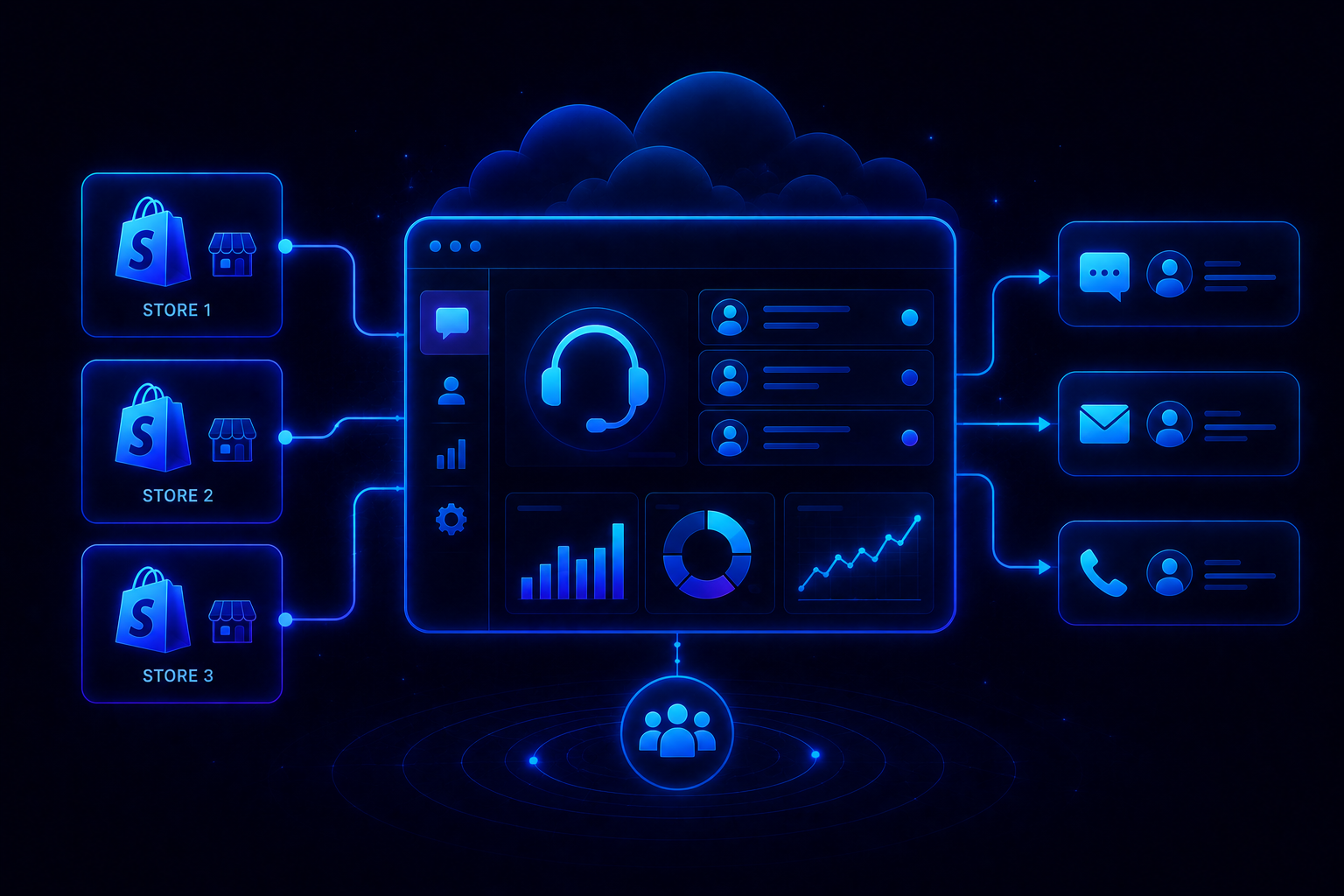
QuantumDesk is an AI-native customer service platform built to resolve high volumes of L1 queries automatically while keeping agents effective for complex escalations across every major support channel.
It is built for D2C brands, ecommerce stores, and SMB to mid-market teams that need strong customer service automation with full omnichannel coverage without GTM-first platform overhead.
Teams choose QuantumDesk over Relevance AI because it is purpose-built for customer support, with a unified inbox, agent copilot tools, and AI resolution included in the core platform rather than assembled from custom-built agents.
Key Features
- AI-native architecture with resolution, agent assist, routing, and analytics built into the core product without separate per-action usage billing on top.
- Quantum AI for L1 resolution handles repetitive customer queries instantly, like order status and refund requests, with seamless escalation when complexity requires agent involvement.
- AI copilot for agents provides drafted responses, conversation summaries, intent identification, and next-action suggestions directly inside the agent workspace.
- Unified omnichannel inbox managing email, live chat, WhatsApp, and social in a single workspace without per-channel fees or separate tool subscriptions.
- Admin performance visibility delivering real-time insights on resolution rates, escalation patterns, and customer satisfaction metrics for support leaders.
Why Choose QuantumDesk Over Relevance AI?
- Relevance AI is built for GTM and sales workflows; QuantumDesk is purpose-built for customer service with SLA tools, unified inbox management, and escalation handling included.
- Relevance AI's dual-meter billing creates unpredictable costs as automation volume scales; QuantumDesk's custom pricing aligns to actual support volume without per-action overages compounding.
- Relevance AI requires custom agent-building for support use cases; QuantumDesk delivers customer-facing AI and agent copilot tools out of the box without configuration overhead.
Pros
- Purpose-built for customer support, eliminating the workflow configuration overhead Relevance AI requires to approximate support-specific tooling and inbox management.
- AI resolution, agent copilot, omnichannel inbox, and admin analytics are all included in the core platform without dual-meter billing adding costs unpredictably.
- Custom pricing scales with conversation volume rather than per tool run, making costs predictable during seasonal peaks and high-volume campaign periods.
Cons
- Ecosystem and services partner network are newer than long-standing enterprise platforms like Zendesk or Salesforce Service Cloud.
- Best value is realized at mid-to-high ticket volumes; very small teams may not fully utilize the depth of AI the platform provides.
- Not built for GTM or sales workflow automation, meaning it does not replace Relevance AI for revenue operations or outreach use cases.
Customer Review
Reviewers point to QuantumDesk's ability to handle repetitive queries automatically, reducing agent workload while maintaining resolution quality across growing ticket volumes.
Pricing
QuantumDesk uses custom, quote-based pricing aligned to ticket volume and team stage, without per-action billing or minimum seat commitments required upfront.
2. Lindy - Best For Out-of-the-Box Business Workflow Agents

Lindy is an AI agent platform that enables business teams to deploy pre-built autonomous agents for inbox management, meeting scheduling, and lead qualification without custom development from scratch.
It is built for small to mid-sized teams, founders, and operations professionals who want ready-to-run AI agents for customer support and GTM workflows at a predictable monthly cost with minimal setup overhead.
Key Features
- Pre-built library of agents for inbox triage, meeting booking, and lead qualification without requiring agents to be built from scratch.
- Conversational agent builder that creates and deploys AI agents through natural language descriptions without technical configuration from engineering teams.
- Tier-based pricing with published monthly plan rates, avoiding the Action and Vendor Credit complexity Relevance AI applies as volume scales.
Why Choose Lindy Over Relevance AI?
- Lindy publishes clear tier pricing; Relevance AI's Pro and Team plans require a sales conversation before monthly costs are visible.
- Pre-built agents deploy faster than Relevance AI's builder-first approach, reducing time to production for non-technical operators.
Pros
- Fast deployment with pre-built agents suits teams with limited technical resources or tight deployment timelines.
- Predictable tier pricing removes the dual-meter forecasting complexity Relevance AI's billing model introduces at scale.
- Cleaner onboarding experience versus the dense interface G2 reviewers consistently flag with Relevance AI.
Cons
- Multi-agent orchestration and enterprise governance depth fall short of Relevance AI's architecture for complex deployments.
- BYOK and multi-LLM routing flexibility are more limited than Relevance AI's vendor-agnostic model management.
- Customization for bespoke enterprise playbooks falls short of Relevance AI's programmatic YAML-based configuration.
Customer Review
Lindy users praise deployment speed and interface clarity, noting significant time savings on inbox and scheduling workflows without technical overhead.
Pricing
Lindy starts at approximately $49.99 per month with tier-based plans that scale with usage volume, avoiding the per-action overage billing Relevance AI applies.
3. n8n - Best For Developer-Controlled Self-Hosted Automation
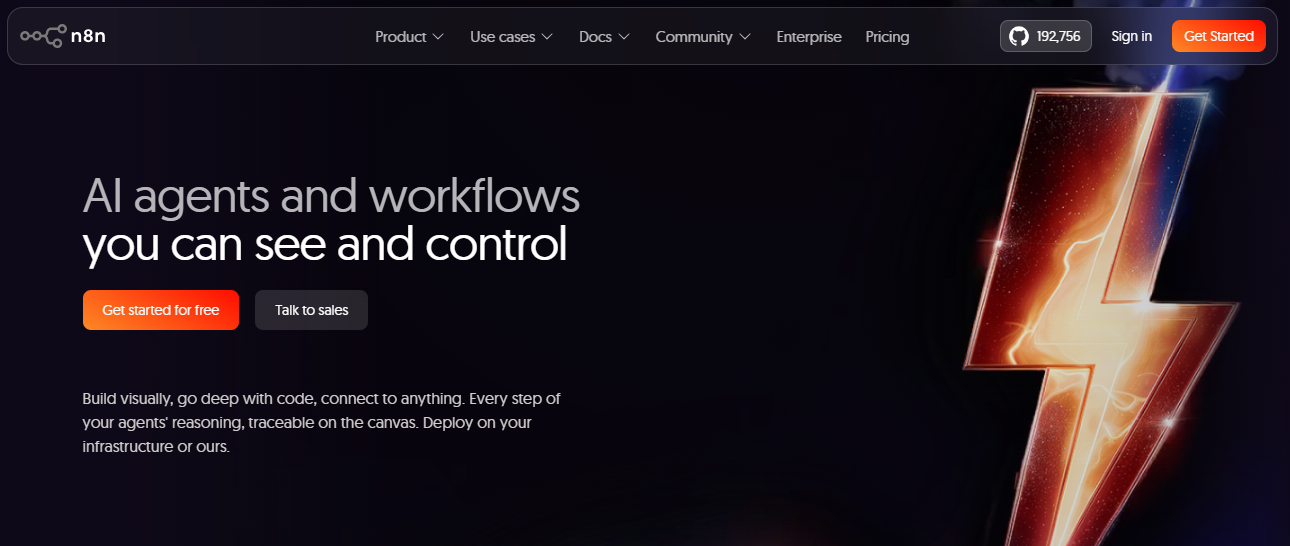
n8n is an open-source workflow automation platform that allows technical teams to build, self-host, and fully control multi-step automation pipelines with deep data routing, branching logic, and API-level customization.
It is built for developers, DevOps engineers, and technically resourced startups and mid-market teams that want complete infrastructure ownership over their automation stack.
Key Features
- Open-source codebase with full self-hosting capability, giving technical teams complete data control and infrastructure ownership without cloud vendor dependency.
- Visual workflow editor supporting complex branching, conditional logic, and multi-step pipelines without requiring code for the majority of configurations.
- Execution-based billing model on the cloud version with a clear per-workflow pricing structure instead of dual-meter Action and Vendor Credit accounting.
Why Choose n8n Over Relevance AI?
- n8n's self-hosted option gives technical teams complete data residency control without relying on Relevance AI's cloud-based multi-region deployment.
- Execution-based pricing is easier to forecast than Relevance AI's dual-meter model combining per-Action overages and variable Vendor Credits.
Pros
- Open-source and self-hosted options eliminate vendor lock-in and give engineering teams full control over workflow logic and infrastructure.
- Active community and extensive documentation reduce the learning curve friction G2 reviewers flag for Relevance AI's onboarding.
- Execution-based pricing is simpler to model for finance teams than dual-meter accounting with monthly overage uncertainty.
Cons
- Requires significant technical resources to set up and maintain, making it unsuitable for non-technical operators without engineering support.
- No native AI agent governance or enterprise compliance features at the production-ready level Relevance AI provides.
- Multi-agent orchestration depth falls behind Relevance AI's architecture for complex enterprise AI workforce deployments.
Customer Review
n8n users consistently praise its open-source flexibility and self-hosting control, citing it as the developer community's preferred platform for full-control automation.
Pricing
n8n starts at approximately $24 per month on the cloud plan, with a free self-hosted option for teams managing their own infrastructure.
4. Gumloop - Best For Visual Nested Workflow Building
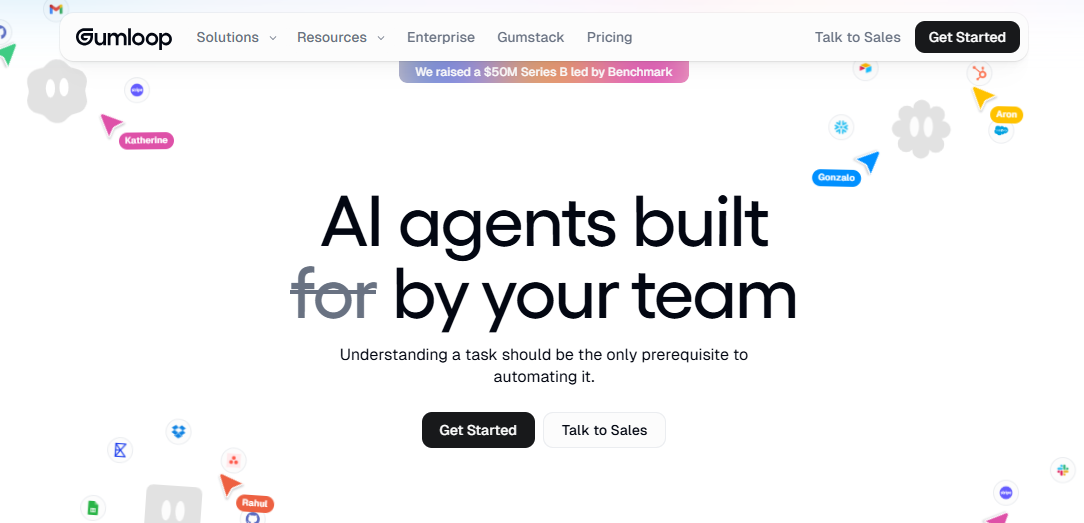
Gumloop is a visual AI workflow platform that enables teams to build nested, data-extraction-heavy automation pipelines with a drag-and-drop builder, built-in LLM management, and a generous free entry tier.
It is built for growth teams, marketing analysts, and operations professionals who need competitive intelligence workflows and AI-driven data extraction without managing LLM API keys separately.
Key Features
- Drag-and-drop visual builder for nested workflow construction supporting complex branching logic and multi-step data extraction without requiring code.
- Built-in LLM management removing the need for teams to configure separate API keys or navigate BYOK setup independently.
- Generous free tier enabling teams to validate automation use cases before committing to any paid plan costs.
Why Choose Gumloop Over Relevance AI?
- Gumloop's free tier provides meaningful workflow capacity; Relevance AI limits free users to 200 Actions with no BYOK or scheduled task support.
- Built-in LLM management removes the API key configuration overhead that Relevance AI's BYOK model places on individual teams.
Pros
- Visual drag-and-drop builder eliminates the interface complexity G2 reviewers consistently flag as Relevance AI's primary onboarding barrier.
- Robust free tier enables full use-case validation without upfront cost commitment, reducing evaluation risk for smaller teams.
- Built-in LLM management simplifies cost control by removing the need to track Vendor Credit consumption alongside Action overages.
Cons
- Enterprise governance features including RBAC, SSO, and SOC 2 are significantly less developed than Relevance AI's enterprise security stack.
- Multi-agent orchestration depth falls behind Relevance AI's architecture for complex enterprise AI workforce deployments.
- Per-credit costs above the base plan are not published transparently, creating similar forecasting uncertainty to Relevance AI's dual-meter model.
Customer Review
Gumloop users highlight the visual builder and free tier as standout strengths, with growing teams noting enterprise compliance as a gap once deployments scale to production.
Pricing
Gumloop offers a free tier for initial exploration, with the Pro plan at approximately $150 per month for higher automation volume and advanced features.
5. Relay.app - Best For Clean UI and Fast Integration Setup
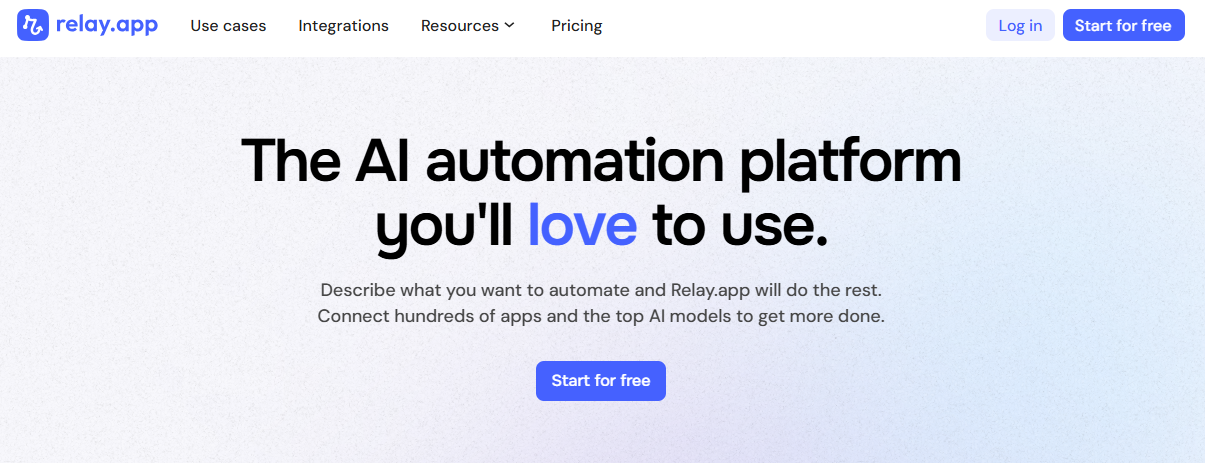
Relay.app is a business workflow automation platform combining AI-powered agents, human-in-the-loop approval triggers, and fast integration setup in an interface designed specifically for non-technical operators.
It is built for operations managers, customer success teams, and founders who want intuitive agent-driven automation without complex configuration or a dependency on engineering resources.
Key Features
- Intuitive workflow builder designed for non-technical operators, enabling automation creation without engineering involvement at any stage.
- Human-in-the-loop approval triggers allowing teams to insert manual review checkpoints before consequential actions execute.
- Fast integration setup with pre-built connectors covering major business tools that deploy in minutes rather than hours of API configuration.
Why Choose Relay.app Over Relevance AI?
- Self-serve entry pricing at approximately $30 per month removes the sales conversation requirement that Relevance AI's Pro and Team plans impose.
- Interface clarity and usability directly address the interface complexity complaints G2 reviewers raise about Relevance AI.
Pros
- Clean interface significantly reduces the onboarding friction and UX complexity G2 reviewers flag as a barrier with Relevance AI.
- Accessible self-serve pricing gives teams cost clarity before committing, unlike Relevance AI's sales-gated plan structure.
- Human-in-the-loop controls provide built-in approval workflows without custom safety gate configuration in the agent builder.
Cons
- Multi-agent orchestration and enterprise governance capabilities are significantly lighter than Relevance AI for regulated enterprise deployments.
- BYOK and multi-LLM routing are not available at the level Relevance AI's vendor-agnostic architecture supports.
- Less suited for high-volume agentic deployments that Relevance AI's enterprise tier is built to govern and scale.
Customer Review
Relay.app users frequently highlight interface quality and exceptional support responsiveness as reasons they chose it over more technically demanding alternatives.
Pricing
Relay.app starts at approximately $30 per month with transparent self-serve access and published plan tiers that do not require a sales conversation.
6. Zapier - Best For Broad Integration Coverage and Simple Automation
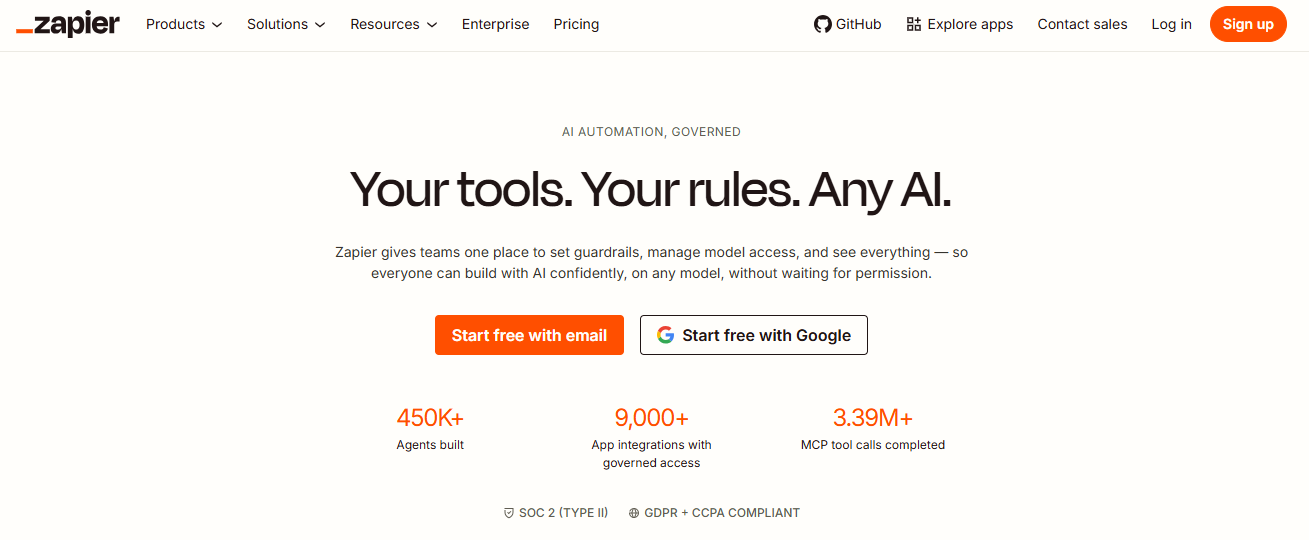
Zapier is a widely used workflow automation platform offering 8,000-plus integrations, a dedicated AI agent pricing tier, and a simple trigger-action builder that connects business tools without writing code.
It is built for business professionals, marketing teams, and operations managers across small to mid-sized organizations who need fast, reliable tool-to-tool automation without platform complexity.
Key Features
- 8,000-plus native integrations covering virtually every major SaaS tool category across marketing, sales, operations, and support.
- Dedicated AI agent pricing tier enabling autonomous multi-step workflows with AI decision-making at a transparent, self-serve cost structure.
- Simple trigger-action builder that configures automations in minutes for non-technical teams without significant onboarding requirements.
Why Choose Zapier Over Relevance AI?
- 8,000-plus integrations significantly exceed Relevance AI's 1,000-plus native connectors for breadth of SaaS tool coverage.
- Self-serve pricing starting at $29.99 per month removes the sales conversation requirement Relevance AI's Pro and Team plans impose.
Pros
- Largest integration library in the automation category provides connectivity no other platform currently matches for breadth.
- Transparent self-serve pricing and quick setup make it accessible for small teams without a sales-qualified procurement process.
- Mature ecosystem with extensive documentation and community templates that reduce implementation friction significantly.
Cons
- AI agent capabilities are significantly less sophisticated than Relevance AI's multi-agent orchestration and enterprise governance controls.
- Complex multi-step workflows with conditional logic are harder to manage in Zapier's Zap model than in Relevance AI's programmatic builder.
- BYOK and multi-LLM routing are unavailable; Zapier's AI features lack the vendor-agnostic model flexibility Relevance AI provides.
Customer Review
Zapier users consistently praise integration breadth and ease of setup, but note AI depth limitations when workflows require complex reasoning or multi-agent coordination.
Pricing
Zapier starts at approximately $29.99 per month with transparent self-serve access, and AI agent tiers are available on higher plans at published pricing.
7. StackAI - Best For Enterprise Agentic RAG Deployments
StackAI is an enterprise AI platform purpose-built for Retrieval-Augmented Generation workflows, enabling organizations to deploy knowledge-intensive AI agents with SOC 2, HIPAA, and GDPR compliance as standard.
It is built for large enterprises in regulated industries including healthcare, financial services, and legal operations that require on-premise or VPC deployment as a procurement requirement.
Key Features
- On-premises and VPC deployment options enabling enterprise organizations to meet strict data residency and regulatory requirements cloud-only platforms cannot satisfy.
- SOC 2 Type II, HIPAA, and GDPR compliance built into the platform for regulated industry deployments without additional configuration overhead.
- Agentic RAG framework supporting knowledge-intensive AI agents that retrieve and reason over large enterprise document repositories at scale.
Why Choose StackAI Over Relevance AI?
- On-premise and VPC deployment options address mandated data residency requirements that Relevance AI's cloud-based architecture cannot match.
- HIPAA and GDPR compliance certifications address regulatory requirements in healthcare and financial services Relevance AI's compliance stack may not fully satisfy.
Pros
- On-premises and VPC deployment options address enterprise data governance requirements cloud-only platforms cannot satisfy for regulated organizations.
- HIPAA, GDPR, and SOC 2 reduce the compliance certification burden for procurement teams in regulated industries.
- Purpose-built RAG architecture outperforms general-purpose GTM platforms on document reasoning and retrieval tasks.
Cons
- GTM, sales, and marketing workflow capabilities are significantly less developed than Relevance AI's revenue operations feature set.
- Custom enterprise-only pricing and formal procurement timelines make it inaccessible for smaller teams evaluating quickly.
- Builder tooling is less mature than Relevance AI's no-code Invent builder for non-technical domain experts.
Customer Review
StackAI users in regulated industries praise its compliance depth and on-premise flexibility, describing it as the natural fit for healthcare and financial services AI deployments.
Pricing
StackAI uses custom enterprise quote-based pricing. Teams must engage sales to receive a proposal and implementation scope.
8. Flowise - Best For Open-Source Visual Agent Building
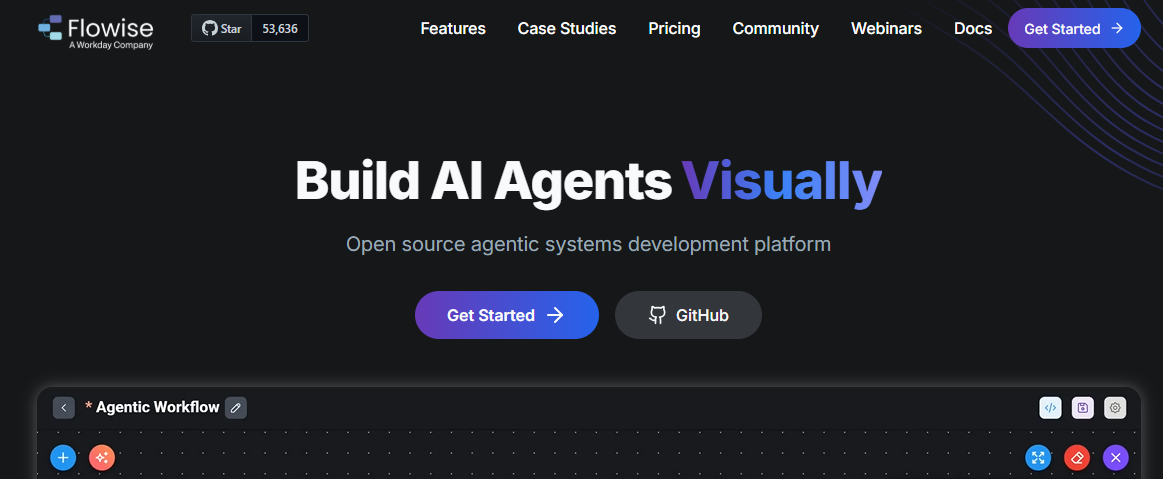
Flowise is an open-source visual agent and RAG builder that enables developers and technical teams to construct AI workflows with built-in tracing, agent evaluations, and LiteLLM proxy support for flexible model routing.
It is built for developers, AI engineers, and technically resourced teams that want full visual control over agent construction alongside open-source transparency and self-hosting options.
Key Features
- Open-source visual agent builder enabling teams to inspect, construct, and modify underlying workflow code without platform restrictions.
- Built-in tracing and evaluation framework for monitoring agent performance and debugging without external tooling.
- LiteLLM proxy integration enabling flexible model routing across multiple LLM providers without rebuilding workflows for each provider migration.
Why Choose Flowise Over Relevance AI?
- Open-source codebase provides full workflow transparency and modification rights that Relevance AI's proprietary platform does not offer at any tier.
- Approximately $35 per month cloud entry provides accessible agent building without Relevance AI's opaque plan pricing requiring sales engagement.
Pros
- Open-source and self-hosted options give development teams complete control over agent logic and infrastructure without vendor dependency.
- Built-in tracing and evaluations address the error visibility gap G2 reviewers consistently flag as a frustration with Relevance AI.
- Lower cloud entry cost makes it accessible for technical teams without entering a formal sales process to see the platform.
Cons
- Enterprise governance including RBAC, SSO, and compliance certifications are significantly less mature than Relevance AI's security architecture.
- Non-technical users face a steep setup curve; Flowise requires development or data engineering support to operate effectively.
- Multi-agent orchestration for GTM and revenue operations falls behind Relevance AI's playbook-driven execution capabilities.
Customer Review
Flowise users highlight open-source flexibility and tracing quality as standout features, citing it as the developer community's preferred platform for visual RAG construction.
Pricing
Flowise starts at approximately $35 per month on the cloud plan, with a free self-hosted version available for teams managing their own infrastructure.
9. BuildShip - Best For Affordable Low-Code Prototyping
BuildShip is a low-code backend and workflow builder enabling teams to prototype AI-powered applications, automations, and API endpoints without server configuration or deployment infrastructure overhead.
It is built for early-stage startups, product teams, and individual developers who need fast, affordable workflow prototyping without enterprise AI platform commitment.
Key Features
- Low-code visual builder for constructing backend workflows, API endpoints, and AI-powered automations without server setup or deployment configuration.
- Transparent per-second credit metering providing granular cost visibility at the workflow execution level without dual-meter billing complexity.
- Affordable entry pricing at approximately $25 per month enabling early-stage teams to prototype AI workflows without enterprise platform costs.
Why Choose BuildShip Over Relevance AI?
- Transparent per-second metering is simpler to forecast than Relevance AI's dual-meter model combining Action overages and variable Vendor Credits.
- $25 per month self-serve entry removes the sales conversation barrier that Relevance AI's Pro and Team plans require before cost is visible.
Pros
- Transparent per-second credit metering eliminates the forecasting complexity Relevance AI's dual-meter billing introduces for budget-conscious teams.
- Low entry pricing makes it accessible for early-stage teams without committing to enterprise-tier AI platform costs.
- Fast backend prototyping without server configuration reduces time to first working automation versus Relevance AI's full configuration workflow.
Cons
- Enterprise governance, multi-agent orchestration, and production-scale observability are significantly less developed than Relevance AI's architecture.
- Not designed for GTM or revenue operations; BuildShip's use case coverage is narrower than Relevance AI's playbook-driven platform.
- SOC 2, RBAC, and SSO are absent, limiting BuildShip to prototyping rather than regulated enterprise deployments.
Customer Review
BuildShip users praise affordable entry pricing and fast prototyping capability, describing it as the ideal starting point for early-stage teams testing AI workflow concepts.
Pricing
BuildShip starts at approximately $25 per month with transparent per-second credit metering, scaling with actual workflow execution volume.
10. Langflow - Best For Open-Source Agents with Native MCP Support
Langflow is a free, open-source AI agent builder with native Model Context Protocol (MCP) client and server support, built-in agent memory, and a visual flow interface for agentic pipeline development.
It is built for AI engineers, researchers, and technically resourced teams that want open-source agent development with native MCP integration and zero platform licensing cost.
Key Features
- Native MCP client and server support enabling agents to connect directly with external tools and data sources using the standardized Model Context Protocol.
- Built-in agent memory allowing agents to retain context across multi-turn conversations without requiring external memory infrastructure.
- Free and open-source codebase with no licensing cost, enabling teams to self-host, modify, and extend the platform without vendor contract obligations.
Why Choose Langflow Over Relevance AI?
- Free and open-source, eliminating the dual-meter billing and opaque plan pricing that Relevance AI's Pro and Team tiers introduce.
- Native MCP support provides standardized agent-to-tool connectivity that Relevance AI's proprietary connector model does not natively implement.
Pros
- Free and open-source with no licensing cost removes the pricing barrier and forecasting complexity Relevance AI's credit-based model creates.
- Native MCP support provides a standardized, forward-compatible approach to agent-tool connectivity proprietary libraries cannot match.
- Built-in agent memory enables multi-turn context retention without external configuration, addressing a gap in simpler automation platforms.
Cons
- Enterprise governance including RBAC, SSO, SOC 2, and audit logs are not available at the production-ready level Relevance AI's enterprise tier provides.
- Requires dedicated engineering resources for deployment and maintenance; non-technical teams cannot operate Langflow independently.
- Commercial support and account management are more limited than Relevance AI's dedicated customer success model for enterprise deployments.
Customer Review
Langflow users in the developer and research community highlight MCP support and zero licensing cost as defining advantages for open-source AI agent projects.
Pricing
Langflow is free and open-source. Managed cloud options may carry costs; self-hosting remains fully available at zero platform licensing cost.
Factors to Consider When Choosing a Relevance AI Alternative
1. Billing Model Clarity and Cost Predictability
Relevance AI's dual-meter model separates Actions and Vendor Credits, making total monthly spend difficult to forecast without modeling both meters simultaneously.
Prioritize platforms that publish clear pricing or use a single billing meter that finance teams can evaluate without a mandatory sales conversation first.
2. Primary Use Case Fit
Relevance AI is built for GTM, sales prospecting, and revenue operations workflows. Teams needing agentic AI for customer service should evaluate purpose-built platforms instead.
Define whether your core use case is sales prospecting, support automation, or general operations before shortlisting tools that appear similar at surface level.
3. Technical Resource Requirements
Platforms like Relevance AI, n8n, Flowise, and Langflow require meaningful technical resources for setup, configuration, and ongoing production maintenance.
Assess whether your team has dedicated engineering or RevOps support before committing to platforms with significant onboarding overhead and configuration lead times.
4. Governance and Compliance Depth
For regulated industries, verify whether your shortlisted alternative provides SOC 2, HIPAA, GDPR, RBAC, SSO, and audit logging at the level your procurement team requires.
Relevance AI's enterprise governance is strong, but alternatives like StackAI offer on-premises and VPC deployment for mandated data residency requirements Relevance AI cannot match.
5. Scalability Without Billing Acceleration
Per-action or per-resolution billing models create costs that grow faster than team size during high-volume automation periods or seasonal campaign spikes.
When thinking about how to scale customer support or GTM operations, evaluate whether the platform's cost structure grows linearly or compounds when automation volume increases rapidly.
Why QuantumDesk Is a Strong Alternative to Relevance AI
QuantumDesk is built for D2C brands, ecommerce teams, and SMB to mid-market support operations that need ai native customer service benefits without Relevance AI's GTM-first architecture, dual-meter billing complexity, or custom agent-building requirements.
Core strengths:
- AI-native architecture: AI resolution, agent assist, routing, and analytics are embedded in the core product, not billed per tool run or per action consumed on top.
- Quantum AI for customers: resolves repetitive L1 queries instantly with full context and seamless human escalation when agent involvement is needed.
- AI copilot for agents: provides drafted responses, conversation summaries, intent identification, and next-action suggestions directly inside the agent workspace.
- Unified omnichannel inbox: manages email, live chat, WhatsApp, and social in one workspace without per-channel fees or separate tool subscriptions required.
- Admin performance visibility: delivers real-time insights on resolution rates, escalation patterns, and satisfaction trends without a separate analytics add-on.
Where Relevance AI requires custom agent-building and dual-meter billing to approximate customer support workflows, QuantumDesk delivers AI resolution, agent copilot, and omnichannel coverage as foundational platform features from day one.
D2C brands and support teams that need predictable AI costs, fast deployment, and purpose-built customer service infrastructure find the strongest long-term fit with QuantumDesk.
If your team is evaluating Relevance AI alternatives with stronger customer service AI and more predictable pricing, explore how QuantumDesk can support your growth → Book a Demo
Frequently Asked Questions About Relevance AI Alternatives
What are the top Relevance AI alternatives?
The top Relevance AI alternatives include QuantumDesk, Lindy, n8n, Gumloop, Relay.app, Zapier, StackAI, Flowise, BuildShip, and Langflow.
The right choice depends on your primary use case, technical resource availability, and pricing preference. QuantumDesk is the strongest choice for support teams needing purpose-built Best AI help desk software without Relevance AI's dual-meter billing complexity.
Is Relevance AI suitable for large-scale use?
Relevance AI is well-suited for large-scale enterprise GTM and revenue operations teams with multi-agent orchestration requirements, enterprise governance needs, and high-volume sales workflow automation.
However, its dual-meter billing model and opaque Pro and Team plan pricing create forecasting challenges as automation volume scales, which enterprise procurement teams should model carefully before committing to an annual contract.
How does QuantumDesk compare to Relevance AI?
QuantumDesk is purpose-built for customer service, delivering a unified inbox, AI Customer Service Agent capabilities, and agent copilot tools embedded in the core platform without custom agent-building required.
Relevance AI is built for GTM and revenue operations workflows, not customer support. Teams needing customer service AI with predictable pricing and fast deployment find QuantumDesk a more focused and cost-efficient long-term fit.
What is the best free alternative to Relevance AI?
Langflow and n8n both offer fully free self-hosted options for technical teams building AI agents without platform licensing costs or usage-based billing at the outset.
Gumloop and Flowise also provide meaningful free or low-cost entry tiers. For customer support use cases, QuantumDesk's custom pricing avoids the cost cliffs that free-tier platforms create, making it the stronger fit for teams evaluating the best customer service software for ecommerce brands at scale.





.avif)