Summarize with AI
Key Takeaways
- Top customer service platforms in 2026 include QuantumDesk for AI-native D2C and SMBs, Zendesk for enterprise scale, and Freshdesk for user-friendly automation.
- Zendesk leads for large teams needing deep customization, while Freshdesk and Zoho Desk suit SMBs needing affordability and ease of use.
- Intercom is the go-to for real-time conversational support, while Help Scout fits teams that prioritize human-centric email-first collaboration workflows.
- QuantumDesk leads for SMBs that want AI-native resolution and resolution-based pricing rather than per-seat AI add-ons billed separately.
- Match the tool to your support volume, channel mix, and team size before comparing pricing or AI feature checklists alone.
Choosing the right customer service software in 2026 directly affects how fast you resolve queries, how much your team can handle, and whether customers stick around after a single bad support experience.Meeting modern customer service expectations means resolving issues before they escalate, not just logging them faster.
A customer ordered a fitness supplement. Six days passed wiMore on the AI-Native customer service benefitsth no tracking update. They reached out for help, and got back a canned "wait longer" reply.
Most platforms see that ticket only after the chargeback hits. The right customer service software in 2026 ties into carrier data, flags the delay automatically, and gets a real ETA out before the customer taps "dispute" in their bank app.
Some of the top customer service software in 2026 include QuantumDesk (best for AI-native SMBs and D2C brands), Zendesk (best for enterprise omnichannel), Freshdesk (best for growing teams), Intercom (best for SaaS conversational support), and Help Scout (best for email-first teams).
We compared each tool on features, pricing, pros, cons, and the kind of team it actually fits in 2026, so you can shortlist faster. If you want a narrower lens on ticketing-first platforms, our best help desk software comparison covers that category specifically.
How tools were evaluated:
- Hands-on testing across real customer service workflows
- Direct customer conversations and feedback from active users
- Reviews on G2, Capterra, and similar platforms
- Insights from Reddit and support community discussions
- Competitive positioning across the customer service category
Pick the customer service software that fits your team size, channel mix, and ticket volume, not the loudest brand on the market.
A Quick Comparison: Best 10 Customer Service Software
How We Chose These 10 Customer Service Tools
We chose these 10 customer service tools by testing each in real workflows, talking to active users, and benchmarking what teams actually rely on day to day instead of what marketing pages promise.
- G2, Capterra, and listing site analysis to verify real user ratings, review patterns, and team size fit
- Customer feedback and direct conversations with support leaders running active customer service operations across SMB and enterprise
- Competitive benchmarking across pricing models, AI capabilities, channel coverage, and integration depth in 2026
- Reddit and niche community discussions to surface real complaints and praise beyond polished marketing claims
- Hands-on product exploration of dashboards, AI features, automations, and real ticketing flows over multi-day trials
- Pricing and scalability considerations for SMB through enterprise customer service teams handling 500 to 50,000 monthly tickets
10 Best Customer Service Software in 2026
1. QuantumDesk – Best AI-Native Customer Service for Growing Teams and SMBs

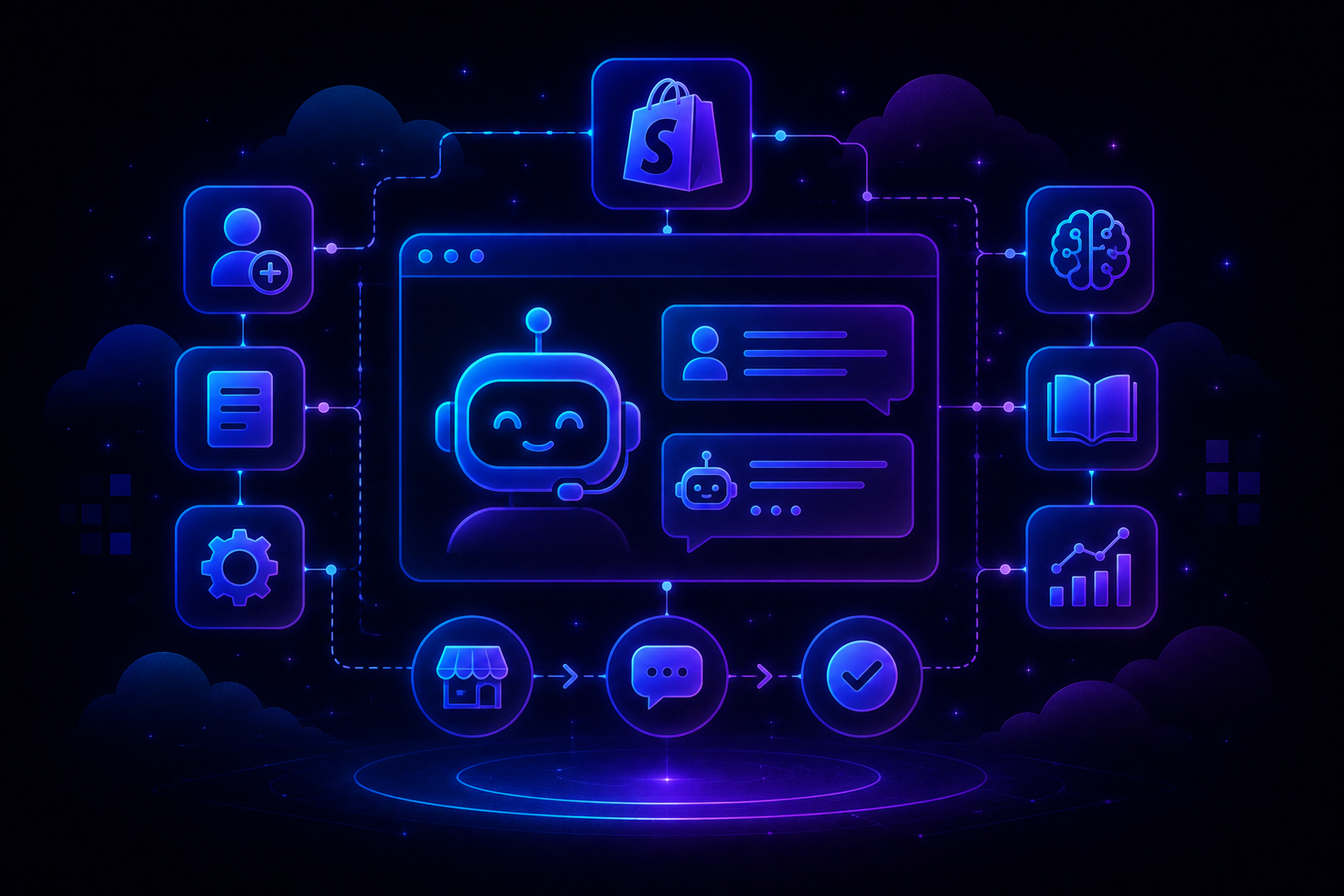
QuantumDesk is an AI-native customer service platform built for SMBs and D2C brands that want to automate L1 queries, unify channels, and grow support capacity without hiring more agents every quarter. It centralizes WhatsApp, email, Instagram, and chat in one workspace where Helix AI resolves repetitive tickets and routes the rest with full context. This makes it a strong fit for small business customer service teams that need enterprise-grade automation without enterprise headcount.
Unlike legacy platforms with AI as a paid add-on, AI is embedded into every workflow at no extra upfront cost.
Take a B2B SaaS team running 1,200 support tickets a month. Onboarding spikes, billing disputes, and integration questions stack up in one shared inbox every Monday.
On QuantumDesk, Helix AI handles routine onboarding questions from the help center, the AI-curated inbox elevates the billing disputes that risk renewal, and Quantum AI Copilot pulls account history into every reply so agents stop asking customers to repeat themselves.
Key Features
- Helix AI resolves repetitive customer queries like order status, refund requests, and product questions without entering an agent's queue
- AI-curated inbox prioritizes incoming tickets by sentiment, urgency, and intent so agents handle the highest-impact issues first
- Quantum AI Copilot drafts replies, summarizes long threads, and surfaces next best actions for agents inside every conversation
- Resolution-based pricing means teams pay only for AI-resolved tickets instead of paying upfront for an AI add-on module
Pros
- AI is built into every workflow from day one, not sold as a separate paid add-on
- Resolution-based pricing keeps costs aligned with actual value delivered, especially for SMBs scaling their monthly support volume
- Designed specifically for SMB scale, not a stripped-down version of an enterprise platform sold to smaller teams
Cons
- Currently in BETA, so feature depth and integrations are still expanding compared to mature category leaders
- Smaller integration library today, which can limit teams already running heavy CRM, ERP, or analytics stacks
Best Use Case
SMBs and D2C brands handling 500 to 5,000 monthly tickets across WhatsApp, Instagram, email, and chat without enterprise complexity.
When to Choose QuantumDesk
Choose QuantumDesk when AI-driven L1 resolution, multi-channel inbox unification, and resolution-based pricing matter more than enterprise feature depth or legacy integration breadth.
Pricing
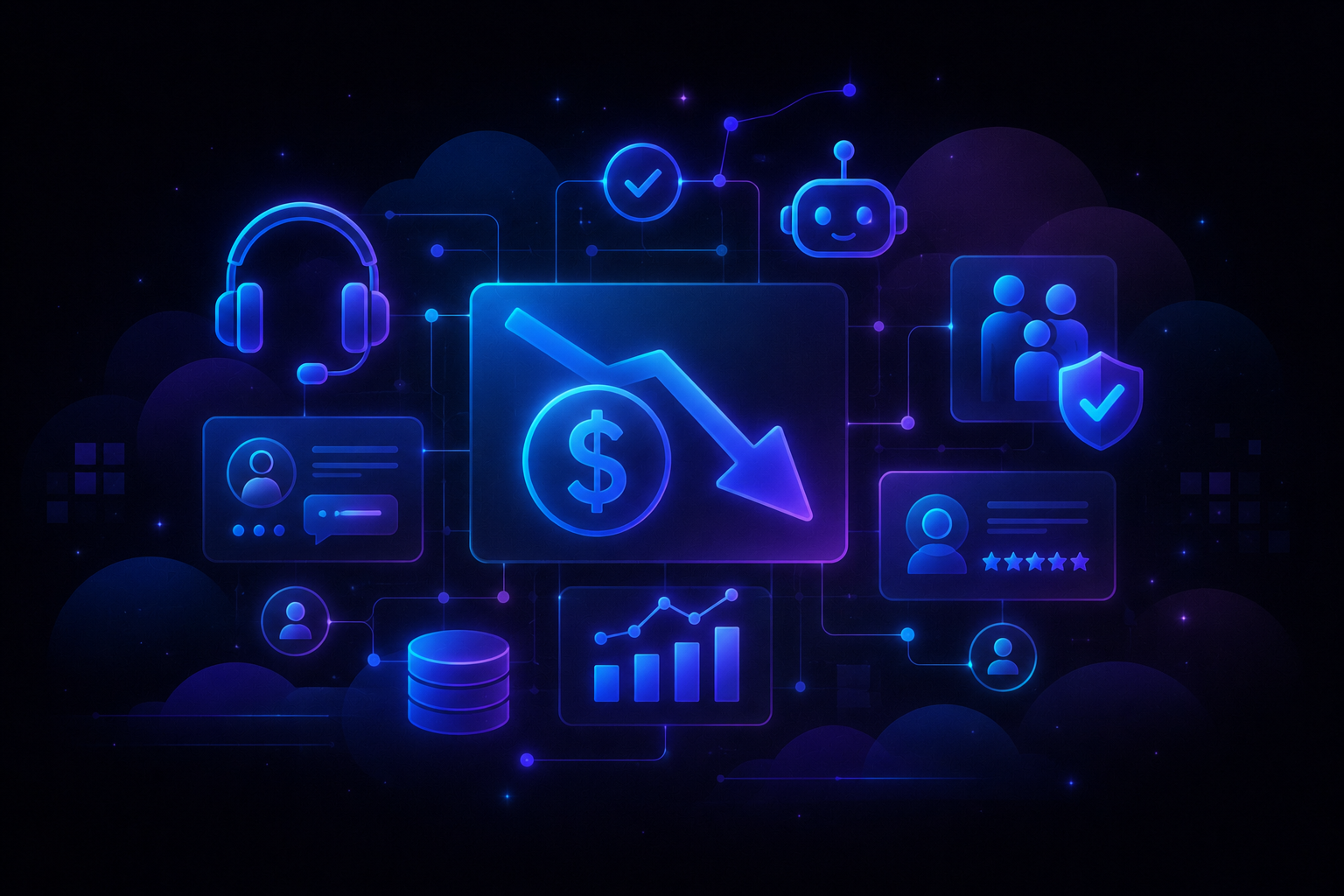
QuantumDesk follows a resolution-based pricing model where teams pay for AI-resolved tickets rather than paying upfront for an AI add-on or per-seat AI license.
2. Zendesk – Best for Omnichannel Support
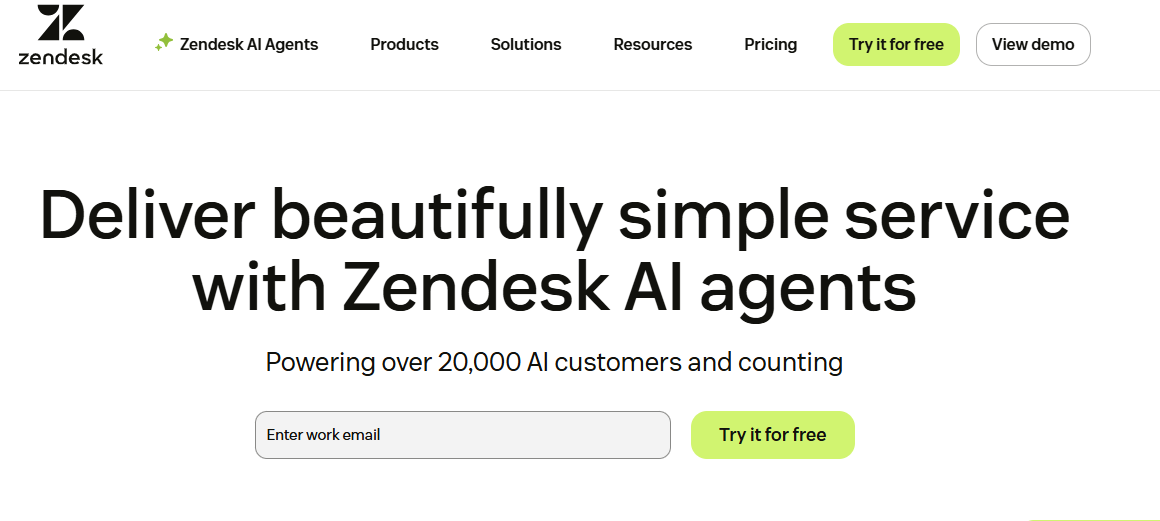
Zendesk is one of the most established customer service platforms, used by enterprise and mid-market teams running support across email, chat, voice, social, and self-service portals at high ticket volumes globally.
It centralizes customer conversations into a single ticketing system with deep automations, custom workflows, and a large marketplace of third-party integrations.
Teams pick Zendesk for omnichannel breadth and enterprise-grade scale rather than for AI-first design or SMB-friendly pricing.
Key Features
- Omnichannel ticketing across email, chat, voice, SMS, social, and self-service in one unified agent workspace
- Macros, triggers, and automations let teams build complex routing, escalation, and SLA workflows at enterprise scale
- Zendesk AI offers reply suggestions, intent detection, and bot resolution as a paid add-on layer
- Marketplace with hundreds of integrations covering CRM, e-commerce, analytics, communication tools, and developer platforms across industries
- Reporting and analytics suite with prebuilt dashboards, custom metrics, and shareable insights for support leaders
Pros
- Mature platform with proven scale, used by enterprise teams handling millions of customer tickets per year
- Massive integration marketplace makes it easy to connect Zendesk to existing CRM, e-commerce, and analytics systems
- Strong omnichannel coverage with a consistent agent experience across email, chat, voice, and social media channels
Cons
- Pricing scales aggressively with seat counts and AI add-ons, which can hurt SMB budgets quickly
- AI capabilities are added on top of legacy ticketing rather than embedded into the core platform
- Implementation and admin setup can feel heavy for small teams that want fast time-to-value out of the box
Best Use Case
Mid-market and enterprise customer service teams with high ticket volume, complex routing, and deep omnichannel needs.
When to Choose Zendesk
Choose Zendesk when omnichannel breadth, mature integrations, and enterprise-grade scale matter more than AI-native design, SMB pricing, or fast lightweight setup for smaller support teams.
Pricing
Zendesk plans start around $19 per agent per month for basic support, with advanced tiers and AI add-ons increasing total cost as ticket volume grows.
3. Freshdesk – Best for Growing Support Teams
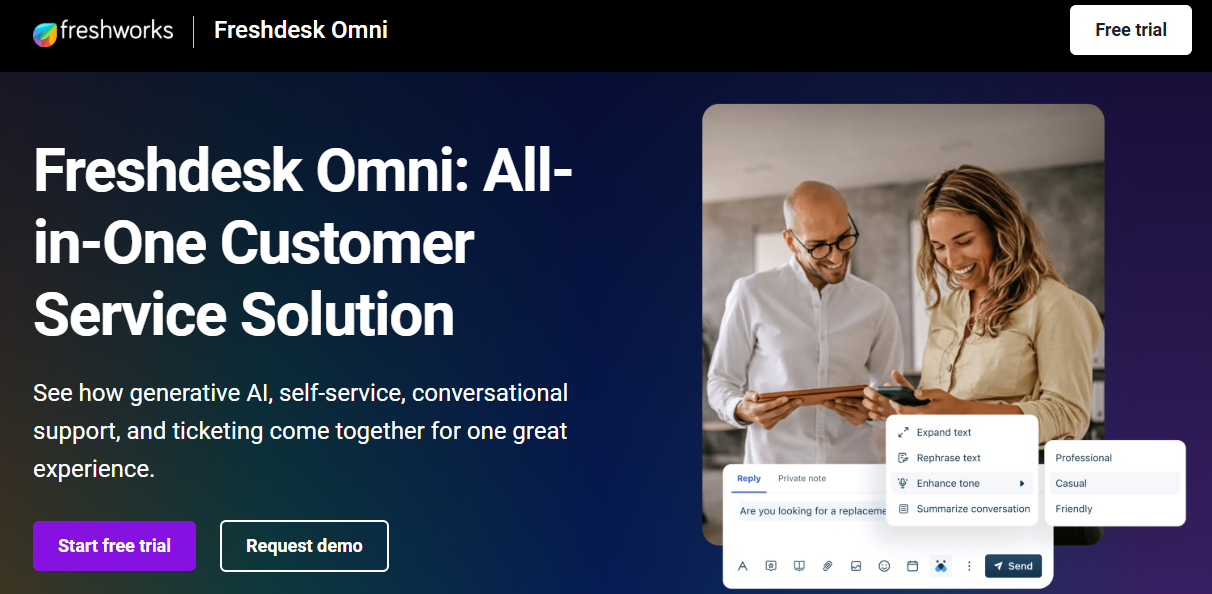
Freshdesk is a mid-market customer service platform built for growing support teams that want multi-channel ticketing, automation, and a friendlier learning curve than enterprise-heavy platforms while still scaling beyond entry-level tools.
It supports email, chat, phone, and social channels in one workspace with team collaboration, SLA management, and a Freddy AI add-on layer.
Teams choose Freshdesk for its balance of features, ease of setup, and pricing that fits growing mid-sized support operations.
Key Features
- Multi-channel ticketing across email, chat, phone, and social with shared team inbox and collision detection
- Built-in automations for routing, SLA tracking, and ticket dispatch reduce manual triaging across the support team
- Freddy AI offers reply suggestions, ticket categorization, and bot deflection, available as an add-on intelligence layer for support teams
- Knowledge base and self-service portal let customers find answers without raising tickets, reducing repetitive load
- Reporting dashboards track ticket volume, resolution times, CSAT, and agent performance across the support team in real time
Pros
- Easier to deploy than Zendesk, with a friendlier interface for support teams scaling beyond shared mailboxes
- Solid balance of features and pricing for mid-sized teams that need more than a basic help desk
- Strong automation library that handles SLA tracking, routing, and escalation without requiring heavy admin lift or scripting
Cons
- AI features sit behind a separate Freddy add-on, increasing cost for teams that want intelligence built in
- Reporting depth is solid but lags behind Zendesk and HubSpot for advanced custom analytics needs
- Mobile and chat experiences can feel less polished than purpose-built chat-first tools for D2C brands
Best Use Case
Growing customer service teams of 10 to 100 agents that need multi-channel ticketing without the complexity of Zendesk.
When to Choose Freshdesk
Choose Freshdesk when your team has outgrown a shared inbox, needs multi-channel coverage, and wants a balance of features, automation, and reasonable per-agent pricing.
Pricing
Freshdesk offers a free tier for small teams, with paid plans starting around $15 per agent per month and Freddy AI billed as an additional layer.
4. Zoho Desk – Best for Cost-Conscious Teams
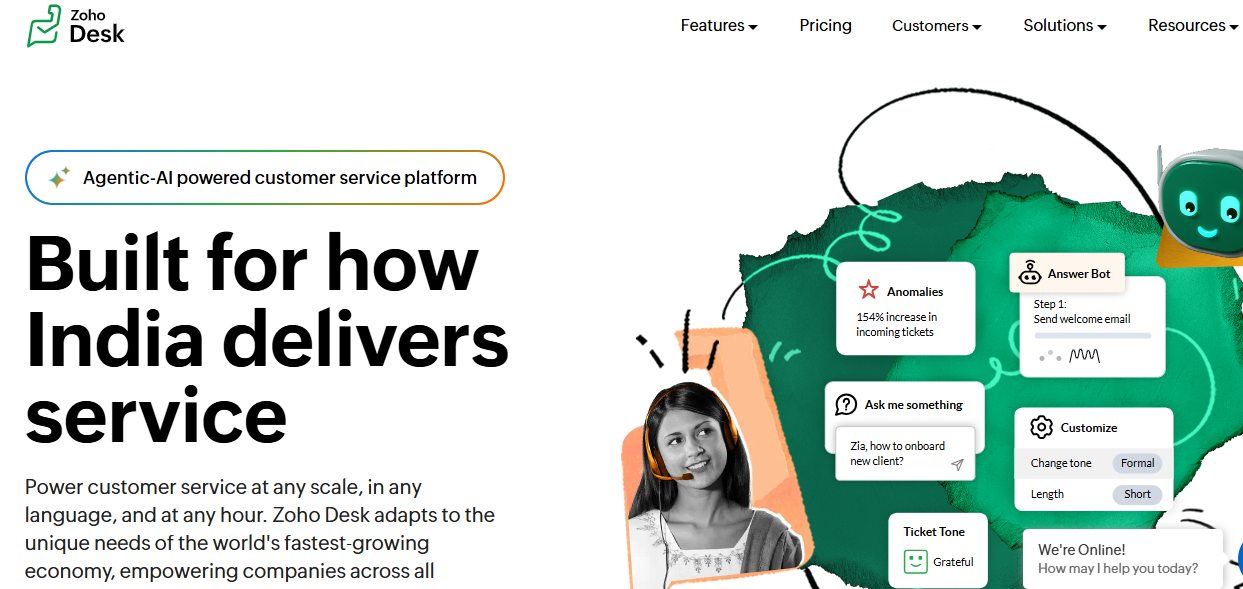
Zoho Desk is a multi-channel customer service platform built for cost-conscious teams already using the Zoho suite, offering ticketing, automation, and self-service at a price point smaller businesses can adopt without long contracts.
It supports email, chat, phone, social, and a self-service portal, with Zia AI providing basic intent detection, reply suggestions, and ticket tagging.
Teams already on Zoho CRM, Books, or Projects pick Zoho Desk for native ecosystem integration and lower total cost.
Key Features
- Multi-channel ticketing across email, chat, phone, social, and a brandable self-service customer portal for end users
- Native integration with Zoho CRM, Books, Projects, and other Zoho tools for connected sales and support workflows
- Zia AI provides basic intent detection, sentiment analysis, anomaly alerts, and reply suggestions inside the agent workspace
- Workflow automations, blueprints, and SLA management help mid-sized teams structure repeatable support processes across departments
- Customizable reports and dashboards track agent performance, ticket trends, and customer satisfaction over rolling time periods
Pros
- Lowest pricing among major customer service platforms, especially attractive for SMBs already running other Zoho business products
- Strong ecosystem integration if your sales, finance, or projects teams already run on Zoho applications today
- Solid feature breadth for ticketing, SLA, and self-service at a fraction of competitor pricing tiers
Cons
- Zia AI is shallow compared to Helix AI or Fin AI in real production support scenarios
- UI feels dated compared to Intercom or Help Scout, which can slow down agent ramp-up
- Best value comes only inside the Zoho ecosystem, weaker for teams running mixed CRM and finance stacks
Best Use Case
Small and mid-sized teams already on Zoho One that want a connected customer service tool at a low total cost.
When to Choose Zoho Desk
Choose Zoho Desk when budget is the top constraint, your team already uses Zoho tools, and you want a connected sales-to-service workflow without enterprise pricing.
Pricing
Zoho Desk offers a free plan for up to three agents, with paid tiers starting around $14 per agent per month for ticketing and automation features.
5. Salesforce Service Cloud – Best for CRM Workflows
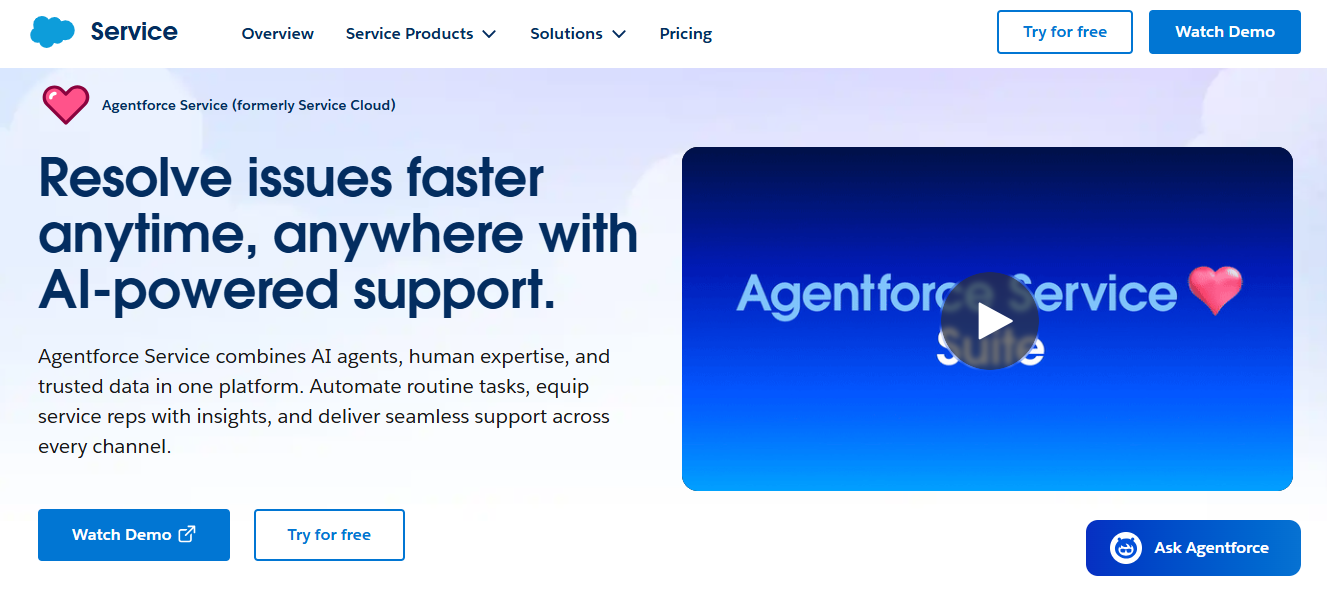
Salesforce Service Cloud is an enterprise-grade customer service platform built on top of the Salesforce CRM, designed for large organizations that want service, sales, and marketing data unified across teams.
It supports omnichannel routing, case management, knowledge bases, AI-powered Einstein agents, and deep integration with the broader Salesforce ecosystem of sales and marketing apps.
Enterprise teams pick Service Cloud when CRM alignment, complex workflows, and deep customization matter more than fast time-to-value or SMB pricing.
Key Features
- Omnichannel routing across email, chat, voice, social, SMS, and customer portal inside one unified Salesforce service workspace
- Einstein AI provides reply suggestions, case classification, intent detection, and predictive analytics across the customer service workflow
- Case management with custom fields, workflows, and approval rules to handle complex enterprise customer service processes at scale
- AppExchange marketplace gives access to thousands of integrations and prebuilt apps for service, sales, and operations
- Reporting and dashboards combine service metrics with sales and marketing data for full revenue lifecycle visibility
Pros
- Best-in-class CRM integration since service, sales, and marketing all run on the Salesforce platform foundation
- Highly customizable with workflows, approvals, and Apex code to fit the most complex enterprise service processes
- Massive AppExchange ecosystem and partner network for integrations, implementation, and ongoing support across regions and verticals
Cons
- Pricing is high, especially when adding Einstein AI seats and additional Salesforce clouds for full coverage
- Implementation usually requires consultants, admins, and ongoing development effort to keep workflows tuned over time
- Not designed for SMBs or D2C brands needing fast time-to-value across WhatsApp, Instagram, and email channels
Best Use Case
Enterprise organizations already running on Salesforce CRM that need deep customization, omnichannel routing, and integrated revenue data.
When to Choose Salesforce Service Cloud
Choose Service Cloud when your business already runs on Salesforce, you have admin and developer resources, and you need deeply customized service workflows at enterprise scale.
Pricing
Salesforce Service Cloud pricing starts around $25 per user per month for Starter, with Enterprise and Unlimited tiers ranging from $165 to $500 per user monthly.
6. Intercom – Best for SaaS Customer Support
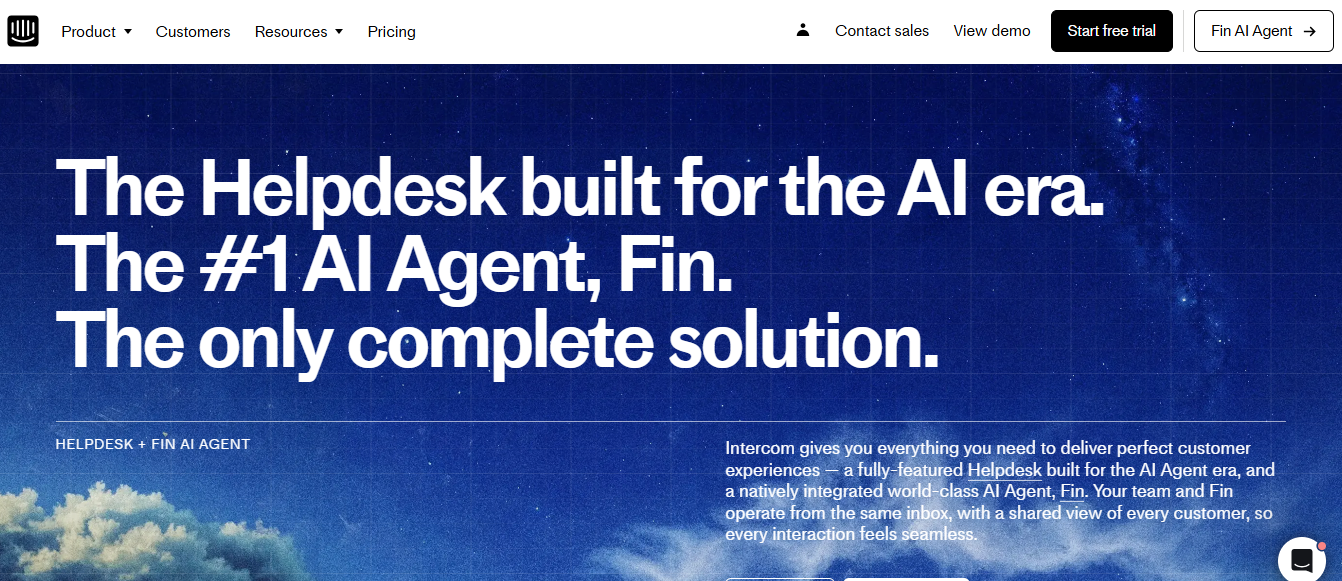
Intercom is a chat-led customer service platform built for SaaS and digital-first companies that want in-app messaging, proactive customer engagement, and AI-driven resolution layered on top of a modern messenger experience.
It centers around the Intercom Messenger, paired with Fin AI for autonomous resolution, plus a help center, ticketing, and outbound campaign tools.
SaaS teams choose Intercom for in-app chat, customer onboarding messaging, and Fin AI as a separate paid resolution engine.
Key Features
- Intercom Messenger embeds in web and mobile apps, supporting chat, bots, product tours, and onboarding flows
- Fin AI delivers autonomous resolution by answering customer questions from your help center and connected knowledge sources
- Outbound campaigns trigger product messages, banners, and emails based on user behavior and lifecycle events
- Inbox combines tickets, conversations, and chat into a single agent workspace with assignment and routing rules
- Reporting dashboards cover conversation trends, Fin AI performance, and team productivity for support and growth teams
Pros
- Strong in-app messaging experience that drives high engagement for SaaS onboarding and product-led growth motions
- Fin AI is one of the more mature autonomous AI agents in the customer service category today
- Outbound and product engagement tools double as a marketing layer beyond basic customer support workflows
Cons
- Pricing scales aggressively, especially when adding Fin AI resolutions on top of seat-based plan costs
- Less suited for D2C brands focused on WhatsApp, Instagram, and email rather than in-app web messaging
- AI is positioned as a paid resolution layer, not as a native foundation across every workflow by default
Best Use Case
SaaS and digital-first companies that run customer service, onboarding, and engagement primarily through in-app chat.
When to Choose Intercom
Choose Intercom when chat is your primary support channel, in-app messaging matters for onboarding, and your budget supports paying separately for Fin AI resolution. Check Intercom reviews for more on real user experiences.
Pricing
Intercom plans start around $39 per seat per month, with Fin AI billed separately on a per-resolution basis that adds significant cost at scale.
7. HubSpot Service Hub – Best for HubSpot Ecosystem
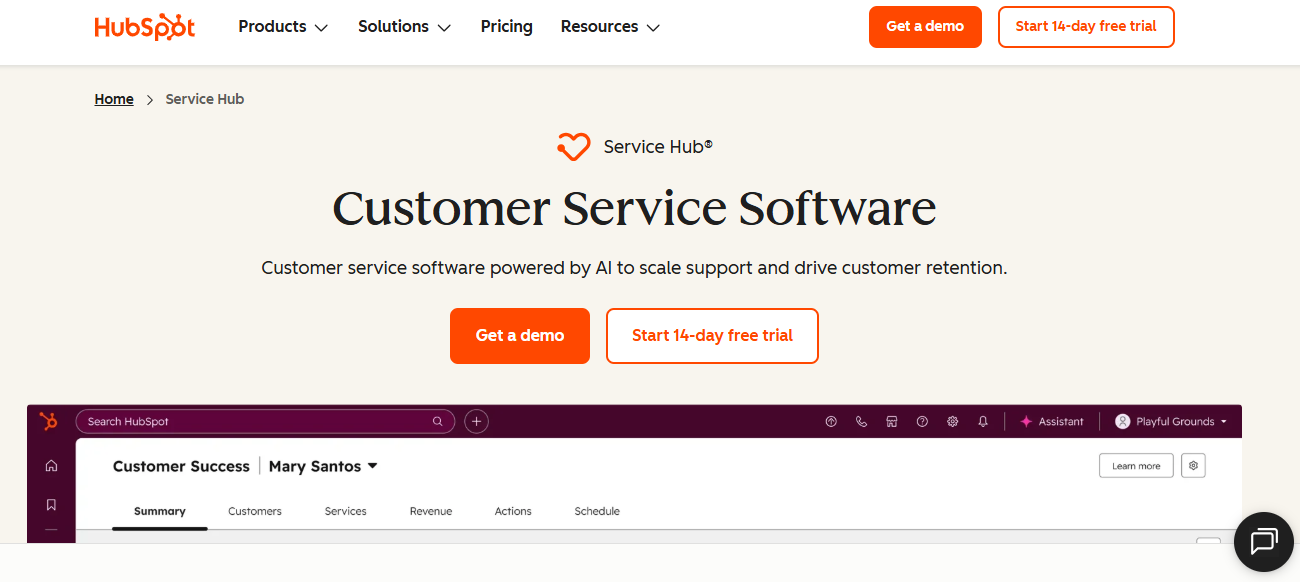
HubSpot Service Hub is a customer service platform tightly integrated with HubSpot CRM, built for teams that want their service, sales, and marketing data living in a single customer record across the revenue lifecycle.
It offers ticketing, knowledge base, customer portal, AI tools, and shared inbox features all connected directly to HubSpot CRM data and contact records.
Teams pick HubSpot Service Hub when revenue alignment and CRM context matter as much as core customer service functionality.
Key Features
- Shared inbox connected to HubSpot CRM so every conversation is tied to contact, deal, and account history
- Ticketing with automation, routing, and SLA tracking aligned to customer lifecycle stage and pipeline data
- Knowledge base, customer portal, and AI chatbot together help deflect repetitive queries with self-service first across the journey
- Reporting dashboards combine service metrics with sales and marketing data for full revenue lifecycle visibility
- Native HubSpot integrations mean service, marketing, and sales teams operate from one shared customer database
Pros
- Best-in-class CRM integration since service, marketing, and sales sit on the same HubSpot platform foundation
- Service workflows benefit from rich customer context, including past purchases, open deals, and marketing engagement touchpoints
- Strong reporting that ties customer service outcomes directly to revenue impact and customer lifecycle stage progression
Cons
- Pricing climbs quickly as teams add Service Hub seats on top of existing HubSpot suite costs
- Less specialized for high-volume D2C support compared to platforms built for WhatsApp, Instagram, and email scale
- AI features are improving but still trail purpose-built AI-native customer service platforms in resolution depth
Best Use Case
Mid-sized teams already on HubSpot CRM that want unified sales, marketing, and customer service data across the lifecycle.
When to Choose HubSpot Service Hub
Choose HubSpot Service Hub when CRM alignment is non-negotiable, your team already uses HubSpot for sales or marketing, and you want one source of customer truth.
Pricing
HubSpot Service Hub starts free for very small teams, with paid Starter, Professional, and Enterprise tiers ranging from roughly $20 to $150 per seat per month.
8. Help Scout – Best for Email-First Support
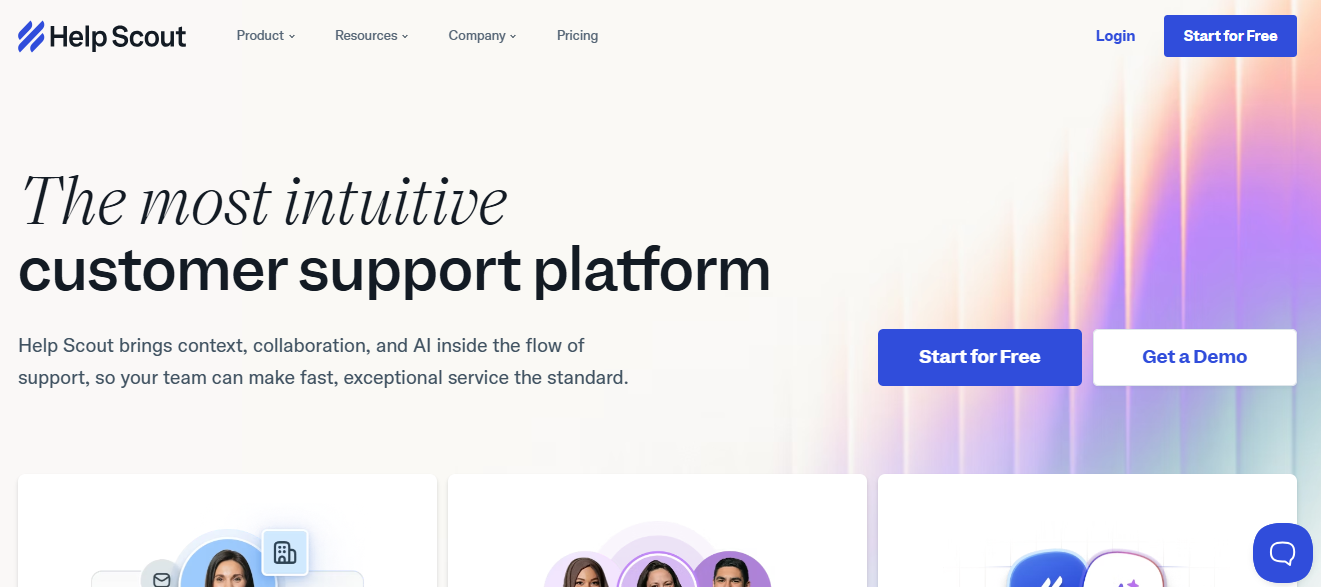
Help Scout is a customer service platform built around email and shared inbox workflows, designed for teams that value a personal, conversational tone over heavy ticket structures and enterprise-style automation queues.
It offers a shared inbox, lightweight ticketing, knowledge base, and chat features, with AI summaries and AI assist available across customer conversations.
Teams choose Help Scout when human-first email support matters more than complex multi-channel routing or deep automation libraries.
Key Features
- Shared inbox that looks and feels like email, reducing agent ramp-up time and keeping conversations personal
- Knowledge base builder with Beacon widget for embedding self-service into any product or marketing page
- AI Assist features include reply summaries, tone shifts, and message generation to speed up response drafting
- Workflows automate repetitive triage tasks like assignment, tagging, and follow-ups based on email content and message rules
- Reporting tracks volume, response times, CSAT, and team workload across shared inboxes and connected support channels
Pros
- Email-first interface keeps agent training light and feels natural for teams already living in inbox workflows
- Strong knowledge base and Beacon widget make self-service easy to deploy on any website or product
- Cleaner experience than legacy ticketing tools, especially for SMB teams that value conversation over process
Cons
- Limited multi-channel coverage compared to Zendesk, Freshdesk, or QuantumDesk for WhatsApp, Instagram, voice, or social DMs
- AI capabilities are growing but remain less integrated than truly AI-native customer service platforms in 2026
- Pricing can climb fast as teams add seats, mailboxes, and reporting tiers across larger support operations
Best Use Case
Email-first SMB and SaaS teams that prioritize conversation quality and personal tone over heavy multi-channel automation.
When to Choose Help Scout
Choose Help Scout when most of your support volume comes through email, your team values conversational tone, and you do not need deep WhatsApp or social coverage.
Pricing
Help Scout pricing starts around $22 per user per month for the standard plan, with higher tiers unlocking advanced automations, AI features, and reporting.
9. Teneo.ai – Best for Enterprise Automation

Teneo.ai is an enterprise conversational AI platform built for large organizations that want to automate complex multi-step customer service interactions across voice, chat, and messaging channels with full control over conversational logic and integrations.
It focuses on long-running, contextual conversations rather than single-turn FAQ deflection, suited to industries like banking, telecom, and travel that need precise dialogue control.
Enterprises pick Teneo.ai for AI automation depth and language coverage rather than for SMB-friendly setup or D2C channel breadth.
Key Features
- Conversational AI builder for designing multi-turn dialogues that handle complex enterprise customer service flows with branching logic
- Multi-language support covering 86 plus languages out of the box for global enterprise customer service operations across regions
- Voice and chat channel coverage for IVR, contact center, and digital messaging automation in one platform
- Integrations with major contact center platforms, CRM systems, and back-office tools used across global enterprise customer service operations
- Analytics dashboards track containment rates, conversation outcomes, and AI performance across customer service channels and language variants
Pros
- Designed for complex multi-turn conversations rather than simple FAQ deflection or basic chatbot scripts found in lighter tools
- Strong multi-language support makes it a natural fit for global enterprises with regional customer service teams
- Deep integrations with contact center and CRM stacks make it suitable for regulated and complex industries
Cons
- Pricing and implementation are enterprise-scale, not suitable for SMB or early-stage D2C customer service teams
- Long implementation cycles requiring conversational designers, integration teams, and ongoing tuning for complex dialogue flows over many quarters
- Not a full-stack help desk or ticketing platform, often paired with another customer service system
Best Use Case
Large enterprises in banking, telecom, travel, or insurance needing deep conversational AI automation across voice and chat.
When to Choose Teneo.ai
Choose Teneo.ai when your organization is enterprise-scale, AI conversation depth is critical, and you have implementation resources to design and maintain long-running conversational flows.
Pricing
Teneo.ai pricing is enterprise-tier, customized per deployment based on conversation volume, language coverage, and integration scope. Quotes are available directly from the Teneo sales team.
10. Udesk – Best for AI-Native Transformation
Udesk is an AI-native customer service platform popular in APAC markets, offering omnichannel ticketing, AI agents, and contact center capabilities tailored to mid-market businesses transitioning from legacy support stacks toward modern AI-driven workflows.
It supports email, chat, social, voice, and messaging apps in one workspace, with built-in AI agents for automated resolution and intelligent triage.
Mid-market teams in APAC pick Udesk for AI-driven transformation rather than for deep North American CRM integration breadth.
Key Features
- Omnichannel ticketing across email, chat, social, voice, and messaging apps in one unified agent workspace
- AI agents handle automated resolution, intent detection, and routing for repetitive customer queries across multiple service channels
- Contact center capabilities including IVR, voice routing, and call recording built directly into the platform
- Knowledge base, chatbot builder, and self-service portal for deflecting tickets before agents get involved in resolution
- Reporting dashboards cover ticket volume, resolution rates, AI performance, and agent activity across the platform in real time
Pros
- AI-native architecture with autonomous resolution and copilot features built into the core customer service platform
- Strong APAC presence and localization, useful for mid-market teams operating in China, Southeast Asia, and beyond
- Wide channel coverage including voice, social, and APAC-specific messaging apps not always supported by global platforms
Cons
- Smaller presence in North America and Europe, with fewer local integrations and partners outside APAC markets
- Documentation and English-language resources are still maturing compared to global competitors like Zendesk or Freshdesk
- AI features are evolving fast, so feature parity with established platforms varies across release cycles
Best Use Case
Mid-market teams in APAC moving from legacy support stacks to AI-driven customer service across digital and voice channels.
When to Choose Udesk
Choose Udesk when your team operates in APAC, you want AI-driven customer service with strong voice and messaging coverage, and global integration depth is not critical.
Pricing
Udesk pricing varies by region and deployment, quoted per agent or per AI resolution. Public tiers are limited, with quotes available from the Udesk sales team.
Factors to Consider When Choosing a Customer Service Tool
A tool built for a Fortune 500 enterprise will sink an early-stage D2C brand running flash sales on WhatsApp at peak season.
A platform built for IT service operations will frustrate a customer support team handling 3,000 monthly tickets across email and Instagram. Filter your shortlist with these five factors before signing a contract or running a proof of concept.
1. AI-Native vs AI Add-On
Some customer service platforms ship with AI built into every workflow, while others sell AI as a paid add-on capped by per-resolution fees or seat licenses. Our dedicated breakdown of the best AI help desk software digs deeper into this distinction across ticketing-first platforms.
2. Channel Coverage
A D2C brand needs WhatsApp, Instagram, and email in one inbox, while a SaaS company often prioritizes in-app chat, knowledge base, and a customer portal instead.
3. Pricing Model and Total Cost
Per-seat pricing rewards small teams but penalizes scaling support volume, while resolution-based pricing aligns cost with outcomes and rewards teams that automate L1 ai in customer service workflows from day one.
4. Time to Value
Some customer service platforms need weeks of admin setup and consultants, while others let small teams go live within a single afternoon.
5. Reporting and Visibility
Support leaders need real visibility into AI versus human resolution rates, escalation patterns, and CSAT trends, not just basic ticket volume dashboards from a decade ago.
How QuantumDesk Simplifies Customer Service with AI
QuantumDesk fits SMBs and D2C brands that want AI customer service tools built AI-first from day one, solving fragmented channels, repetitive L1 queries, and rising agent costs without enterprise pricing.
Its core strength is having AI embedded across the entire customer service workflow with proven ai customer support accuracy, not bolted on as a paid module.
- Helix AI resolves repetitive queries like order status and refund requests automatically, freeing agents to focus on high-value customer conversations
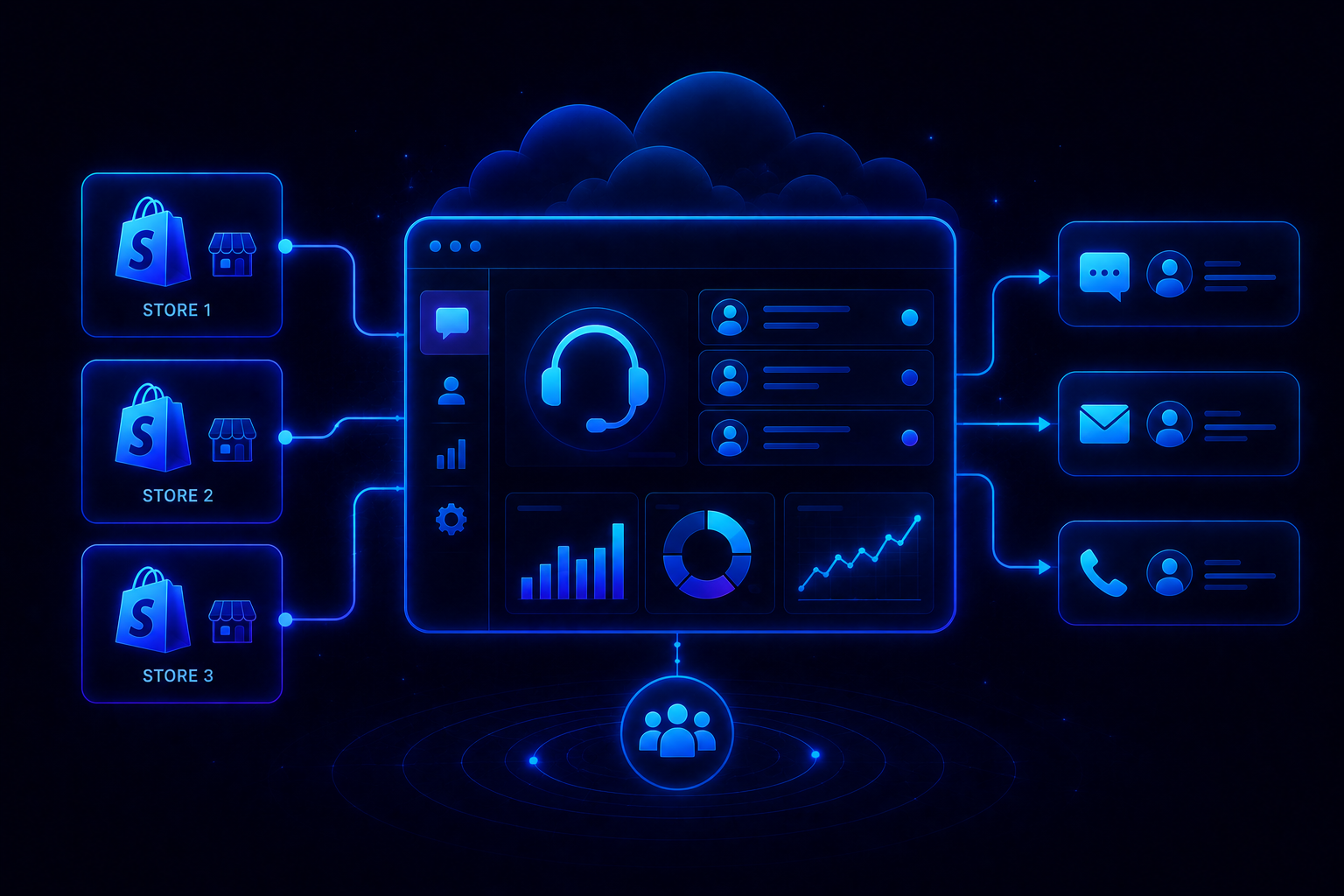
- Unified inbox brings WhatsApp, Instagram, email, and live chat into one workspace with full conversation context preserved across channels
- Resolution-based pricing keeps cost aligned with outcomes instead of charging upfront for AI seats agents may rarely use
- AI-curated inbox prioritizes incoming tickets by sentiment, urgency, intent, and channel so agents handle the highest-impact issues first
- Quantum AI Copilot drafts replies, summarizes long threads, and recommends next actions inside every agent conversation in real time
More on the AI-Native customer service benefits shaping the platform. See it on your own support volume: book a demo with the QuantumDesk team.
Pick the customer service software that fits your team size, channel mix, and ticket volume, not the loudest brand on the market.
Frequently Asked Questions About Customer Service Software
What are the best customer service tools?
The best customer service tools in 2026 include QuantumDesk, Zendesk, Freshdesk, Intercom, Help Scout, Zoho Desk, and HubSpot Service Hub.
Each fits a different team profile, from AI-native SMB support to enterprise omnichannel and CRM-led service workflows, so the right pick depends on channel mix and team size.
Which customer service tool is best for D2C brands?
QuantumDesk is the best customer service tool for D2C brands handling support across WhatsApp, Instagram, email, and live chat together.
Helix AI resolves repetitive order, refund, and product queries automatically while the AI-curated inbox prioritizes urgent complaints from peak sales spikes before they turn into negative public reviews. For a deeper category comparison, our best customer service software for ecommerce guide covers additional D2C-specific tools.
How do I choose the right customer service tool?
Start with the business: team size, channel mix, monthly ticket volume, and whether you need AI for autonomous resolution today.
Then evaluate pricing model, time to value, integration depth, and reporting visibility before testing two or three shortlisted tools on real volume in a small pilot.
Is there a free customer service tool available?
Yes. Zoho Desk, Freshdesk, HubSpot Service Hub, and QuantumDesk all offer free or starter tiers with usage limits today.
These free plans usually cap agents, channels, automations, or AI features, so they suit small teams testing the category before committing to a paid plan. For a full side-by-side, see our roundup of the best free customer service software.



.avif)