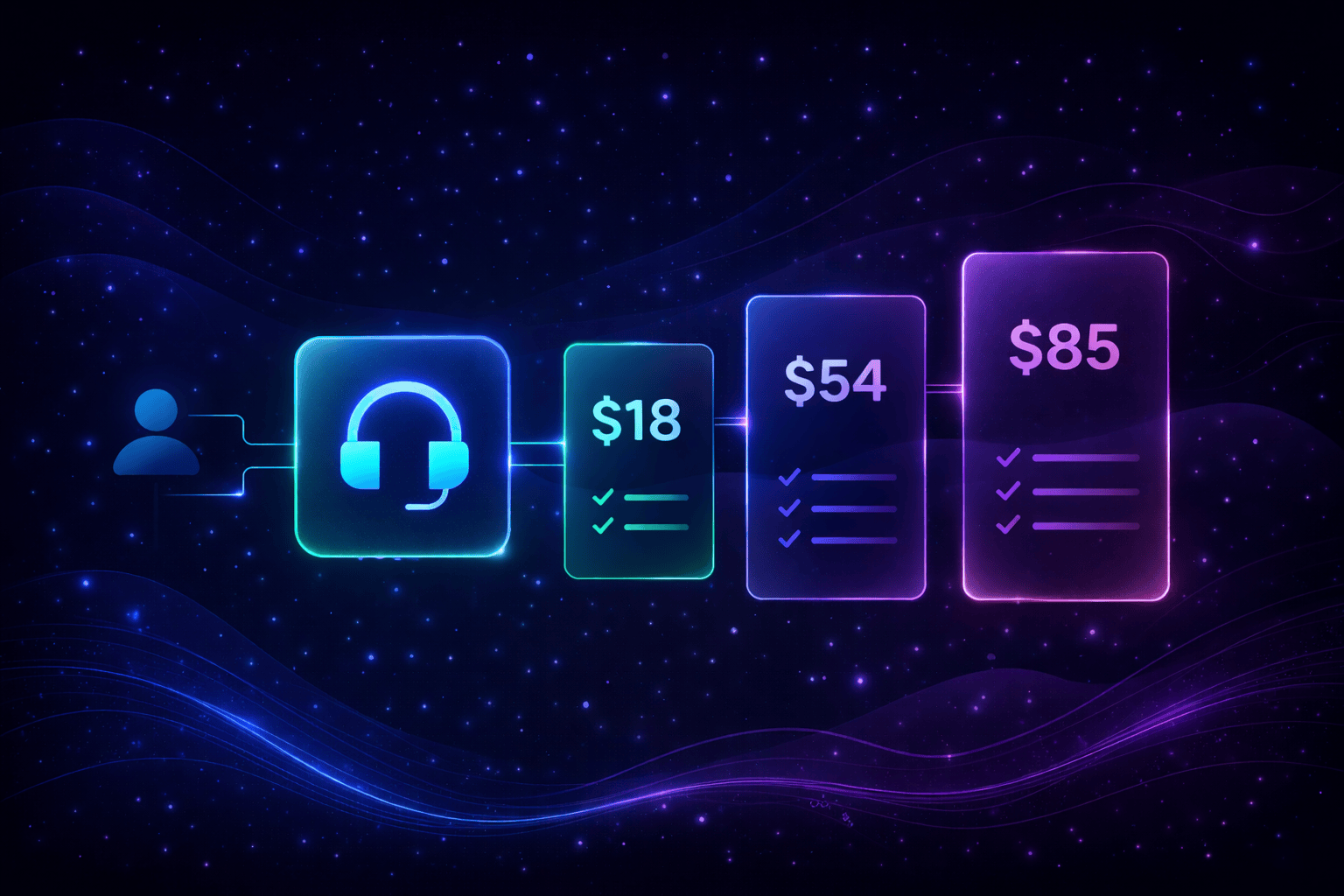
Summarize with AI
Key Takeaways
Freshdesk’s low entry pricing becomes complex and expensive at scale due to per-agent costs, add-ons, and AI usage fees.
- Per-agent pricing increases costs linearly with team growth
- AI features require separate licensing and session-based charges
- Omnichannel support needs multiple paid modules
- QuantumDesk offers unified pricing with AI built into the core platform
Freshdesk advertises pricing starting at $15 per agent per month. That number rarely reflects what most support teams actually pay.
Real pricing depends on usage, scale, and feature limits not obvious upfront.
This guide covers:
- How Freshdesk pricing actually works across plans, add-ons, and AI features
- Where costs increase unexpectedly as teams scale beyond the base plan
- When support teams start looking at Freshdesk alternatives like QuantumDesk
This analysis is written from QuantumDesk's perspective. It focuses on helping support teams make informed pricing decisions.
What Is Freshdesk and Who Is It Built For?
For teams evaluating the best help desk software options, Freshdesk is a cloud-based customer support platform that centralizes incoming communications into numbered tickets teams can track from creation through resolution.
The typical customer is a small to mid-market business. These teams usually have five to fifty agents prioritizing quick deployment and ease of use.
In practice, teams use Freshdesk as a central ticket management hub. It handles email inquiries, social media requests, and self-service portal interactions.
Organizations configure automation rules to route tickets. They apply SLA policies for response commitments and integrate knowledge bases for self-service.
How Does Freshdesk's Pricing Structure Actually Work?
The base ticketing platform includes email ticketing, a customer portal, basic automation, and standard reports. It does not include custom reporting dashboards, satisfaction surveys, or multiple SLAs.
AI-powered agent assistance requires upgrading or purchasing add-ons.
Pricing scales by per-agent licensing on the core platform. Separate per-agent fees apply for add-on modules. Session-based costs apply for AI features.
The main components driving the monthly bill:
- Per-agent plan costs range from $15 to $79 per agent monthly depending on tier. Omnichannel modules add $29 to $109 per agent.
- AI Copilot licensing costs $29 per agent per month across all plans. It is sold entirely separately from base pricing.
- AI Agent sessions cost $49 per 100 sessions after the initial 500 free sessions are exhausted.
- Tier-locked features force full-team upgrades to access capabilities like skill-based routing or custom reporting.
Most teams underestimate real monthly spend. Marketing emphasizes base plan costs without quantifying add-on modules, AI consumption, or tier upgrades.
Freshdesk Pricing Plans Explained (2026)
1. Who Is the Free Plan For?
- Solo founders and very small teams are testing whether Freshdesk fits their workflow
- Organizations with fewer than three support staff handling support as a secondary responsibility
Base Price
For teams researching the best free help desk software options, Freshdesk offers a genuinely free tier supporting up to two agents indefinitely. No credit card is required.
What's Included
- Email and social media ticketing convert messages into numbered support tickets
- Basic knowledge base enabling customer self-service
- Basic team collaboration features for internal communication
- Pre-built reports showing ticket volume trends and agent performance
- Email support from Freshdesk is available 24 hours a day, 5 days a week
- Access to approximately 1,000 marketplace integrations
Where Does This Plan Start Breaking Down?
- The two-agent limit is absolute. Adding a third support person requires upgrading immediately.
- No automation rules exist for routing tickets. No SLA management is available for tracking response commitments.
2. Who Is the Growth Plan ($15/agent/month) for?
- Startups and small businesses need reliable ticketing and basic automation
- Teams handling moderate ticket volumes not yet requiring advanced reporting
Base Price
The Growth plan costs $15 per agent per month, billed annually. Monthly billing is $18 per agent.
What's Included
- Automation rules trigger actions when tickets meet specified conditions
- One SLA policy with target response times and escalation alerts
- Collision detection prevents duplicate work on the same ticket
- Marketplace app access and custom email server configuration
- Custom ticket views and time tracking functionality
- Business hour configuration for SLA compliance management
Where Does This Plan Start Breaking Down?
- Only one SLA policy is permitted. Setting different response targets for VIP versus standard customers is impossible.
- Custom reports, CSAT surveys, and load-balanced ticket distribution are completely unavailable.
3. Who is the Pro Plan ($49/agent/month) for?
- Growing support teams with ten to thirty agents needing performance visibility
- Organizations requiring custom SLAs for different customer segments
Base Price
The Pro plan costs $49 per agent per month, billed annually. Monthly billing is $59 per agent.
What's Included
- Custom reports and dashboards visualizing ticket trends and agent performance
- Customer satisfaction surveys for measuring and tracking CSAT scores
- Multiple SLA policies with different targets per customer segment
- Round-robin and load-balanced ticket assignment across agents
- Custom roles with granular permissions and shared ticket ownership
- Multi-timezone support for distributed teams
Where Does This Plan Start Breaking Down?
- Skill-based routing, sandbox environments, and audit logs remain restricted to Enterprise. That forces a $30/agent upgrade.
- AI features like Freddy Copilot and AI Agents require separate purchases starting at $29/agent/month.
4. Who is the Enterprise Plan ($79/agent/month) for?
- Large support organizations with fifty or more agents requiring advanced security
- Regulated industries needing skill-based routing, sandbox testing, and audit trails
Base Price
The Enterprise plan costs $79 per agent per month, billed annually. Monthly billing is $95 per agent.
What's Included
- Skill-based ticket assignment routing based on agent expertise
- Sandbox environment for testing workflows before production deployment
- Audit logs documenting all administrative changes and agent activity
- IP whitelisting and HIPAA compliance capabilities
- Knowledge base approval workflows and automatic ticket triage
- Social signal detection and agent assist bots
Where Does This Plan Start Breaking Down?
- Despite being the highest tier, all AI capabilities require additional investment. That means $29/agent/month for Copilot plus session-based charges.
- Many enterprise customers need Freshdesk Omni for true omnichannel support. It is priced separately, starting at $29/agent/month on top of the $79 base.
Freshdesk Pricing at a Glance
What Actually Drives Your Monthly Cost on Freshdesk?
How Does Per-Agent Licensing Affect Costs?
Every support team member who logs into Freshdesk counts as a billable agent. This is true regardless of how many tickets they handle.
This creates predictability at fixed team sizes. But costs increase in direct proportion to hiring.
A ten-agent team on Pro at $490/month jumps to $735/month by adding five agents. That is a 50% cost increase with no change in feature utilization.
How Do Omnichannel Modules and Multi-Product Stacking Add Up?
Most teams discover that email ticketing alone no longer meets customer expectations. They layer on Freshdesk Omni, Freshchat, and Freshcaller as separate paid modules.
A team on Pro utilizing all three products pays $49 plus $59 plus $19 plus $15 per agent. That totals $142/agent/month.
For ten agents, this transforms a $490/month base cost into $1,420/month. This is before any AI features.
How Do AI Agent Sessions and Freddy Add-Ons Impact Spend?
Freshdesk includes 500 free AI Agent sessions. Additional sessions cost $49 per 100 after that.
Organizations handling moderate volume deplete free sessions within the first month.
The Freddy AI Copilot add-on costs $29/agent/month separately. That adds $290/month for a ten-agent team. It transforms the Pro plan cost from $490 to $780 before session purchases.
How Do Plan Limitations Create Hidden Cost Constraints?
Essential features restricted to higher tiers force unplanned upgrades. These upgrades often dwarf base costs.
Custom reporting requires a jump from Growth ($15/agent) to Pro ($49/agent). Skill-based routing requires Enterprise ($79/agent).
These constraint-driven upgrades are often unexpected. The base plan appears capable until organizations implement actual workflows.
Key takeaway: The advertised price is rarely the final price. Add-on modules, AI costs, and tier upgrades drive most billing surprises.
What Does Freshdesk Actually Cost in Real-World Scenarios?
Example 1: Small Support Team, Low Volume
A three-person SaaS startup handles fifty tickets monthly through email. They initially select the Growth plan.
- Initial cost: 3 agents × $15/agent = $45/month on the Growth plan
- After Pro upgrade for CSAT and custom reports: 3 agents × $49/agent = $147/month
- After adding Freshchat for live chat: additional $19/agent brings total to $204/month
- After enabling Freddy AI Copilot: additional $29/agent pushes total to $261/month
What appeared as a $45/month platform became $261/month. That is a 481% increase driven by feature adoption.
Example 2: Growing Support Team, Moderate Volume
A mid-market e-commerce company runs ten agents handling 800 tickets monthly, the kind of operation that often also evaluates Gorgias pricing before committing. They use email, chat, and phone.
Cost Component
Per Agent
Monthly Total
Pro ticketing
$49
$490
Freshchat
$19
$190
Freshcaller
$15
$150
AI Copilot
$29
$290
AI sessions (~500/mo)
—
$49
Total
—
$1,169
The initial $490/month estimate failed to account for $679/month in omnichannel modules and AI customer service tools add-ons. That is a 139% increase.
Example 3: High-Volume, Rapidly Scaling Team
A thirty-agent fintech company handles 5,000+ tickets monthly. They use email, chat, phone, and social media.
They deploy Enterprise ticketing plus Omni, Freshchat Pro, and Freshcaller Pro at $266/agent/month.
- Base monthly platform cost: 30 agents × $266 = $7,980
- AI sessions (~5,000/mo) + Copilot: $250 + $870 = $1,120
- Total monthly spend: $9,100 ($109,200 annually)
- Peak period with 10 temporary agents: monthly cost spikes to $12,950
Scaling from twenty to forty agents over eighteen months doubled platform costs. Cost per resolution did not decrease. This illustrates the per-agent model's fundamental limitation.
Where Does Freshdesk Pricing Fall Short as You Scale?
Organizations typically experience pricing sticker shock eighteen to twenty-four months after deployment. The gap between entry-level affordability and scaling reality widens as teams grow.
- Per-agent costs scale linearly with hiring. Adding agents increases spend but does not improve the technology's capacity.
- Modular architecture fragments the agent experience. Separate ticketing, chat, and phone interfaces increase training burden.
- Session-based AI pricing introduces unpredictable monthly costs. Consumption depends on actual inquiry patterns and peak periods.
Organizations scaling from ten to thirty agents often find Freshdesk's modular costs no longer deliver ROI, prompting them to explore Freshdesk alternatives.
Key takeaway: Freshdesk's entry pricing is competitive, but scaling costs grow faster than most teams anticipate.
How Does QuantumDesk Approach Pricing Differently?
QuantumDesk is an AI customer service software platform. It is designed to scale support capacity without scaling headcount or stacking multiple subscriptions.
- AI resolution of first-contact queries reduces per-ticket cost at scale. It automatically handles repetitive inquiries that typically constitute 40–60% of incoming volume.
- A unified omnichannel inbox consolidates email, chat, WhatsApp, SMS, social media, and voice into a single interface. This eliminates the need for separate module subscriptions.
- Support capacity scales through AI efficiency improvements rather than proportional seat or usage cost increases. Per-ticket costs decrease as volume grows.
Teams typically begin evaluating QuantumDesk, or comparing options like Zendesk pricing, when monthly Freshdesk spend exceeds $2,000–$3,000. Team size reaching fifteen to twenty agents is another common trigger.
Freshdesk vs QuantumDesk: Which Is the Better Fit?
Here is how the two platforms compare across criteria that matter most for scaling support teams.
When Does Freshdesk Make Sense, and When Is QuantumDesk a Better Choice?
Freshdesk Makes Sense If…
- Your team has three to ten agents handling primarily email inquiries. Per-agent licensing provides simplicity without substantial add-on costs.
- You have not yet adopted live chat, social media, or phone channels. You do not require omnichannel capabilities at this stage.
- You prefer a low entry point with incremental feature adoption. Teams that have explored best free customer service software options often find Freshdesk's free tier or $15/agent Growth plan a natural next step.
QuantumDesk Is a Better Fit If…
- You need cost predictability and want to reduce total support costs through AI chatbots for customer service automation.
- You handle 800+ tickets monthly and need a unified omnichannel inbox. This eliminates the $29–$99/agent costs of separate Freshdesk modules.
- You prioritize first-contact resolution rates and need AI Copilot capabilities built into the platform — book a demo to see it in action.
Frequently Asked Questions About Freshdesk Pricing
Does Freshdesk Have Hidden Costs?
Freshdesk's $15/agent starting price is genuine for the Growth plan on annual billing. However, most teams do not anticipate the full cost.
Essential features like custom reporting require Pro ($49/agent). Skill-based routing requires Enterprise ($79/agent). All AI capabilities require separate add-on purchases.
Achieving omnichannel support requires additional modules. These can push actual spend to 2–3× the advertised base price.
Why Is My Freshdesk Bill Higher Than Expected?
Bills typically increase when teams upgrade plans to access restricted features. Enabling AI add-ons is another common driver.
A Growth-to-Pro upgrade for custom reports creates a $34/agent monthly increase. Enabling Freddy AI Copilot for ten agents adds $290/month.
Stacking omnichannel modules like Freshdesk Omni and Freshchat adds further per-agent costs. These compounds quickly spread across larger teams.
Can I Predict My Monthly Cost on Freshdesk?
Base platform cost is predictable if the team size stays constant and no new modules are adopted.
In practice, real-world prediction is difficult. AI session consumption varies with inquiry volume and peak periods.
Module adoption, tier upgrades, and team size changes throughout the year make annual cost forecasting unreliable for most growing organizations.
When Should I Switch from Freshdesk to QuantumDesk?
Evaluate switching when the monthly Freshdesk spend exceeds $2,000–$3,000. Team size reaching fifteen to twenty agents is another signal.
At that scale, the per-agent model's efficiency deteriorates compared to AI-native alternatives. The switch makes particular sense when the combined costs of Freshdesk, Omni, Freshchat plus Freshcaller create complexity.
A unified platform like QuantumDesk eliminates that complexity. Check Freshdesk reviews for additional context.
Is QuantumDesk More Expensive Than Freshdesk?
For a small three-agent team handling 50 tickets monthly, Freshdesk's free or Growth plan will appear cheaper upfront.
However, once teams reach fifteen or more agents and require omnichannel support plus AI capabilities, QuantumDesk's unified pricing typically delivers lower total cost of ownership.
The platform eliminates hidden costs from module stacking, AI add-on licensing, and session-based charges. This makes the true cost more transparent and predictable for small business customer service teams scaling operations.



.avif)