
Summarize with AI
Key Takeaways
- CSAT measures customer satisfaction after a specific interaction, purchase, or support experience.
- Businesses calculate CSAT using the percentage of customers who provide positive satisfaction ratings.
- Most industries consider a CSAT score between 75% and 85% a strong benchmark.
- CSAT works best alongside NPS and CES to provide a complete customer experience view.
- Faster support, lower customer effort, and AI-powered service can significantly improve CSAT scores.
Most brands pour budget into acquisition and barely measure what happens after. Yet how a customer feels after a single support interaction determines whether they buy again, complain publicly, or quietly move to a competitor. That is where customer satisfaction metrics like CSAT become useful.
For D2C brands and SaaS companies, one bad support interaction does not just affect the ticket. It affects the next purchase, the review score, and the referral that never happens.
I ordered a limited-edition hoodie during a flash sale → received the wrong size → contacted support on WhatsApp → waited two days for a response → eventually received help but felt disappointed. When the brand sends a satisfaction survey afterward, my response directly affects its CSAT score.
Here is what CSAT captures at each stage:
- Measures customer satisfaction immediately after a support interaction, purchase, or service experience, before the feeling fades.
- Helps support teams catch recurring service failures before they show up in churn reports.
- Gives teams fast, specific feedback they can act on within days rather than waiting for quarterly reviews.
- Tracks how customer sentiment shifts across different stages of the purchase and support experience.
You will learn how to calculate CSAT, read benchmark scores, compare it with other customer service metrics, and use it to drive real improvement.
A Quick Example of CSAT Score Ratings
Only customers who select Satisfied or Very Satisfied will be count as positive responses. Those are the only ratings used to calculate the final CSAT score.
What Is a Customer Satisfaction (CSAT) Score?
CSAT, or Customer Satisfaction Score, measures how a customer felt about a specific interaction, not the brand overall. A customer can love a brand and still be frustrated by a slow support response. CSAT catches that gap.
It is one of the most widely used customer service metrics because the question is simple: "How satisfied were you with your experience today?" answered on a scale of 1 to 5 or 1 to 10.
Surveys go out immediately after key interactions, through email, in-app prompts, or chat follow-ups. Businesses then count only the 4s and 5s, divide by total responses, and get a percentage. That percentage is the CSAT score.
Why Is CSAT Important for Businesses?
A drop in CSAT is often the first sign that something in the support operation has broken. Before the refund requests spike, before the one-star reviews, the scores shift.
Teams that read those shifts early have time to fix the problem. Teams that ignore them find out later, through churn.
- Flags service quality problems within hours of a poor interaction, not weeks later in a monthly report.
- Shows which specific interactions, ticket types, or channels are pulling the score down so teams fix the right thing.
- Reveals whether experience improvements are actually changing how customers feel, not just whether tickets are closing.
- Gives support managers real data for agent coaching, not vague impressions from ticket audits.
- Connects support quality directly to business outcomes: a 10-point CSAT gain in post-purchase support typically corresponds to a measurable lift in repeat purchase rates.
How Do You Calculate a CSAT Score?
The calculation takes minutes once survey responses are in.
There is no statistical modeling involved. Businesses collect responses after key interactions, count the satisfied customers, and apply one formula. That is why CSAT works as a core KPI even for small teams with no data infrastructure, and for larger teams running customer service automation programs at scale.
Step 1: Send a Customer Satisfaction Survey
The survey should go out within minutes of the interaction ending, not hours later.
A customer who just had their return processed remembers exactly how that felt. The same customer asked to rate the experience 48 hours later is reconstructing a memory that has already been influenced by whatever else happened that day.
Step 2: Identify Positive Responses
Not every rating goes into the CSAT calculation. Only customers who selected 4 or 5 on a five-point scale, or 9 to 10 on a ten-point scale, count as positive.
Neutral and negative responses stay out of the numerator. They do not drag the score down mathematically, but they absolutely matter for diagnosis.
Step 3: Apply the CSAT Formula
Divide the number of satisfied customers by the total number of respondents. Multiply by 100.
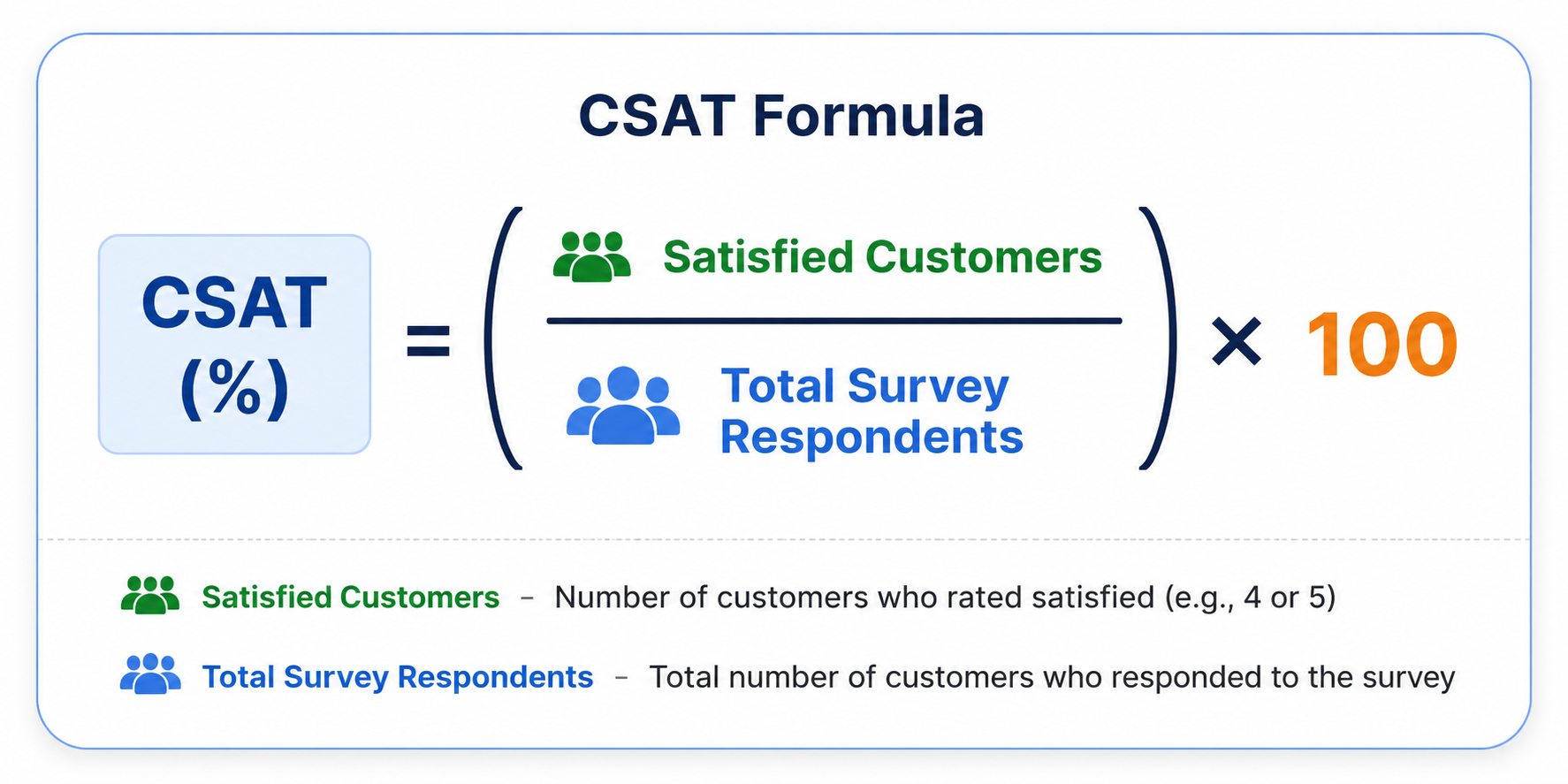
Example Calculation
A D2C lifestyle brand surveys 200 customers after a high-volume support week. Of those, 170 chose Satisfied or Very Satisfied. That gives an 85% CSAT score.
The 15% who did not respond positively are the more interesting group. Investigating what those interactions had in common, which channel, which query type, which agent, is where improvement actually starts.
A Quick Overview: CSAT Score Calculation Example
When Should Businesses Measure CSAT?
Surveying after every interaction creates fatigue and garbage data. Survey at the moments that actually reveal service quality.
- After resolving customer support tickets, to measure whether the resolution met the customer's expectations.
- Following product purchases or deliveries, to catch fulfillment failures before they become reviews.
- After onboarding or implementation milestones, to check whether new customers are set up to succeed or quietly struggling.
- Following a major product update, to find out whether the change helped or frustrated the people using it daily.
- Before subscription or contract renewals, to identify which accounts are at risk before they decide not to renew.
What Is a Good CSAT Score?
There is no single number that defines "good." Industry, query type, and channel all affect what a realistic score looks like.
An e-commerce brand processing 5,000 monthly shipping queries will have a different baseline than a B2B SaaS company managing complex technical onboarding. Benchmark ranges give useful context, but they are not the goal.
CSAT Score Benchmark Table
Benchmarks tell you where others stand. Your own trend line tells you whether your support operation is improving or degrading.
A brand that moves from 64% to 73% over two quarters has learned something real about what was wrong and fixed it. That progress is more useful than sitting at 80% for three years with no change.
When scores stay below 70%, the problem is structural. Support leaders should pull the lowest-scoring interactions and look for patterns: what type of query, which channel, how long the resolution took, how many messages the customer had to send. That audit usually reveals two or three specific breakdowns driving the bulk of the damage.
How Can You Improve Your CSAT Score?
Collecting the score is the easy part. The teams that improve over time are the ones that treat every low score as a specific question: what exactly happened in this interaction, and why?
That discipline, applied consistently, is what separates support operations with upward-trending scores from those that plateau. For teams managing high-volume periods, this guide on improving CSAT during peak support covers the operational detail.
1. Collect Customer Comments Alongside Ratings
A 2 out of 5 tells you the customer was unhappy. It does not tell you whether they were unhappy because the response was slow, the agent was dismissive, the resolution required three follow-ups, or the return process was confusing.
An open-ended comment field does. Teams that read and tag those comments regularly find the same problems appearing across dozens of interactions, problems that a score alone would never surface.
2. Act on Negative Feedback Quickly
A customer who rates an interaction poorly is not necessarily gone. What happens next determines that.
A follow-up within 24 hours, genuine and specific to their complaint, changes the outcome more often than most support teams expect. The customer already knows the first interaction failed. They are watching to see whether the brand cares enough to respond.
3. Train Agents Using Real Customer Feedback
Scripted training tells agents what to do in theory. Low-scoring transcripts show them what went wrong in practice.
Bringing real interactions into coaching sessions, specifically the ones where a conversation lost the customer, gives agents the kind of feedback that sticks. They can see the moment the tone shifted, the point where they missed the customer's actual concern, and the response that made things worse instead of better.
4. Reduce Customer Effort
Customers who have to explain their problem twice, switch channels to get a response, or wait through an unnecessary escalation do not just feel frustrated. They leave.
Reducing the number of steps between "customer has a problem" and "problem is resolved" consistently moves CSAT scores upward, even when the resolution itself stays the same. Less effort felt means higher satisfaction reported.
5. Improve Response and Resolution Times
Waiting is one of the few things that reliably makes a support experience worse regardless of how it ends.
A customer who gets a response in four minutes and a resolution in eight minutes will rate that interaction differently from someone who waited three hours and then received the same answer. Speed is not a superficial factor. It changes how the entire exchange feels in retrospect.
6. Use AI and Automation to Improve Customer Satisfaction
An apparel brand running a flash sale might receive 1,200 support queries in 48 hours. More than 700 of those are likely "where is my order?"
Handled manually, those queries back up the queue, delay responses on everything else, and wear agents down on repetitive work. With AI in customer service resolving order-tracking queries instantly, agents get their time back for the interactions that cannot be automated.
The customer whose gift order arrived damaged the morning of a birthday needs a person, not a template. That interaction determines whether the customer comes back or leaves a review warning others away. Response times drop across the board. Agents handle fewer low-value queries. CSAT scores from that same sale period tell a different story.
7. Track Trends and Continuously Improve
One score is a snapshot. Twelve weeks of scores is a pattern.
Support leaders should track CSAT by channel, interaction type, agent, and time of day. When a specific channel or query type starts declining while others hold steady, that is the lead to follow. The earlier that signal gets caught, the less damage it does before it gets addressed.
What Are the Pros and Cons of CSAT?
CSAT is fast to deploy and easy to explain. Those qualities make it popular. They also make it easy to misuse.
Knowing where it works and where it does not keeps it from becoming a number that gets reported without changing anything.
Pros of CSAT Scores
- Fast to collect and calculate, with no data team required and no statistical background needed.
- Gets higher participation rates than longer feedback instruments because it takes under 30 seconds.
- Surfaces service problems quickly, often within hours of a poor interaction rather than weeks later.
- Tied to specific interactions, making it easier to diagnose what caused the score rather than guessing from general sentiment.
- Simple to set targets around and communicate upward to business stakeholders.
Cons of CSAT Scores
- Does not explain the reason behind a low score, leaving teams to guess without the open-ended comments to back it up.
- Can be swayed by emotions outside the support interaction, such as a customer rating the brand poorly because the product itself disappointed them.
- Participation skews toward customers with strong reactions, which can overweight the very satisfied and very dissatisfied.
- Only captures how someone felt immediately after one interaction, with no view into how they feel about the relationship overall.
- Tells you nothing about customer loyalty or how much effort the customer had to put in, which limits what the score can actually predict.
What Is the Difference Between CSAT, NPS, and CES?
Each of the three major customer experience metrics answers a different question. None of them answers all three.
Using only one means missing what the other two reveal. That is why support teams serious about understanding their customers use all three, and why the combination matters when building a customer service metrics framework.
CSAT vs NPS vs CES: At a Glance
1. CSAT measures immediate satisfaction
CSAT captures one thing: how the customer felt right after a specific interaction ended.
That precision is its strength. It tells you whether this ticket, this agent, this resolution landed well. It does not tell you whether that customer will renew next quarter.
2. NPS measures long-term loyalty
Net Promoter Score asks: how likely are you to recommend us to someone you know?
That answer comes from the full history between the customer and the brand, not any single interaction. It reflects whether they trust the product, the support, and the company enough to put their name behind it. NPS is typically measured every quarter, not after every ticket.
3. CES measures customer effort
Customer Effort Score asks how easy it was to resolve an issue or get something done.
Effort is a stronger predictor of churn than satisfaction in many support contexts. A customer who rated a support interaction as satisfactory but had to message four times across two channels to get there still experienced high effort. That effort score will predict their behavior more accurately than their CSAT rating did.
Tracking all three gives a clearer view of what customers feel in the moment, whether they plan to stay, and how much friction they are absorbing to get what they need.
What are the Mistakes to Avoid with CSAT Score?
Measuring CSAT and acting on it are two different things. Most support teams do the first and underinvest in the second.
The most common mistakes are not complex. They are habits that make the data less useful over time.
1. Looking only at the score
A percentage shows you how many customers were satisfied. It does not tell you which channel produced the lowest scores, which interaction type is consistently failing, or which segment of customers is quietly at risk.
The score is where the investigation starts. Stopping there means missing everything the data was trying to surface.
2. Ignoring customer comments
Most CSAT surveys include an open-ended comment field. Most teams barely read them.
Those comments are where the patterns live. The same complaint phrased twenty different ways across twenty different interactions points directly at something specific that needs to change. Skipping the comments means fixing symptoms instead of causes.
3. Surveying too late
A survey that reaches a customer two days after their support interaction is not capturing how they felt about that interaction. It is capturing how they feel today, shaped by everything that happened since.
Send surveys within minutes of a resolved interaction, while the experience is still fresh and specific.
4. Surveying too frequently
Customers who get a satisfaction survey after every interaction with a brand start ignoring them or answering carelessly.
Survey at the interactions that matter most for understanding service quality. Leave the lower-stakes touchpoints unsurveyed. The data quality that comes from selective, well-timed surveys beats high-volume response rates every time.
5. Using CSAT without NPS or CES
A CSAT score of 85% looks strong. But if the same customers are giving low NPS scores or reporting high effort, that 85% is obscuring a bigger problem.
Brands managing multi-channel customer service run into this often. CSAT scores look acceptable channel by channel while the cross-channel experience is causing the real frustration. Layering in NPS and CES catches what CSAT misses.
How QuantumDesk Helps Teams Improve CSAT Scores
When a customer's conversation starts on Instagram, continues on email, and escalates to WhatsApp, the agent handling the third message has none of the history from the first two. They ask the customer to repeat themselves. The customer, already frustrated, now has to explain everything again before anything gets resolved.
That is not a failure of effort. It is a failure of infrastructure, and it shows up in CSAT scores.
I bought a moisturizer recommended by the brand's skincare quiz → my skin reacted badly → I messaged their Instagram DM → got a generic FAQ link → I followed up on email → was asked to repeat my order details and describe the reaction again → waited 48 hours for a response → the issue was eventually resolved, but the experience left me feeling like the brand had no record of who I was or what I had already told them.
One interaction. Multiple channels. Repeated context. The CSAT survey sent afterward was rating the whole experience, not just the resolution. This is the specific gap that AI-native customer service addresses.
How QuantumDesk helps improve CSAT
- Quantum AI resolves repetitive queries like order status, ingredient questions, and return eligibility without touching an agent's queue, cutting wait times on the interactions customers care most about.
- AI-Curated Inbox reads incoming conversations for urgency, intent, and sentiment, then surfaces the ones that need immediate attention before they escalate into reviews or disputes.
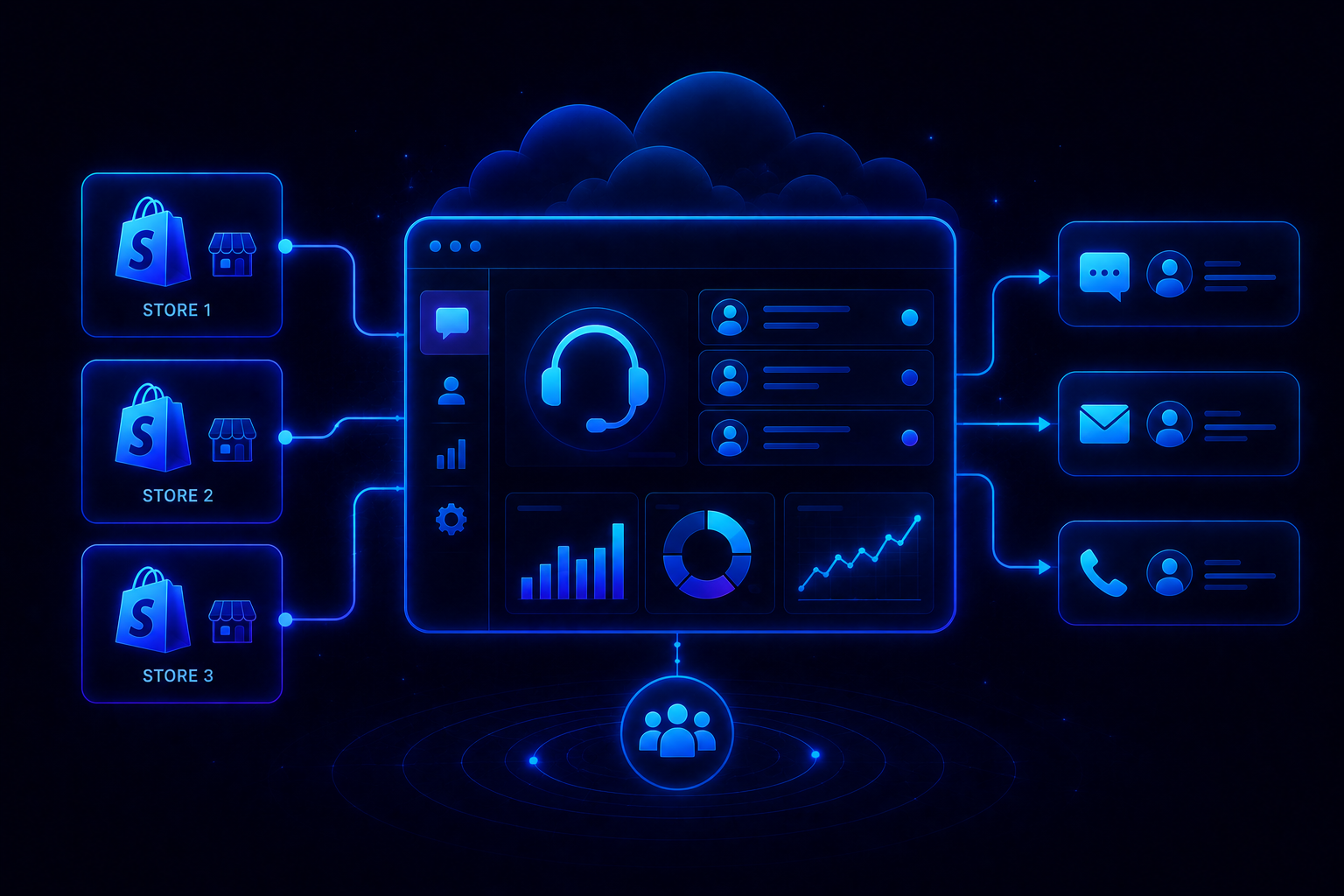
- Unified Inbox pulls every conversation from email, chat, WhatsApp, and social channels into one workspace, so agents see the full history without asking the customer to repeat a word of it.
- Quantum AI Copilot reads the conversation thread and suggests the next response, giving agents a starting point that accounts for everything the customer has already said rather than drafting from scratch.
- Faster resolution times and fewer repeated messages reduce the customer effort score on each interaction, which directly moves CSAT upward across the board.
- Analytics give support managers a breakdown of which interaction types, agents, and channels are driving the lowest scores, so coaching and process changes target the right problems.
QuantumDesk does not improve CSAT by tweaking survey design or changing how questions are worded. It improves CSAT by making fewer interactions go badly in the first place. Support teams handle more conversations with the same headcount. Agents spend their time on the problems that actually need a human.
For D2C brands specifically, where poor post-purchase support directly reduces repeat orders, the compounding effect on retention is where the real business impact sits.
Frequently Asked Questions
What does CSAT stand for?
CSAT stands for Customer Satisfaction Score. It measures how satisfied a customer felt after a specific support interaction, purchase, or service experience. Businesses collect responses through short post-interaction surveys using a 1-to-5 or 1-to-10 rating scale. The final score is a percentage representing the share of respondents who gave a positive rating.
How is a CSAT score calculated?
Divide the number of satisfied customers (those who rated 4 or 5 on a five-point scale) by the total number of survey respondents, then multiply by 100. If 80 out of 100 respondents gave a positive rating, the CSAT score is 80%. Neutral, dissatisfied, and very dissatisfied responses are excluded from the calculation but should be reviewed separately for service improvement.
What is considered a good CSAT score?
Most industries treat 75% to 89% as a solid range, and anything above 90% as strong performance. Scores below 70% typically point to a recurring service issue rather than isolated incidents. That said, the more useful number is not the score itself but whether it is moving in the right direction over time.
Should businesses use CSAT alone?
No. CSAT tells you how a customer felt about one interaction. It does not tell you whether they plan to renew, how much effort they had to put in, or how they feel about the brand overall. Pairing CSAT with NPS and Customer Effort Score gives a far more complete view. NPS tracks loyalty over time; CES catches process friction that CSAT alone will miss.
Can AI improve customer satisfaction scores?
Directly, yes. AI customer service tools cut response times, handle repetitive queries without delay, and give agents the conversation context they need to resolve issues on the first response rather than the third. A support team where agentic AI handles 60% of incoming L1 queries can redirect agent time toward the interactions that most affect satisfaction and long-term retention.





.avif)