
Summarize with AI
Key Takeaways
- Retrieval-Augmented Generation grounds AI answers exclusively in a verified knowledge base instead of relying on general pre-trained memory.
- Strict boundary prompting instructs AI to admit uncertainty and offer human escalation instead of guessing at answers.
- Confidence thresholds automatically trigger escalation to human agents whenever the AI's certainty falls below a set score.
- Requiring AI to cite the exact source document it used makes answers easier to audit and more transparent to customers.
- Batch testing AI against past conversations and edge cases before launch reveals how it behaves when information is missing.
AI hallucinations in customer support happen when AI confidently provides incorrect information that can mislead customers and damage trust.
For D2C brands, Shopify businesses, SMBs, and B2B SaaS companies, even one incorrect AI response can create serious customer service issues. Research shows AI hallucinations can occur in up to 20% of generative AI responses without proper controls.
I asked about my refund status → AI confirmed a refund was processed → no refund arrived → human support later said it was incorrect → I lost trust in the brand.
Common AI hallucination problems support teams experience:
- AI creates incorrect refund or return policy answers
- Chatbots provide outdated product or pricing information
- Customers receive wrong delivery timelines
- AI answers questions without verified company data
You will learn how to improve AI customer support accuracy by reducing hallucinations through better data, workflows, monitoring, and human escalation systems.
Quick Comparison: Uncontrolled AI vs Reliable Customer Support AI
Why Do AI Hallucinations Happen in Customer Support?
AI hallucinations usually happen because the AI system lacks the right information, instructions, or boundaries. The problem is often caused by how AI workflows are designed rather than AI technology alone.
1. AI does not have access to verified company information
AI systems generate incorrect responses when they cannot access accurate customer support data.
For example, a Shopify customer asks about a return policy. If an AI customer service agent cannot find the latest policy document, it may create an answer based on incomplete information.
This creates problems such as:
- Incorrect refund eligibility information
- Wrong warranty or replacement details
- Outdated product recommendations
- Fake discount or promotional offers
Support AI should always connect with verified sources like FAQs, order systems, policy documents, and customer information before answering.
2. AI tries to answer instead of escalating
Many AI support failures happen because the system has no clear instruction on what to do when information is unavailable.
Instead of saying it cannot help, AI tries to create the most likely response.
I asked if my damaged product qualified for replacement → AI approved it instantly → support later rejected the request → I became frustrated with inconsistent answers.
Deciding exactly what AI vs human customer support should each handle is what closes this gap.
AI needs clear escalation paths for:
- Complex customer complaints
- Missing order information
- High-value customer issues
- Policy exceptions
3. Poor knowledge base quality creates inaccurate answers
AI is only as reliable as the information connected to it.
If support documents are outdated, incomplete, or inconsistent, AI in customer service will reflect those problems in every response it generates.
Common knowledge base issues:
- Old return policies still available
- Missing product details
- Conflicting internal documents
- Unstructured FAQ information
Maintaining accurate knowledge sources is one of the most important steps for reducing AI hallucinations.
5 Proven Strategies to Prevent AI Hallucinations in Customer Support
Preventing AI hallucinations requires creating systems where AI answers from trusted information, follows clear rules, and knows when human support is required.
1. Connect AI with verified knowledge using RAG
Retrieval-Augmented Generation (RAG) helps AI retrieve answers from approved business information instead of depending only on general training data. This kind of conversational AI in customer service only works reliably when it is grounded in real data.
AI responses can be connected to:
- Help center articles
- Product documentation
- Return and refund policies
- Customer account information
- Order management systems
For a D2C brand managing thousands of support conversations, this prevents AI from creating incorrect answers about shipping timelines, exchanges, or product availability. For Shopify brands specifically, connecting AI directly to Shopify order and refund data is what prevents the exact kind of hallucinated refund confirmation described earlier, since the AI checks real order status instead of guessing.
2. Create clear AI response boundaries
AI should have strict instructions explaining what it can answer and when it should stop.
Example instruction:
"If the answer is unavailable in approved documents, do not guess. Transfer the conversation to a support agent."
Strong AI boundaries prevent:
- Fake policy explanations
- Incorrect account information
- Unsupported promises
- Wrong troubleshooting steps
The goal is not making AI answer everything. The goal is making AI answer accurately.
3. Build human escalation workflows
AI-native customer service works best when AI and agents handle the right conversations. This is where agentic AI for customer service needs the clearest limits, since acting on incomplete information is worse than not acting at all.
AI should resolve repetitive queries while agents manage complex issues requiring judgment.
Human escalation should happen when:
- Customer frustration increases
- The AI confidence score is low
- Customer requests human support
- Sensitive issues need approval
This prevents automation mistakes while keeping customer conversations moving.
4. Continuously test AI responses
AI accuracy should be reviewed before and after deployment.
Support teams should test AI using:
- Previous customer conversations
- Unusual customer questions
- Complex refund scenarios
- Product-specific questions
Testing shows whether AI provides verified answers or creates unsupported responses.
5. Monitor AI conversations regularly
AI performance changes as products, policies, and customer expectations evolve.
Teams should review:
- AI resolution accuracy
- Escalation patterns
- Incorrect responses
- Customer satisfaction metrics and trends
Continuous monitoring helps businesses identify issues before they impact large groups of customers.
Why AI Accuracy is Important for Customer Service
AI hallucinations create more than incorrect answers. They affect customer trust, support efficiency, and long-term relationships.
1. Incorrect AI answers reduce customer trust
Customers expect support answers to be reliable.
One incorrect response about refunds, billing, or delivery can make customers question every future interaction with the brand.
2. AI mistakes increase agent workload
When AI provides wrong answers, agents spend additional time correcting mistakes instead of solving new customer problems. This is one of the clearest ways excessive customer conversations reduce support quality across an entire team.
This creates:
- Longer resolution times
- More escalations
- Repeated customer conversations
- Lower support productivity
3. Reliable AI improves support scalability
Accurate AI helps businesses automate repetitive conversations without sacrificing quality, which is central to any plan to scale customer support with AI.
For growing D2C, Shopify, and SaaS brands, trustworthy AI creates faster support while keeping agents focused on complex customer needs.
How QuantumDesk Prevents AI Hallucinations in Customer Support
QuantumDesk is an AI-native customer service platform built to help support teams automate conversations while maintaining accuracy, context, and control.
Unlike basic AI chatbots that operate separately from support workflows, QuantumDesk connects AI with customer conversations, support context, and agent workflows to create more reliable responses while improving the way teams manage customer interactions. The ai native customer service benefits come from this grounding, not from the AI operating on its own assumptions.
Quantum AI helps businesses resolve repetitive queries automatically while ensuring complex situations move to human agents with full conversation history.
What Are QuantumDesk's Key Capabilities?
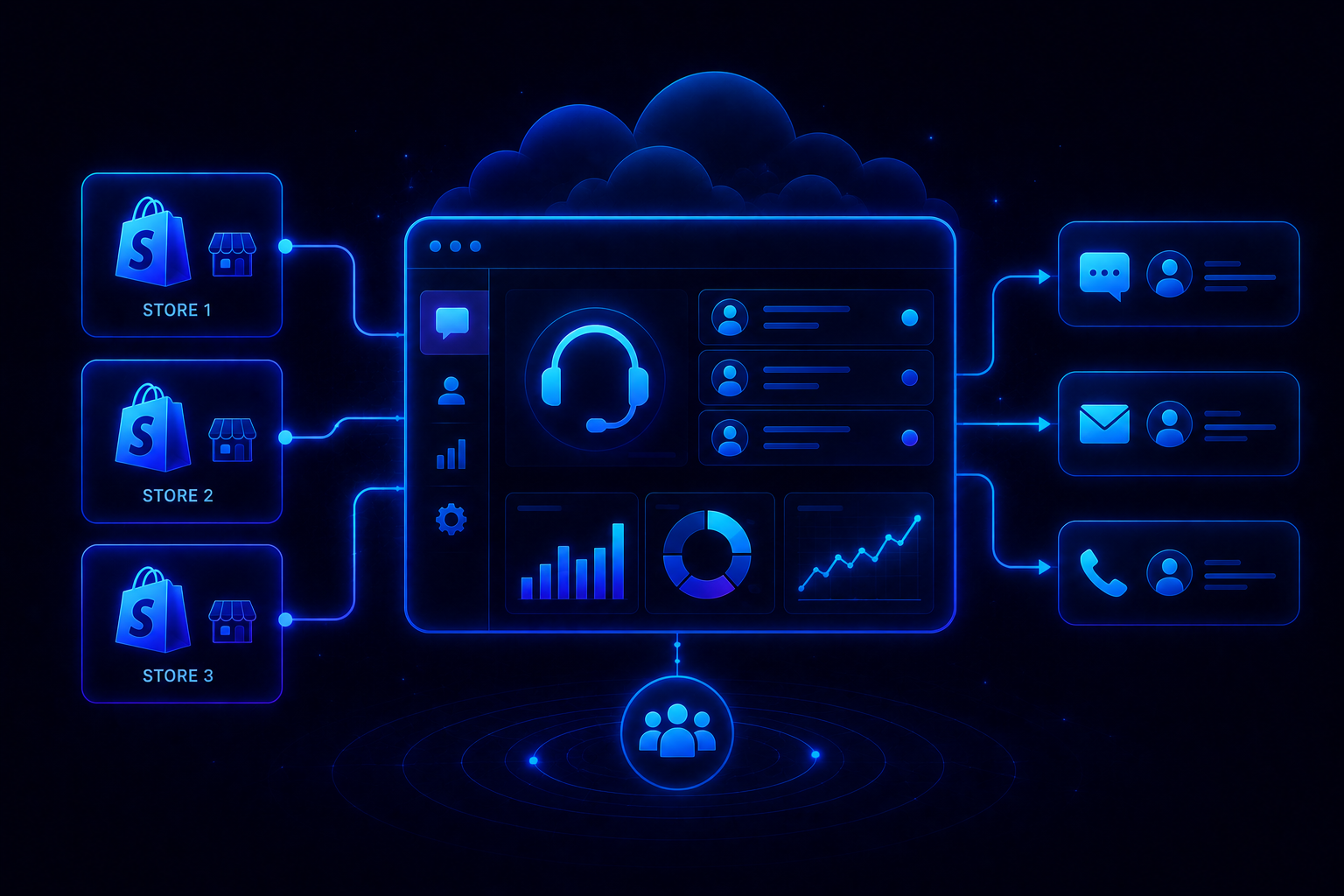
- Quantum AI resolves repetitive customer queries using available support context instead of creating unsupported responses.
- Unified workspace centralizes email, WhatsApp, chat, and social conversations so AI and agents work with the complete customer history.
- AI-curated inbox prioritizes conversations based on urgency, sentiment, and intent before customer issues escalate.
- Quantum AI Copilot assists agents with summaries, suggested replies, and next-best actions for faster, accurate resolutions.
- Admin analytics helps support leaders track AI performance, escalation trends, and customer support quality.
Ready to see how it works? Book a demo to explore QuantumDesk for your team.
Frequently Asked Questions
1. What is AI hallucination in customer support?
AI hallucination in customer support happens when an AI system generates incorrect or unsupported information while presenting it confidently. Examples include wrong refund details, inaccurate policies, fake delivery updates, or responses not based on verified company data.
2. Why do AI chatbots hallucinate?
AI chatbots hallucinate when they do not have enough reliable information, access outdated data, or lack clear instructions. Without proper boundaries, AI may create responses instead of admitting uncertainty or escalating conversations.
3. How can companies prevent AI hallucinations?
Companies can prevent AI hallucinations by connecting AI to verified knowledge bases, using RAG, creating strict response rules, adding human escalation workflows, testing AI outputs regularly, and monitoring customer conversations for accuracy.
4. Can AI hallucinations be completely removed?
AI hallucinations cannot always be completely removed because generative AI can produce unexpected outputs. However, businesses can significantly reduce errors through accurate data, controlled workflows, monitoring systems, and human review processes.
5. Does human support still matter with AI customer service?
Yes. Human support remains important because complex issues need judgment, empathy, and decision-making. AI helps automate repetitive conversations while allowing agents to focus on situations that require personal attention.



.avif)