
Summarize with AI
Key Takeaways
- Integrating AI into your helpdesk means automating repetitive work so your team focuses on complex, high-value customer interactions instead of routine queries.
- Start by auditing and cleaning your knowledge base before connecting any AI tool, since AI accuracy depends entirely on the quality of content it draws from.
- Choose native platform add-ons or third-party AI agents depending on your current helpdesk stack, team size, and how much customization your operation can realistically support.
- Run a phased pilot on high-volume, low-complexity tasks first, then define escalation rules before expanding AI across all support workflows and channels.
- Apply the 30 percent rule: AI handles the bulk of repetitive and preparatory work while humans retain oversight, complex troubleshooting, and judgment on sensitive cases.
Most helpdesks are not broken. They are handling work that AI could do faster, more consistently, and at a fraction of the current cost.
For D2C brands processing thousands of monthly orders, 60 to 70 % of daily tickets are repetitive queries that require no human judgment. Three out of four CEOs believe organizations that integrate AI into their helpdesk will gain a measurable competitive advantage within the next two years.
For B2B SaaS teams and SMBs managing lean support operations, adding more agents is not always the answer. Integrating AI into the existing workflow is.
What teams are dealing with before AI is in place:
- Agents answering the same five queries hundreds of times each week, with no automation in place to reduce the repetitive load
- New tickets are sitting unrouted in shared inboxes because manual triage cannot keep pace with incoming volume
- Knowledge base articles outdated or incomplete, leaving AI tools with nothing accurate to draw from when customers ask routine questions
- No clear handoff rules are defined between what AI should resolve and when a human agent needs to step in
You will learn how to integrate AI into your existing helpdesk step by step, from knowledge base readiness through tool selection, pilot deployment, and performance measurement.
A Quick Comparison: Traditional Helpdesk vs AI-Integrated Helpdesk
Why Your Current Helpdesk Creates Friction as Volume Grows
Helpdesk friction is not usually a people problem. It is a structural problem that only becomes visible once ticket volume reaches a threshold the current setup was never designed to handle.
1. Repetitive Queries Consume the Largest Share of Agent Capacity
Most helpdesks were built when ticket volume was manageable and predictable. As e-commerce customer service demand and SaaS user bases grow, a human-agent-per-ticket model that worked at 200 monthly tickets fails completely at 2,000 without any structural change to the underlying workflow.
2. Context Loss at Every Handoff Multiplies the Cost of Each Ticket
I raised a billing ticket via email → received an auto-acknowledgment → waited 16 hours for a first response → was transferred to a second agent with zero context from the first interaction → repeated the full issue from scratch → resolved on day three for a query any AI could have handled in 60 seconds.
One routine billing query. Two agents. Three days. No context carried between interactions. This pattern repeats hundreds of times monthly in helpdesks without intelligent routing. Each handoff adds cost without adding resolution quality or speed.
3. Outdated Knowledge Bases Limit What Any AI Tool Can Do
An AI tool connected to an outdated or incomplete knowledge base generates wrong responses from the first conversation. Wrong responses cost more to recover from than manual replies. A knowledge base cleanup is not a preliminary step; it determines whether AI integration succeeds or fails from day one.
How to Integrate AI into Your Helpdesk: A Four-Phase Approach
AI integration is not a single deployment event. It is a sequence of decisions where each phase builds on the previous. Teams that move through these phases in order report better AI performance and faster ROI than teams that skip straight to deployment.
1. Audit and Clean Your Knowledge Base
Before connecting any AI tool, the knowledge base must be in a state where AI can draw accurate answers from it. This single step determines whether the integration delivers results or produces wrong responses at scale.
What does a knowledge base audit involve before AI integration
- Remove outdated articles and archive content that contradicts current policies before any AI tool indexes the knowledge base for live queries
- Standardize formatting across troubleshooting guides, FAQs, and internal documentation so AI retrieves consistent, structured information every time
- Identify content gaps by reviewing the top 20 most common support queries and checking whether each has a clear, current article behind it
- Customer service automation built on incomplete content produces wrong answers at scale, making this audit the single most important pre-integration step
2. Choose the Right Integration Approach for Your Stack
The method depends on your existing helpdesk platform and how much customization your team can realistically manage. Most SMBs and D2C brands have two practical paths available from their current setup.
Two integration approaches based on your current helpdesk setup
- Native platform add-ons like Zendesk AI or Freshdesk AI connect to your existing system with minimal setup and no custom development required from your team
- Third-party AI customer service agents connect to any inbox or ticketing channel if your current helpdesk does not include built-in AI capabilities out of the box
- Best AI help desk software options vary significantly in how deeply they integrate with your existing CRM, ticketing system, and communication channels
- Evaluate integration compatibility first: an AI layer that does not share data with your CRM creates context gaps that defeat the purpose of integration entirely
3. Run a Focused Pilot on High-Volume, Low-Complexity Queries
Never deploy AI across your entire helpdesk at once. A focused pilot on two or three high-volume, low-complexity ticket categories gives you containment data before expanding to more complex or sensitive query types.
What a well-scoped AI pilot looks like in practice
- Start with WISMO, password resets, and billing status queries: high frequency, no judgment required, and measurable resolution outcomes visible within the first two weeks
- Test AI against 90 days of historical tickets before going live to check accuracy against the most common query types in your actual support history
- Set a confidence threshold so AI only closes queries where its accuracy exceeds a defined limit; anything below that score routes automatically to an agent
- Agentic AI for customer service can take direct action within conversations during the pilot, pulling order data, initiating exchanges, and updating records without any agent involvement
4. Set Human Oversight Rules and Measure Performance
Apply the 30 percent rule: AI should handle the bulk of repetitive and preparatory work while humans retain oversight, complex troubleshooting, and final judgment on any sensitive or escalated case in the queue.
What human oversight looks like alongside AI in your helpdesk
- Define escalation triggers based on sentiment score, specific keywords like cancel or fraud, and three consecutive unresolved AI replies within the same conversation
- AI copilot for ecommerce support ensures agents reviewing escalated tickets have full context, reply suggestions, and conversation history ready before they type a single word
- Best help desk software tracks AI containment rate, resolution time, and CSAT separately for AI-handled and human-handled interactions so performance stays measurable
- Review AI performance weekly in the first 90 days: knowledge base gaps appearing in week one are not the same gaps that emerge in week eight as query patterns shift
Common Mistakes to Avoid When Integrating AI into a Helpdesk
The integration steps are straightforward. Where most teams go wrong is in the sequencing and in the metrics they choose to measure whether it is actually working.
1. Connecting AI Before the Knowledge Base Is Ready
An AI tool connected to an outdated or incomplete knowledge base generates wrong responses from the first conversation. Wrong responses cost more to recover from than a manual reply would have.
The knowledge base audit is not a preliminary step; it determines whether the entire integration succeeds or produces compounding errors from day one.
2. Deploying Across All Channels Before Any Are Calibrated
Launching AI simultaneously across email, WhatsApp, chat, and social creates multiple failure points before any single channel has been tuned with real performance data. Starting with one channel, testing against live tickets, and expanding only after accuracy is proven consistently, produces better 90-day containment rates than a full simultaneous rollout across all platforms.
3. Tracking Deflection Instead of Resolution Quality
A high deflection rate means fewer customers reached a human agent. It does not confirm that their issue was resolved. Tracking customer satisfaction metrics separately for AI-handled and human-handled tickets reveals whether deflection represents real resolution or customers returning the next day with the same unresolved problem and more frustration.
How QuantumDesk Integrates AI into the Complete Support Workflow
QuantumDesk is an AI-native customer service platform that integrates AI directly into the support workflow, not as an add-on layer but as the operational foundation the entire platform is built on.
For D2C brands, B2B SaaS teams, and SMBs integrating AI into their helpdesk, QuantumDesk removes the complexity of connecting separate tools across separate systems.
Understanding the ai native customer service benefits is clearest on platforms where AI operates across routing, resolution, and agent assistance from a single intelligence layer rather than bolted on top of manual workflows.
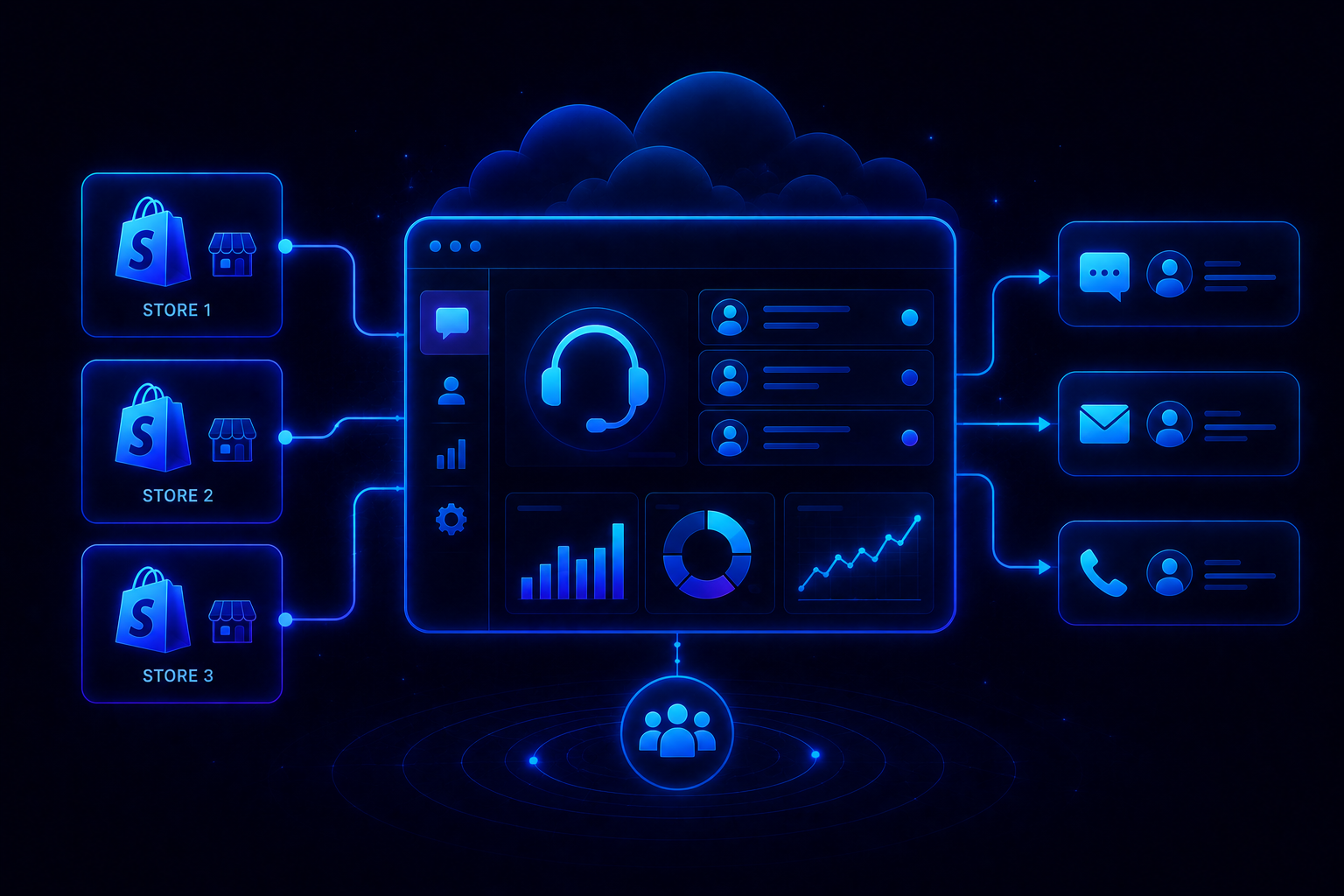
For teams deciding where to start, the unified customer support inbox gives both AI and agents a shared view of every customer conversation across every channel, eliminating the context gaps that make helpdesk integration complex.
How QuantumDesk's AI Capabilities Integrate Into Your Helpdesk
- Quantum AI resolves repetitive tier-1 queries automatically across WhatsApp, chat, email, and social, including order tracking, return eligibility, and account access, before they ever reach an agent queue.
- AI-curated inbox categorizes and prioritizes incoming conversations by urgency, sentiment, and intent, replacing manual triage with intelligent routing that improves accuracy with every interaction processed.
- Quantum AI Copilot surfaces reply suggestions, conversation summaries, and full customer history inside the active workflow so agents have complete context the moment an escalated ticket arrives in their queue.
- Knowledge base integration allows Quantum AI to draw from existing documentation and flag content gaps when it encounters queries it cannot answer accurately, keeping the knowledge base current without requiring manual audit cycles.
- Admin analytics track AI containment rate, resolution time, escalation patterns, and CSAT by interaction type, giving support leaders full visibility into integration performance from the first week of deployment.
Ready to see how it works? Book a demo to explore QuantumDesk for your team.
Frequently Asked Questions
How do I start integrating AI into my existing helpdesk?
Start by auditing and cleaning your knowledge base, then choose a native add-on or third-party AI agent compatible with your helpdesk stack. Run a focused pilot on your top three highest-volume ticket categories before expanding AI scope.
Do I need to replace my current helpdesk software to add AI?
No. Most AI tools integrate with existing platforms through APIs or native plugins. You can add AI capabilities to your current helpdesk without migrating to a new system or rebuilding any existing support workflows.
Which helpdesk queries should AI handle first?
Order tracking, password resets, billing status, return eligibility, and account access. These account for 60 to 80 percent of total ticket volume and require no human judgment, making them the safest and fastest pilot starting point.
How do I measure whether my AI helpdesk integration is working?
Track AI containment rate, cost per resolved ticket, first contact resolution, and CSAT separately for AI and human interactions. Deflection rate alone does not confirm resolution quality and consistently overstates how well the integration is performing.
How long does it take to see results from AI helpdesk integration?
For well-scoped deployments with a clean knowledge base, measurable improvements in response time and ticket containment appear within the first few weeks. Break-even on the investment typically occurs within 60 to 90 days.



.avif)