Summarize with AI
Key Takeaways
- The top Help Scout alternatives in 2026 include QuantumDesk, Zendesk, Intercom, Freshdesk, Front, Tidio, Gorgias, Crisp, and LiveChat.
- QuantumDesk is the strongest Help Scout alternative, with AI natively embedded in the core platform and no pay-per-resolution add-on costs.
- Freshdesk offers a robust free tier and plans from $15 per month, ideal for budget-conscious teams needing multi-channel support and SLA management.
- Zendesk is the industry heavyweight for scaling teams, offering deep customisation and advanced reporting for large enterprise support operations.
- Intercom excels in AI-first ticket deflection and proactive conversational chat, making it a strong fit for SaaS teams needing in-product messaging.
A Quick Comparison: 10 Best Help Scout Alternatives
Help Scout has earned strong loyalty among SaaS and SMB teams for its email-first design, but as channel needs, AI maturity, and pricing expectations grow, many teams begin exploring alternatives.
A D2C brand handling 2,000 routine queries monthly pays $1,500 extra for Help Scout's AI deflection.
That cost stacks on top of per-user plans tripling from $25 to $75. WhatsApp requires a tier upgrade. For D2C teams on chat and social, the email-first design creates constant friction.
This article compares the top 10 Help Scout alternatives to help you make a confident, well-informed platform decision.
Tools were evaluated based on:
- Customer conversations and direct feedback from D2C, e-commerce, and B2B SaaS support leaders across multiple industries and team sizes.
- Verified review analysis across G2 and Capterra to surface real satisfaction levels and recurring pain points.
- Hands-on testing of shortlisted tools across AI capability, deployment ease, and workflow quality for practical comparison.
The goal is: to help you find the platform that fits your team best.
What is Help Scout?
Help Scout is an email-first customer support platform built around shared inboxes, a Docs knowledge base, and AI-assisted workflows. It is positioned as a clean alternative to chatbot-heavy helpdesks for growing businesses.
It is primarily designed for SaaS, healthcare, professional services, and SMB teams that prioritise email-style support over aggressive chat or bot-led experiences.
Teams use Help Scout to manage customer email and chat conversations in one shared inbox, deflect routine questions through Docs articles, and assist agents with AI Drafts, Summarize, and Answers features.
Key features of Help Scout
- Shared inbox with team assignments, internal notes, tagging, snooze, and saved replies for collaborative email-based support workflows.
- Docs knowledge base for branded help centres with articles, search, and customer-facing self-service that teams report deflects around 30 percent of volume.
- Beacon widget that surfaces knowledge base articles, contact forms, and chat directly on your website for in-context support.
- AI Inbox, Drafts, and Summarize features that assist agents with replies, conversation summaries, and faster ticket handling inside the inbox.
- AI Answers chatbot sold as a pay-per-resolution add-on that autonomously resolves common queries at $0.75 per resolution.
- Workflows and SLAs for automation, routing, and response-time policies, with deeper capabilities unlocked at the Plus and Pro tiers.
When should you consider a Help Scout alternative?
1. AI Answers is sold as a separate pay-per-resolution add-on
Help Scout's AI Answers chatbot is not bundled into any base plan. Teams pay $0.75 per resolution on top of the per-user subscription.
A D2C cosmetics brand handling 2,000 routine ingredient queries per month pays an additional $1,500 just to enable autonomous AI deflection alongside the base seat cost.
2. Per-user pricing scales steeply from Standard to Pro
Help Scout's tiers move from $25 per user on Standard to $45 on Plus to $75 on Pro. That is a three-times cost increase per seat to access advanced capabilities.
For a B2B SaaS team scaling from 5 to 15 agents needing HIPAA or SSO compliance, the annual bill jumps from $1,500 to $13,500 just at base seat cost.
3. Advanced workflows, SLAs, and integrations are gated to higher tiers
Unlimited workflows, multiple SLAs, SSO/SAML, HIPAA compliance, and Salesforce, Jira, and HubSpot integrations all sit behind the Plus or Pro tiers in Help Scout's structure.
A D2C lifestyle brand needing routing rules, CRM integration, and compliance features quickly finds the $25 Standard plan insufficient for actual operational requirements at scale.
4. Email-first design feels constraining for chat-led D2C operations
Help Scout's strength is structured email conversations, but D2C brands operating primarily through WhatsApp, Instagram, and live chat find the platform's design philosophy works against their actual channel mix.
For a D2C apparel brand running flash sales where 70 percent of inbound volume hits Instagram and WhatsApp, an email-centric workspace adds friction rather than removing it.
5. Reporting depth and customisation feel limited at scale
Reviews consistently flag Help Scout's reporting as solid for basics but shallow on CSAT trends, agent performance deep dives, and customisable dashboards needed by support leaders.
Support managers running structured B2B SaaS operations often export data into spreadsheets to answer questions that more analytics-rich platforms surface natively.
How did we evaluate the best Help Scout alternatives?
This evaluation goes beyond feature checklists. The goal was to assess how each platform performs in real D2C, SMB, and B2B SaaS support environments.
- Review platform analysis. Studied verified ratings and written reviews on G2 and Capterra to identify real satisfaction levels and recurring pain points.
- Community and forum research. Analysed discussions from D2C founders, CX leaders, and SaaS support managers across Slack communities, Reddit, LinkedIn groups, and SaaS forums.
- SaaS directories and analyst reports. Cross-referenced tools listed across major SaaS directories to validate market presence and category positioning.
- Capability comparison. Evaluated each tool against a consistent framework covering AI capabilities, omnichannel support, workflow automation, integrations, and pricing transparency.
- Hands-on testing. The top five shortlisted tools were directly tested by our team to evaluate automation quality, usability, escalation handling, and support workflow experience.
This methodology gives D2C, SMB, and SaaS support teams a practical, unbiased basis for evaluating which platform fits their needs.
10 Best Help Scout alternatives to consider
The tools below were evaluated based on AI capability, channel coverage, ease of deployment, escalation design, and overall value for D2C, SMB, and B2B SaaS support teams. Each listing follows a consistent evaluation framework for a fair comparison.
1. QuantumDesk - Best AI-native support for D2C and SMB teams

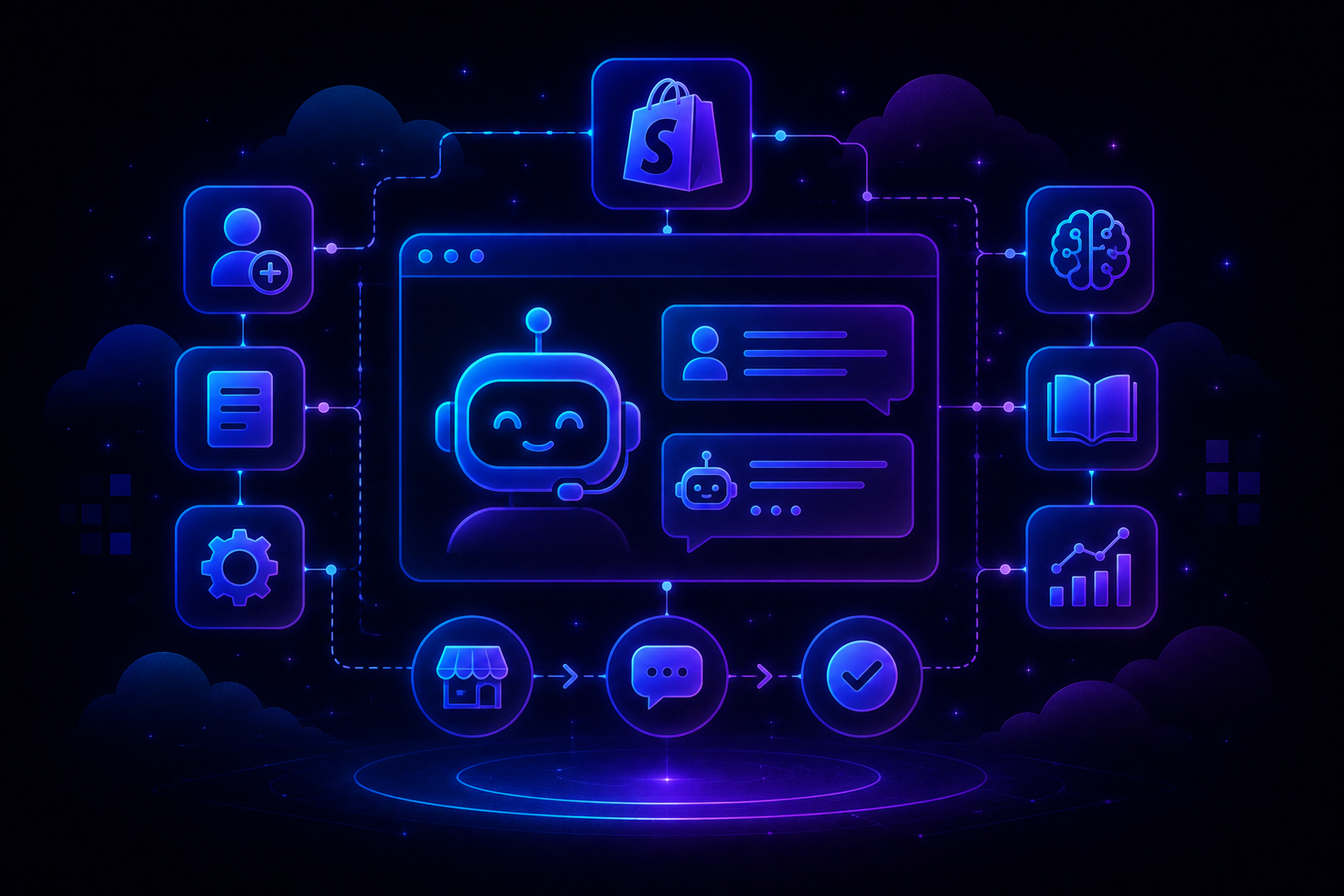
QuantumDesk is an AI-native customer service platform built to resolve high volumes of L1 queries automatically while keeping agents effective for complex escalations across every major channel.
It is built for D2C brands, e-commerce stores, and SMB to mid-market teams that need strong AI automation, full omnichannel coverage, and agent productivity tools for e-commerce customer service.
Teams choose QuantumDesk over Help Scout specifically because AI is embedded into the core platform rather than billed per resolution, and pricing scales predictably with volume.
Key features
- AI-native architecture. Resolution, agent assist, routing, and analytics are built into the core product, not sold as separate add-on modules.
- Quantum AI for L1 resolution. Resolves repetitive customer queries instantly, like "where is my order?", with escalation when complexity requires it.
- AI copilot for agents. Provides drafted responses, conversation summaries, intent identification, and next-action suggestions directly within the agent workspace.
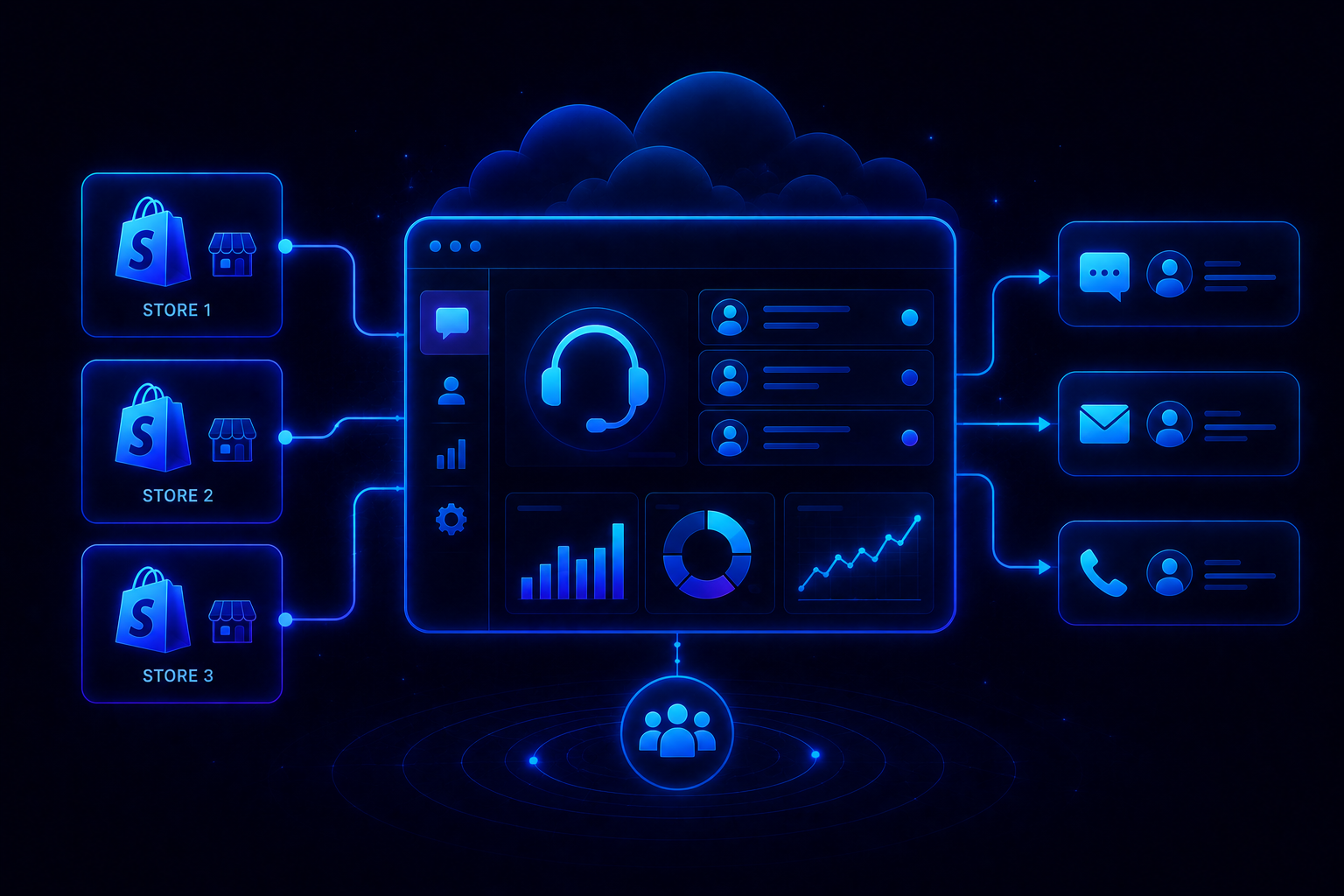
- Unified omnichannel inbox. Manages email, live chat, WhatsApp, and Instagram conversations in a single workspace without separate tool subscriptions.
- Admin performance visibility. Delivers real-time insights on resolution rates, escalation patterns, and customer satisfaction metrics for team leaders.
Why choose QuantumDesk over Help Scout?
- Help Scout sells AI Answers at $0.75 per resolution as a separate add-on. QuantumDesk includes AI resolution in the core platform.
- Help Scout's per-user pricing triples from Standard at $25 to Pro at $75. QuantumDesk offers custom pricing aligned to actual usage.
- Help Scout's analytics are flagged as basic by reviewers. QuantumDesk delivers real-time dashboards covering resolution, escalation, and CSAT trends.
Pros
- Deep AI handling of L1 tickets and agent workflows means per-ticket cost typically drops as support volume scales.
- Unified omnichannel inbox eliminates the need for separate tools or add-ons across email, chat, WhatsApp, and social.
- Custom pricing lets teams negotiate around usage and growth stage rather than being locked into rigid per-user tiers.
Cons
- Ecosystem and services partner network are newer than long-standing incumbents like Zendesk or Salesforce Service Cloud.
- Best value realised at mid-to-high ticket volumes. Very small teams may not fully use the AI depth available.
Customer review
Reviewers highlight QuantumDesk's ability to handle repetitive queries automatically, reducing agent workload while maintaining resolution quality across growing ticket volumes.
Pricing
QuantumDesk uses custom, quote-based pricing. Teams pay in line with ticket volume and complexity rather than rigid per-seat or per-resolution tiers.
2. Zendesk Suite - Best for enterprise CX operations
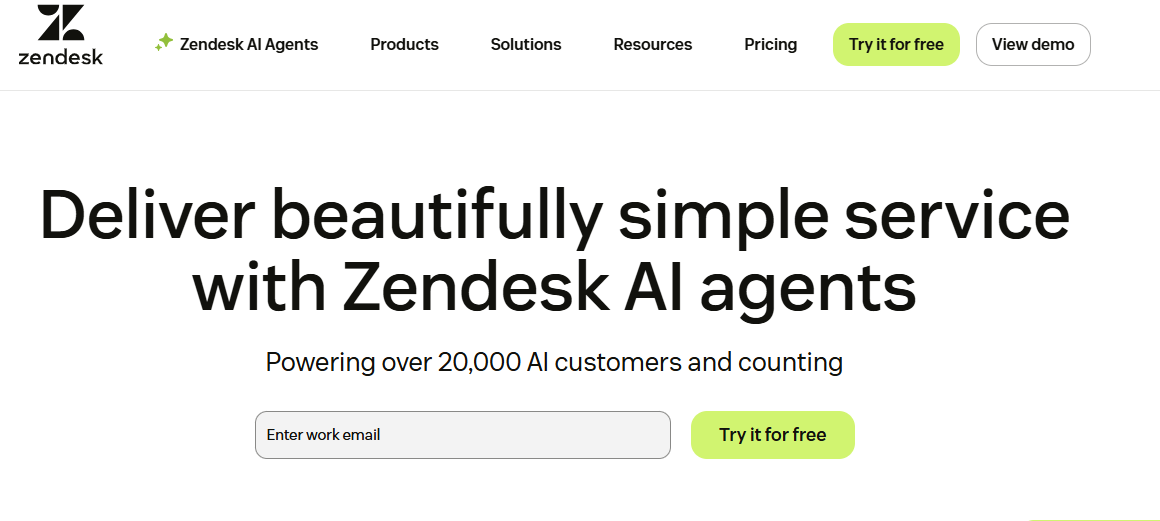
Zendesk Suite is an enterprise customer experience platform built for large support operations that need omnichannel ticketing, advanced routing, SLA management, and a broad integration marketplace.
It is built for mid-market and enterprise teams running complex, multi-region support operations where configurability and compliance are non-negotiable requirements.
Teams choose Zendesk over Help Scout when they need configurability, deeper analytics, and an ecosystem that goes far beyond Help Scout's email-first SMB design.
Key features
- Omnichannel ticketing. Manages support across email, chat, voice, social, and messaging in a unified agent workspace.
- Advanced routing and SLAs. Supports complex conditional routing rules and SLA policies across multiple teams and regions.
- Large integration marketplace. Connects with hundreds of third-party tools across CRM, analytics, billing, and operations workflows.
- Zendesk AI. Built-in AI for ticket triage, agent assist, and intent detection across the agent workspace.
Why choose Zendesk over Help Scout?
- Zendesk's enterprise-grade routing, SLA depth, and reporting capabilities go well beyond what Help Scout's email-first platform currently offers.
- Zendesk's mature ecosystem with certified implementation partners removes ceiling concerns that scaling teams encounter with Help Scout's tier-gated features.
Pros
- Highly configurable workflows, strong analytics, and a broad app ecosystem suit complex mid-market and enterprise support operations.
- Trusted by large organisations needing advanced routing, SLA management, and compliance-intensive customer service environments.
- Mature AI suite with deflection, agent assist, and intent detection across email, chat, and messaging channels.
Cons
- Per-seat pricing with AI and compliance add-ons can push total cost significantly higher than initial expectations.
- Requires dedicated administration and ongoing configuration, adding operational burden for lean SMB and D2C support teams.
- Overkill for very small SaaS or D2C teams that want simple email-style support without enterprise depth.
Customer review
Users praise Zendesk's configurability and ecosystem depth but frequently cite unexpected cost growth from layered add-ons as a recurring frustration.
Pricing
Suite plans start at around $55 per agent per month. Real-world deployments with AI and advanced tiers often reach $115 to $169 per agent.
3. Intercom - Best for SaaS in-product messaging
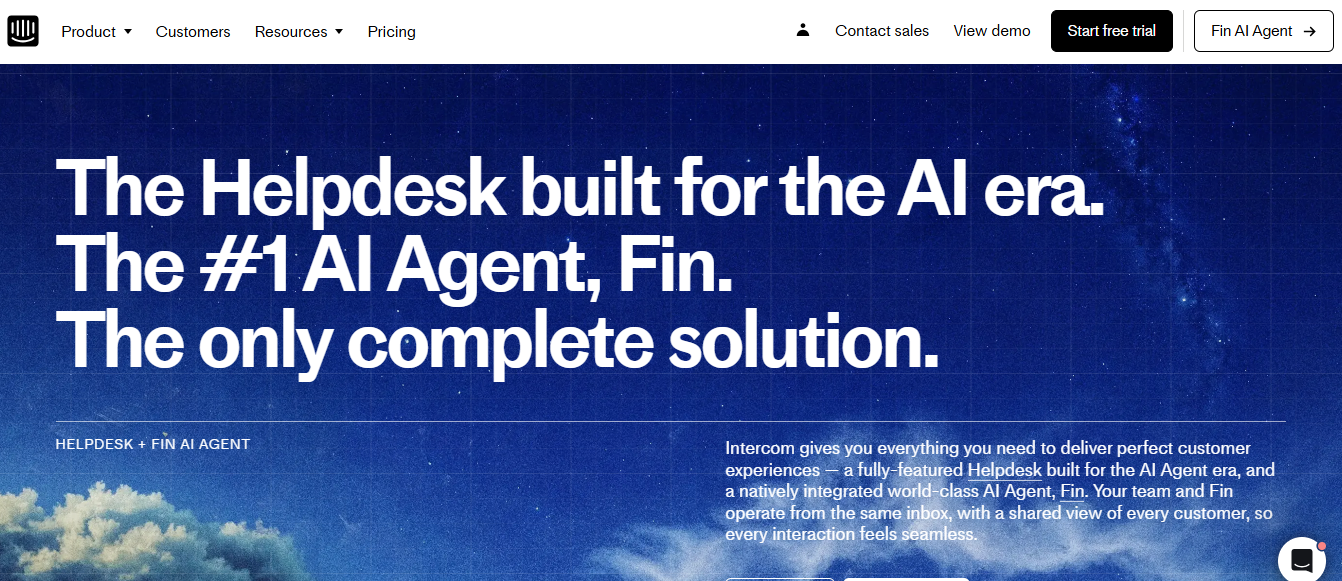
Intercom is a product-led support and messaging platform that combines in-app chat, email, a help centre, and the Fin AI bot for SaaS teams focused on embedded customer engagement.
It is built for B2B SaaS and digital-first companies that prioritise in-product messaging, proactive engagement, and lifecycle marketing alongside their support operations.
Teams choose Intercom over Help Scout because its Fin AI bot is more mature for deflection, and its in-app messaging capability is purpose-built for SaaS engagement.
Key features
- In-app messaging. Embeds support and proactive messaging directly inside the product for a native end-user experience.
- Fin AI bot. Deflects a meaningful share of L1 queries when fully trained against your knowledge base and product documentation.
- Workflows and automation. Visual workflow builder handles routing, triage, and automated responses across support and onboarding use cases.
- Customer data platform. Builds segmented audiences from product behaviour and conversation history for targeted lifecycle messaging.
Why choose Intercom over Help Scout?
- Intercom's Fin AI bot is more developed than Help Scout's AI Answers for high-volume deflection, particularly in B2B SaaS technical environments.
- Intercom's in-product messaging is purpose-built for SaaS, whereas Help Scout's email-first design is secondary when in-app chat is critical.
Pros
- Excellent in-product chat and proactive messaging make it a strong fit for product-led SaaS growth motions.
- Mature Fin AI bot deflects a significant share of L1 queries when configured with a solid knowledge base.
- Deep customer data platform enables targeted, segment-based outreach beyond what most support tools offer.
Cons
- Per-resolution AI pricing on top of seat licences causes bills to rise quickly as automation usage scales.
- Over-featured and expensive if the primary need is straightforward SMB email support rather than lifecycle messaging.
- Steep learning curve for smaller teams. Significant configuration is needed to access the platform's full value.
Customer review
Intercom users report strong AI deflection performance and in-app messaging quality but flag rising costs from per-resolution billing as volume scales.
Pricing
Plans start at around $39 per seat per month on the Essential tier. Fin AI bot is billed additionally per successful resolution.
4. Freshdesk - Best for budget-conscious SMB helpdesk
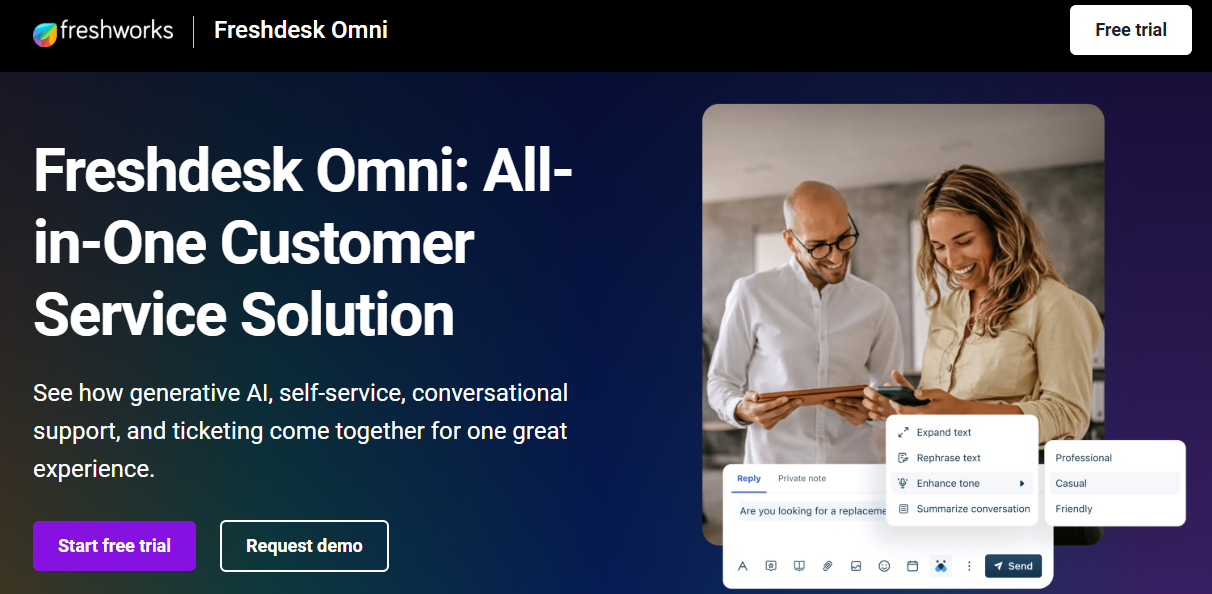
Freshdesk is a multichannel helpdesk for SMB and mid-market teams, offering email, chat, phone, and social ticketing alongside Freddy AI features across free and paid plan tiers.
It is built for small to mid-sized D2C and service teams that want a full helpdesk without enterprise-level pricing, particularly those needing phone support.
Teams choose Freshdesk over Help Scout because of its lower entry tiers, stronger phone capabilities, and ability to grow without Help Scout's three-times per-user escalation.
Key features
- Multichannel ticketing. Manages support from email, chat, phone, and social in a unified agent workspace.
- Freddy AI. Provides AI-assisted triage, suggested responses, and self-service deflection across higher plan tiers.
- Free and low-cost entry plans. Includes a free plan and affordable tiers with solid out-of-the-box helpdesk functionality.
- Integrated phone support. Native Freshcaller integration for voice support alongside digital channels.
Why choose Freshdesk over Help Scout?
- Freshdesk offers a meaningful free plan and lower-cost paid tiers, avoiding Help Scout's $25-to-$75 per-user tier escalation entirely.
- Freshdesk includes native phone support and traditional ticketing depth that Help Scout's email-first model does not natively cover.
Pros
- Free and low-cost entry plans make adoption easy for small D2C and SMB teams without high upfront commitment.
- Solid ticketing, phone integration, and a broad marketplace cover most SMB and mid-market support use cases.
- Smooth scaling from SMB to mid-market without a sudden, disproportionate cost jump between tiers.
Cons
- Freddy AI and Pro tier add-ons increase per-agent costs well beyond headline pricing expectations.
- AI depth and experience are rated behind newer AI-native platforms for sophisticated automation workflows.
- Interface and configuration can feel dated compared to modern email-first platforms like Help Scout or Front.
Customer review
Freshdesk users rate its ease of setup highly, but commonly note that costs rise sharply once AI and omnichannel modules are added.
Pricing
Free plan available. Paid plans start at around $15 per agent per month and scale to $79 on Pro tier with annual billing.
5. Salesforce Service Cloud - Best for CRM-embedded service
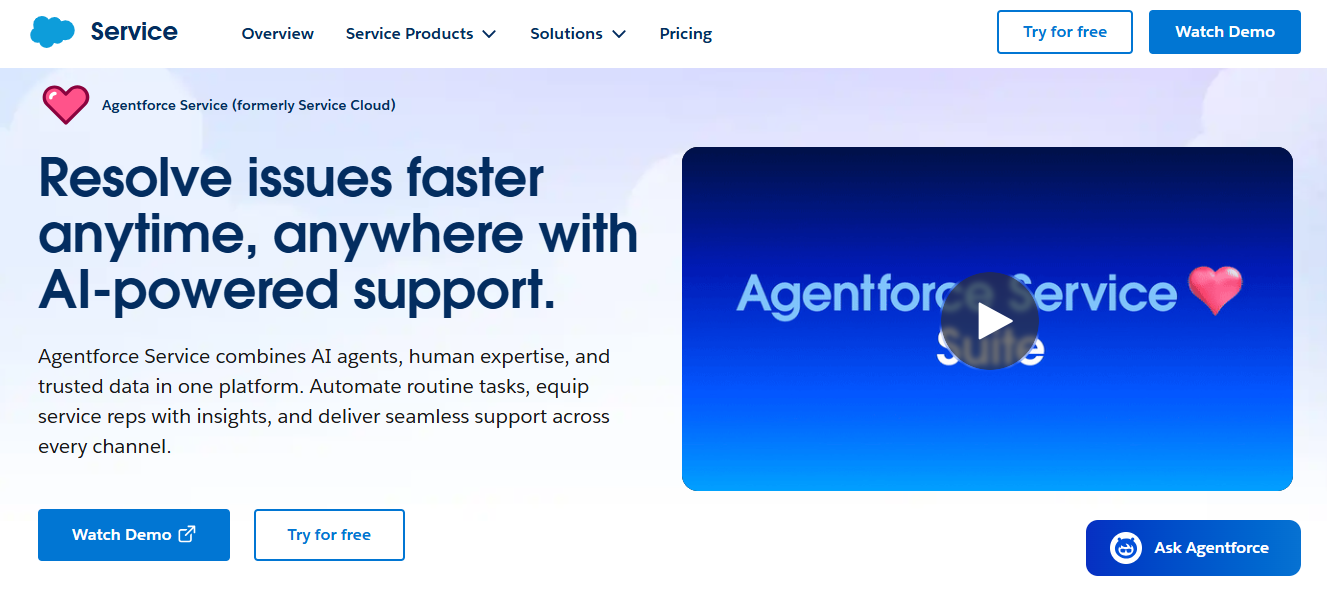
Salesforce Service Cloud is an enterprise CRM-embedded support platform for organisations already on Salesforce, connecting support cases directly with account, opportunity, and contact data.
It is built for B2B SaaS and enterprise teams already operating inside the Salesforce ecosystem that need service tightly aligned with sales and customer data.
Teams choose Service Cloud over Help Scout when they need account-level CRM context, Einstein AI capabilities, and enterprise-grade reporting that Help Scout's SMB design cannot match.
Key features
- Native Salesforce CRM integration. Connects support cases with accounts, contacts, and opportunities for full customer context per interaction.
- Einstein AI. Embeds generative AI into the agent workspace for suggested responses, case summaries, and next-action guidance.
- Enterprise analytics. Provides customisable Einstein-powered dashboards across case volumes, SLAs, and agent performance metrics.
- Service Cloud Voice. Native voice channel integration alongside digital channels for full omnichannel coverage.
Why choose Salesforce Service Cloud over Help Scout?
- Service Cloud's native Salesforce integration provides account-level support context at a depth Help Scout's standalone platform cannot replicate.
- For B2B SaaS teams already on Salesforce, Service Cloud eliminates the data fragmentation that running a separate Help Scout instance creates.
Pros
- Deep native Salesforce integration provides powerful automation and full customer context across every support interaction.
- Enterprise-grade reporting, security, and a large ecosystem of certified implementation partners reduce integration risk.
- Mature Einstein AI capabilities for agent assist, case summaries, and predictive routing.
Cons
- Among the most expensive options at scale. Implementation and admin overhead add substantially to total cost.
- Overkill for SMB and D2C teams that do not need full Salesforce customisation to run effective support operations.
- Requires Salesforce admin expertise. Lean teams without dedicated platform owners struggle to configure effectively.
Customer review
Enterprise reviewers cite Service Cloud's CRM integration depth as a major strength, but consistently flag high cost and implementation complexity as major considerations.
Pricing
Plans range from around $25 per user per month on Starter to $550 per user on Agentforce 1. Most deployments land well above entry tiers.
6. Front - Best for email-first collaborative teams
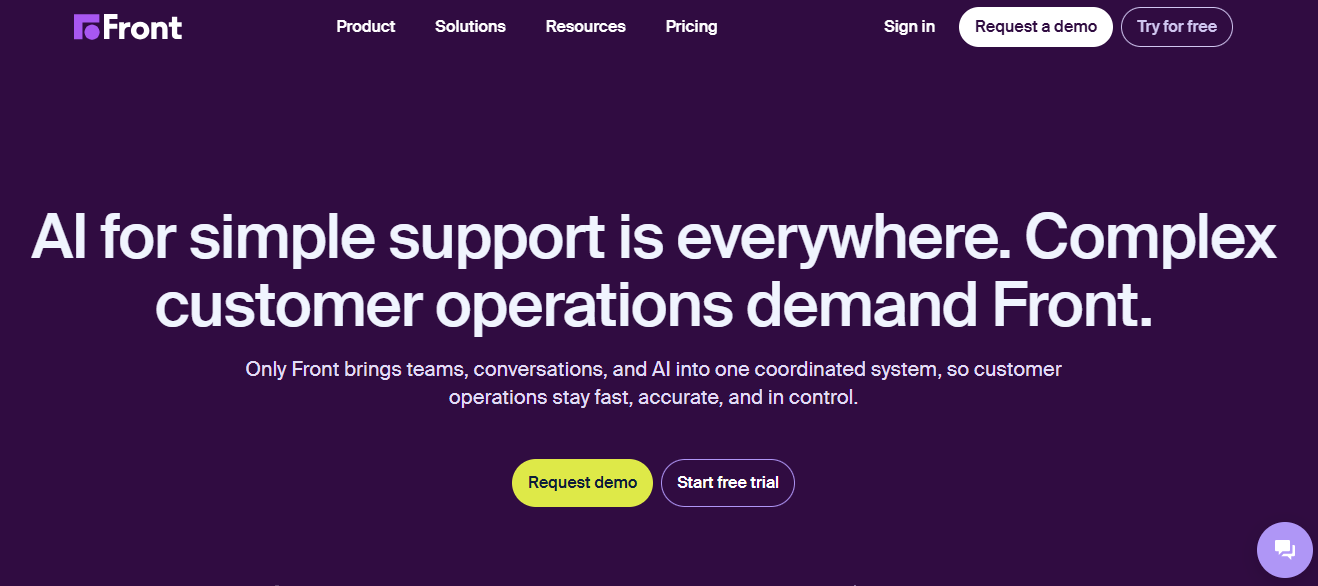
Front is a collaborative shared inbox platform for small support and account teams, built around email with internal comments, shared drafts, and SLA tracking baked in.
It is built for B2B SaaS, professional services, and account-led teams that prioritise email collaboration with light SLA and channel management.
Teams choose Front over Help Scout when they want stronger collaboration tooling, internal comments, and shared drafts for email workflows that Help Scout treats more lightly.
Key features
- Collaborative shared inbox. Team members leave internal comments, share drafts, and assign conversations without customers seeing internal activity.
- SLA tracking. Sets and monitors response time targets, giving team leads basic performance visibility without a full helpdesk.
- Omnichannel inboxes. Connects email, SMS, social, and chat into a shared workspace for conversation management beyond email.
- Front AI. AI-powered response suggestions and conversation summarisation across the shared inbox.
Why choose Front over Help Scout?
- Front's collaboration tooling, including internal comments and shared drafts, is more developed for team-based email workflows than Help Scout.
- Front's pricing model with included channels at lower tiers contrasts with Help Scout's gating of WhatsApp and advanced workflows to higher plans.
Pros
- Strong collaboration features make it effective for small team-based email support without heavy helpdesk overhead.
- Simpler than full helpdesks, with enough SLA and analytics structure for modest support operations.
- Modern UX that feels natural to email-native teams and reduces ramp time for new agents.
Cons
- Limited as a primary platform when volumes and automation needs grow beyond email and basic omnichannel use.
- AI capabilities are not a core strength. Teams needing deep customer service automation will find Front's tooling insufficient.
- Reporting depth and advanced workflow logic lag behind enterprise-focused alternatives like Zendesk and Service Cloud.
Customer review
Front users praise the collaborative inbox experience as a standout feature while noting that the platform becomes limiting as team size grows.
Pricing
Starter starts at around $25 per seat per month (up to 10 seats). Professional around $65 per seat. Enterprise around $105 per seat.
7. Tidio - Best for SMB live chat and chatbot support
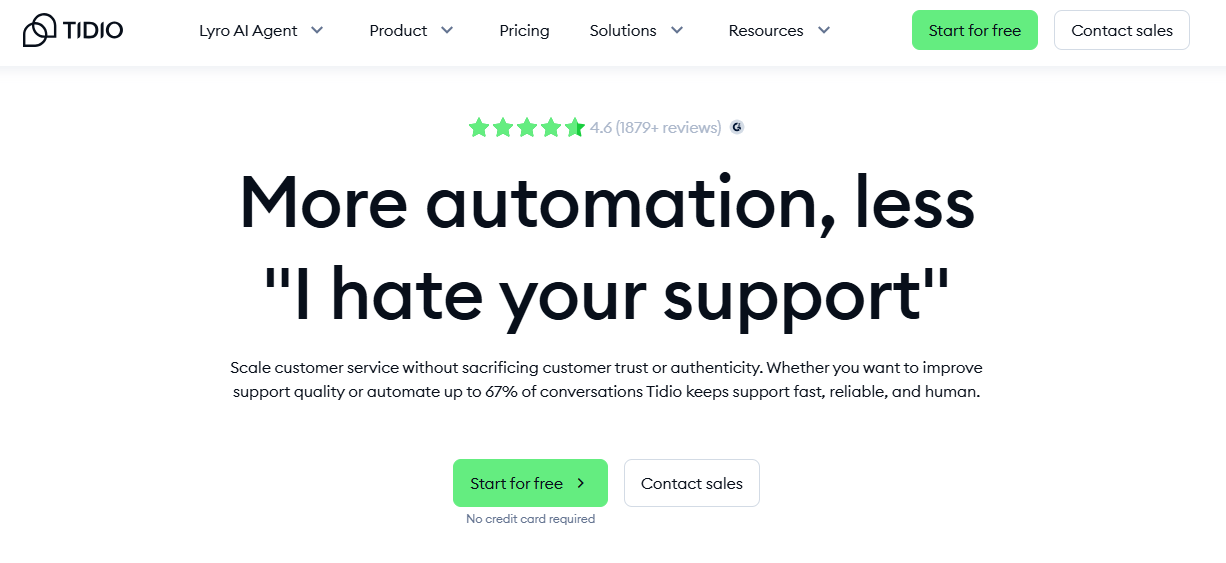
Tidio is an all-in-one customer service platform combining live chat, the Lyro AI agent, helpdesk ticketing, and no-code automation flows into a single workspace for SMB and e-commerce teams.
It is built for D2C brands and small e-commerce stores that need fast deployment, chat-first engagement, and conversion-focused automation alongside support.
Teams choose Tidio over Help Scout when their primary channel is live chat rather than email and they want a chat-first widget tied to D2C conversion goals.
Key features
- Live chat widget. Embeddable widget with typing indicators, visitor information, and operating-hours controls for direct customer engagement.
- Lyro AI agent. AI chatbot trained on FAQ and connected knowledge, with vendor-cited resolution rates between 60 and 77 percent.
- Multichannel inbox. Centralises website chat, email, Messenger, Instagram, and WhatsApp conversations in one workspace.
- Flows automation builder. No-code triggers for proactive messages, lead capture, quote reminders, and offline follow-ups.
Why choose Tidio over Help Scout?
- Tidio is built around live chat and proactive engagement, whereas Help Scout's email-first design treats chat as a secondary channel.
- Tidio's conversion-focused Flows and visual chatbot builder serve D2C goals better than Help Scout's structured email collaboration model.
Pros
- Quick setup and intuitive chat widget make adoption fast for D2C stores without developer support.
- Lyro AI handles routine queries well for repetitive e-commerce scenarios like order tracking and returns.
- Strong multi-channel inbox covering chat, email, WhatsApp, Messenger, and Instagram in one workspace.
Cons
- Lyro AI sold as a separate add-on starting at $32.50 per month on top of the base plan.
- Steep pricing cliff from Growth at $59 per month to Plus at $749 with no intermediate tier.
- Analytics depth is flagged as basic for CSAT trends and agent performance reporting by scaling teams.
Customer review
Tidio users praise the visual chatbot builder and Lyro AI but consistently flag pricing that ramps up quickly as conversation volumes grow.
Pricing
Starter starts at around $29 per month. Growth at $59 per month. Plus jumps to $749 per month. Lyro AI priced separately as add-on.
8. Gorgias - Best for Shopify-based e-commerce support
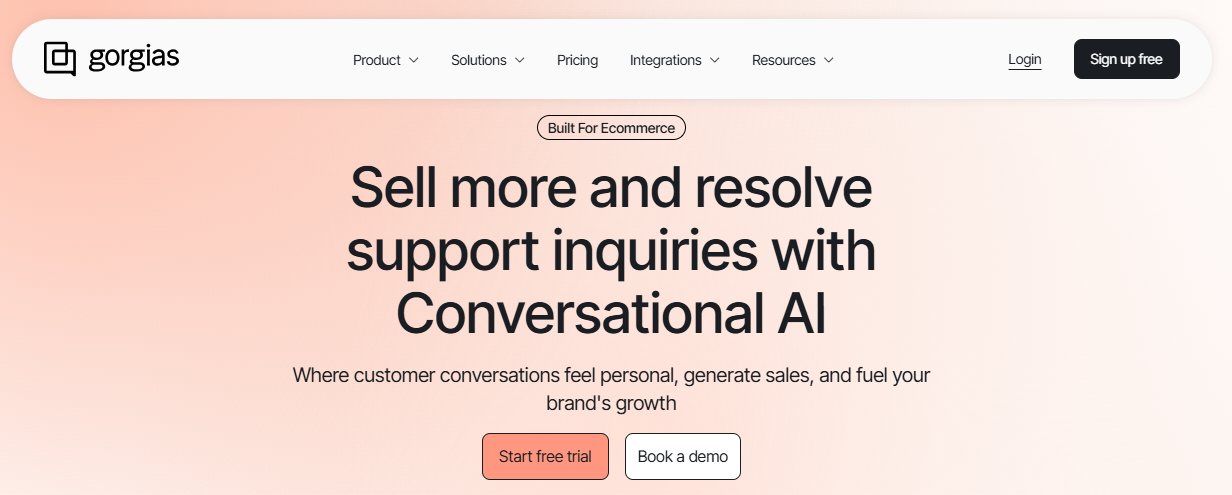
Gorgias is an e-commerce-focused helpdesk built around tight Shopify, WooCommerce, and BigCommerce integrations, making it relevant to teams comparing the Best Help Desk Software for Shopify for order-driven support.
It is built for D2C and Shopify-based e-commerce brands that need support tightly integrated with order data, refund workflows, and store actions.
Teams choose Gorgias over Help Scout when their support is heavily order-driven and they need to perform store actions like refunds without leaving the helpdesk.
Key features
- Native Shopify integration. Surfaces order, customer, and product data inside every ticket for full e-commerce context.
- One-click store actions. Process refunds, cancel orders, and update shipping addresses directly from the support inbox.
- Multi-channel ticketing. Manages email, chat, Instagram, Facebook, and WhatsApp support in one workspace.
- Gorgias AI agent. AI-powered automation for resolving routine e-commerce queries like order status and return requests.
Why choose Gorgias over Help Scout?
- Gorgias surfaces order data and enables store actions directly inside the ticket. Help Scout requires external Shopify lookups for the same.
- Gorgias is purpose-built for e-commerce workflows, whereas Help Scout's SaaS and professional services design is less suited to D2C operations.
Pros
- Native Shopify integration removes friction from order-based support workflows for D2C brands.
- One-click store actions reduce ticket resolution time for refunds, exchanges, and shipping updates.
- AI agent and macros handle common e-commerce queries like order tracking and return policy questions.
Cons
- Less suited for B2B SaaS or non-e-commerce teams where order context is not the central support driver.
- Ticket-based pricing tiers can become expensive as inbound volume grows during peak D2C seasons.
- AI capability is improving but rated less mature than embedded AI-native platforms for complex queries.
Customer review
Gorgias users praise the Shopify integration depth and store-action workflows but flag pricing tiers as steep when ticket volume spikes seasonally, making Shopify Stores Automate Repetitive Customer Queries a relevant consideration for growing stores.
Pricing
Starter plan starts at around $10 per month with low ticket allowance. Basic tier with meaningful capacity starts at around $60 per month.
9. Crisp - Best for all-in-one SMB messaging
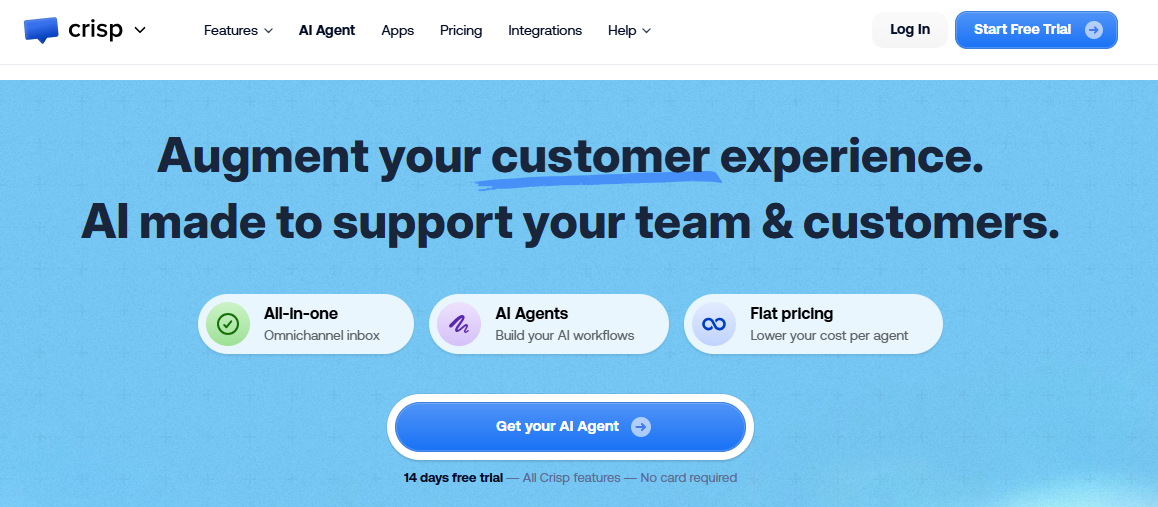
Crisp is an all-in-one customer messaging platform that combines live chat, email, voice, and a knowledge base alongside an AI chatbot for small businesses and growing teams.
It is built for small businesses, agencies, and early-stage D2C brands that want broad channel coverage at a flat per-workspace price.
Teams choose Crisp over Help Scout when they want per-workspace pricing rather than per-user billing, especially for small teams handling multiple channels at low volume.
Key features
- Multichannel inbox. Centralises chat, email, Messenger, Instagram, WhatsApp, and Twitter in a single shared workspace.
- MagicReply AI. AI-powered response suggestions and chatbot capabilities for handling repetitive queries automatically.
- Live calls and screen sharing. Built-in voice and video calling alongside text-based chat for richer customer support.
- CRM and shared knowledge base. Lightweight customer data records and a built-in help centre for self-service deflection.
Why choose Crisp over Help Scout?
- Crisp uses flat per-workspace pricing rather than Help Scout's per-user model, which removes seat-count pressure for small teams.
- Crisp includes voice, video, and screen sharing in standard plans, capabilities that require integrations or workarounds in Help Scout.
Pros
- Flat per-workspace pricing creates predictable costs without per-user scaling concerns for small SMB teams.
- Broad channel coverage including voice, video, and messaging apps in a single workspace.
- Modern interface and quick setup make it an easy fit for small businesses and agencies.
Cons
- AI capabilities are less mature than dedicated AI-native platforms for high-volume deflection at scale.
- Limited advanced workflow automation compared to enterprise-focused helpdesks like Zendesk and Service Cloud.
- Reporting and analytics depth lag behind mid-market and enterprise competitors as teams grow.
Customer review
Crisp users praise the breadth of channels and predictable pricing model while noting that AI and analytics capabilities are still maturing.
Pricing
Free plan available. Pro starts at around $25 per workspace per month. Unlimited around $95 per workspace per month for advanced features.
10. LiveChat - Best for sales and support live chat
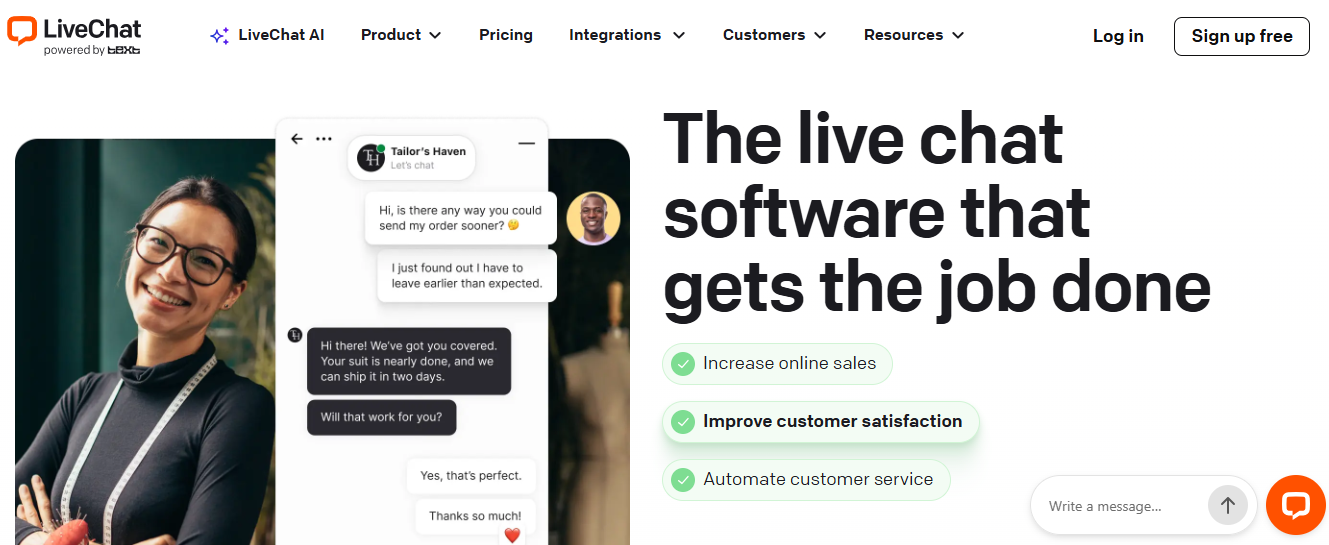
LiveChat is a dedicated live chat platform for sales and support teams, making it relevant for businesses evaluating Best Live Chat Software for E-commerce alongside broader help desk platforms.
It is built for D2C e-commerce stores, B2B SaaS teams, and service businesses that want a reliable, focused chat tool without all-in-one platform complexity.
Teams choose LiveChat over Help Scout when chat is their primary engagement channel and they want a specialist tool rather than an email-first platform.
Key features
- Customisable chat widget. Highly configurable widget with sales-oriented features like product cards, transcripts, and visitor tracking.
- HelpDesk ticketing. Companion product for managing email and ticket-based support alongside live chat conversations.
- ChatBot automation. Visual no-code bot builder for handling FAQs, lead capture, and qualification workflows.
- Sales-focused reporting. Reports tracking chat conversions, agent performance, and sales attribution metrics.
Why choose LiveChat over Help Scout?
- LiveChat's widget customisation and sales-oriented features are more developed than Help Scout's Beacon, which prioritises self-service over engagement.
- LiveChat's modular pricing lets teams pay only for chat, ticketing, or bot capabilities rather than Help Scout's bundled per-user tiers.
Pros
- Highly customisable chat widget with strong sales-oriented features like product cards and conversion tracking.
- Modular product family lets teams adopt chat, ticketing, and bots independently as needs evolve.
- Mature, well-documented platform with reliable uptime and a strong integration ecosystem.
Cons
- AI and bot capabilities require the separately priced ChatBot product, increasing total platform cost.
- All-in-one helpdesk experience requires bundling multiple LiveChat products rather than a single unified platform.
- Less embedded AI capability compared to AI-native platforms purpose-built for autonomous query resolution.
Customer review
LiveChat reviewers praise the widget customisation and reliability but note that the modular product structure can become expensive when bundled.
Pricing
LiveChat starts at around $20 per agent per month on Starter. HelpDesk and ChatBot are priced separately as companion products.
What factors should you consider when choosing a Help Scout alternative?
1. Is AI capability embedded or sold separately?
Not all platforms include AI in the base price. Help Scout sells AI Answers at $0.75 per resolution. Evaluate whether AI is part of the core platform.
Look specifically for autonomous L1 resolution, real-time agent assist, and AI-powered routing rather than basic response drafting or pay-per-resolution chatbot pricing.
2. How does the pricing model scale per user?
Per-user pricing scales linearly with headcount. Help Scout's tier model triples per-user cost from Standard to Pro, which compounds quickly across growing teams.
For a D2C brand or B2B SaaS team scaling past 10 agents, evaluate whether the alternative offers usage-aligned pricing that does not penalise team growth.
Evaluate:
- Whether AI is included in the base plan or billed per resolution
- How pricing scales between Standard, Plus, and Pro tiers
- Whether mid-tier options provide reasonable capability without forcing a Pro upgrade
3. Does the platform cover channels beyond email?
Verify the alternative covers every channel your customers actually use, particularly WhatsApp, Instagram, and chat for D2C brands operating beyond email, as outlined in our guide to Best omnichannel customer support software.
Help Scout's email-first design works well for SaaS but creates friction for D2C teams running flash sales primarily through Instagram and WhatsApp, where Best Live Chat Software for D2C Brands can provide more channel-focused support.
4. How deep are analytics and reporting for support leaders?
Support leaders need visibility into agent performance, escalation patterns, CSAT trends, and resolution rates. Many SMB platforms offer only basic dashboards at entry tiers.
If you run a structured operation, confirm the platform supports the reporting depth needed without forcing an upgrade to the highest tier.
5. Are compliance, SSO, and enterprise requirements included?
Help Scout gates HIPAA, SSO/SAML, and advanced workflows to the Pro tier at $75 per user, which can become operationally expensive at scale.
For B2B SaaS, healthcare, or regulated D2C operations, evaluate whether the alternative offers these requirements at a more reasonable tier or includes them by default.
How does QuantumDesk help D2C and SMB teams scale beyond Help Scout?
QuantumDesk is built for D2C and SMB support teams that need AI embedded into the core of the platform rather than billed per resolution. Where Help Scout sells AI Answers at $0.75 per resolution on top of $25 to $75 per-user plans, QuantumDesk includes Quantum AI for L1 resolution, the AI Copilot for agents, and the AI-Curated Inbox as foundational capabilities. This makes customer service automation a built-in advantage rather than a growing cost line.
A D2C cosmetics brand running a product launch sees ingredient and skin-sensitivity questions flooding WhatsApp, Instagram, and email simultaneously, making Best AI support tools for D2C particularly relevant for handling high-volume conversations.
- The Unified Inbox brings every conversation into one workspace.
- The AI-Curated Inbox prioritises urgent reactions by sentiment and intent.
- Quantum AI resolves repetitive ingredient queries autonomously before they ever reach an agent's queue, preventing excessive conversations from reducing support quality.
For support leaders, Admin Analytics replaces the spreadsheet exports Help Scout reviewers describe, with real-time visibility into AI versus human resolution rates, escalation patterns, and CSAT trends across every channel.
If your team is evaluating Help Scout alternatives with stronger AI and broader channel coverage, explore how QuantumDesk can support your growth.
Frequently asked questions about Help Scout alternatives
What are the top Help Scout alternatives?
The top Help Scout alternatives include QuantumDesk, Zendesk Suite, Intercom, Freshdesk, Salesforce Service Cloud, Front, Tidio, Gorgias, Crisp, and LiveChat.
The right choice depends on your channel mix, AI requirements, and budget. QuantumDesk is the strongest option for D2C and SMB teams needing AI-native architecture and predictable pricing beyond Help Scout's per-user model.
Is Help Scout suitable for large-scale use?
Help Scout works well for SaaS and SMB teams with structured email support, but per-user pricing makes scaling to large teams expensive.
The jump from Standard at $25 to Pro at $75 per user, combined with AI Answers billed per resolution, means total costs at scale often exceed enterprise-ready alternatives like Zendesk or QuantumDesk.
How does QuantumDesk compare to Help Scout?
QuantumDesk embeds AI into the core platform, whereas Help Scout sells AI Answers as a separate pay-per-resolution add-on on top of per-user pricing.
QuantumDesk also offers deeper analytics, broader omnichannel coverage including WhatsApp and Instagram, and custom pricing that avoids Help Scout's three-times per-user tier escalation, making it better suited for scaling D2C teams.
What is the best low-cost alternative to Help Scout?
Freshdesk and Crisp both offer affordable entry tiers suitable for small teams managing basic support without committing to Help Scout's pricing structure.
Tidio is another low-cost starting option for D2C teams. For teams expecting growth, QuantumDesk's custom pricing is worth evaluating early to avoid outgrowing entry-tier limitations quickly.




.avif)