
Summarize with AI
Key Takeaways
- Sprinklr's enterprise complexity and opaque pricing push mid-market and D2C teams toward simpler, faster alternatives.
- QuantumDesk is the strongest AI-native alternative for teams needing embedded support automation without enterprise minimums.
- Sprout Social and Hootsuite are strong fits for teams prioritizing social publishing and community management at scale.
- Brandwatch leads for consumer intelligence, while Zendesk remains the benchmark for structured support ticketing operations.
- Sprinklr enterprise contracts often start at $50,000 annually, making total cost of ownership difficult to forecast before commitment.
A Quick Comparison: Best 10 Sprinklr Alternatives
Sprinklr is one of the most comprehensive enterprise CXM platforms available, but its complexity and cost lead many teams to explore alternatives.
Sprinklr holds a 4.3 out of 5 rating on G2 across 744 verified reviews. Users consistently praise its unified dashboard and AI tools, but recurring complaints about setup complexity, performance delays, and enterprise contract minimums starting at $50,000 annually push mid-market and D2C teams toward more focused options that deploy faster and cost less to evaluate.
This comparison covers the 10 strongest Sprinklr alternatives across AI capability, pricing transparency, channel coverage, and deployment speed for CX and support teams.
Tools were evaluated based on:
- Customer conversations and direct feedback from D2C, ecommerce, and B2B SaaS support leaders
- Verified review analysis across G2 and Capterra
- Hands-on testing of shortlisted tools across AI capability, deployment ease, and workflow quality
You will find a direct comparison of the 10 strongest alternatives so your team can evaluate options with confidence and choose the platform that fits your actual needs.
What Is Sprinklr?
Sprinklr is an enterprise Unified-CXM platform that consolidates social media management, digital marketing, customer service, and consumer intelligence into one system, built for large organizations managing high interaction volumes across multiple channels, teams, and global regions simultaneously.
Key Features of Sprinklr
- Sprinklr Service for omnichannel customer support, AI copilot, intelligent routing, and agent workflows across email, chat, and social.
- Sprinklr Social for publishing, engagement, listening, and community management across 30-plus social networks.
- Sprinklr Insights for consumer intelligence, voice of customer analytics, and brand sentiment monitoring at enterprise scale.
- Sprinklr Marketing for campaign orchestration and digital advertising across multiple brands and global regions.
- Enterprise governance with role-based controls, compliance tooling, and cross-team permission structures for global deployments.
When to Consider a Sprinklr Alternative
1. Pricing Is Opaque and Enterprise Contracts Create Budget Uncertainty
Sprinklr does not publish standardized pricing. Third-party data and G2 reviews suggest packages between $249 and $359 per user per month, with annual minimums from $50,000 upward before implementation costs are counted.
Teams that need to evaluate total cost of ownership independently before a sales conversation cannot do so. This gap adds weeks to the process before any trial access begins.
2. Platform Complexity Creates Long Onboarding Timelines
Sprinklr spans social, marketing, service, and insights simultaneously. Getting full value requires significant configuration, training, and technical administration that users consistently flag on G2 as a major barrier to faster adoption.
A D2C brand that needs customer support running within weeks cannot absorb that setup overhead without delaying time to value by an entire quarter.
3. Performance Issues Affect High-Volume Workflows
Multiple reviewers on G2 and Capterra flag slow loading and performance delays when working with large data sets or high message volumes in Sprinklr workflows.
For a support team managing thousands of daily tickets, performance friction translates directly into slower resolution times and agent frustration across every shift.
4. Smaller Teams Pay for Features They Never Activate
Sprinklr is designed for enterprises running social, service, marketing, and insights operations simultaneously. Mid-market teams often end up paying for platform breadth they never activate.
A B2B SaaS support team that needs customer service automation and an omnichannel inbox does not need the full Sprinklr suite to solve that problem cost-effectively.
5. Reporting and Tagging Gaps Limit Day-to-Day Visibility
G2 reviewers flag Sprinklr's reporting tools as less flexible than expected, with tagging workflows requiring more steps than comparable platforms and custom dashboards needing additional configuration effort.
Support leaders who rely on daily operational metrics find themselves working around current reporting limitations rather than being served by them in real time.
How We Evaluated the Best Sprinklr Alternatives
This evaluation goes beyond feature checklists, assessing how each platform performs in real CX environments for mid-market, D2C, and enterprise support teams evaluating the best AI help desk software and social management options.
- Review platform analysis: Studied verified ratings and written reviews on G2 and Capterra to identify real satisfaction levels and recurring pain points across Sprinklr and its alternatives.
- Community and forum research: Analyzed discussions from support leaders and CX professionals across Slack communities, Reddit, LinkedIn groups, and SaaS forums.
- SaaS directories and analyst reports: Cross-referenced tools listed across major SaaS directories to validate market presence and category positioning for each platform included.
- Capability comparison: Evaluated each tool against a consistent framework covering AI capabilities, omnichannel support, workflow automation, integrations, and pricing transparency.
- Hands-on testing: The top five shortlisted tools were directly tested by our team to evaluate automation quality, usability, escalation handling, and support workflow experience.
This methodology gives mid-market, D2C, and SMB support teams a practical, unbiased basis for evaluating which platform fits their actual needs.
10 Best Sprinklr Alternatives to Consider in 2026
The tools below were evaluated based on AI capability, channel coverage, ease of deployment, escalation design, and overall value for D2C, SMB, mid-market, and enterprise support and CX teams. Each listing follows a consistent evaluation framework for a fair comparison.
1. QuantumDesk - Best For AI-Native Customer Support and Faster Deployment

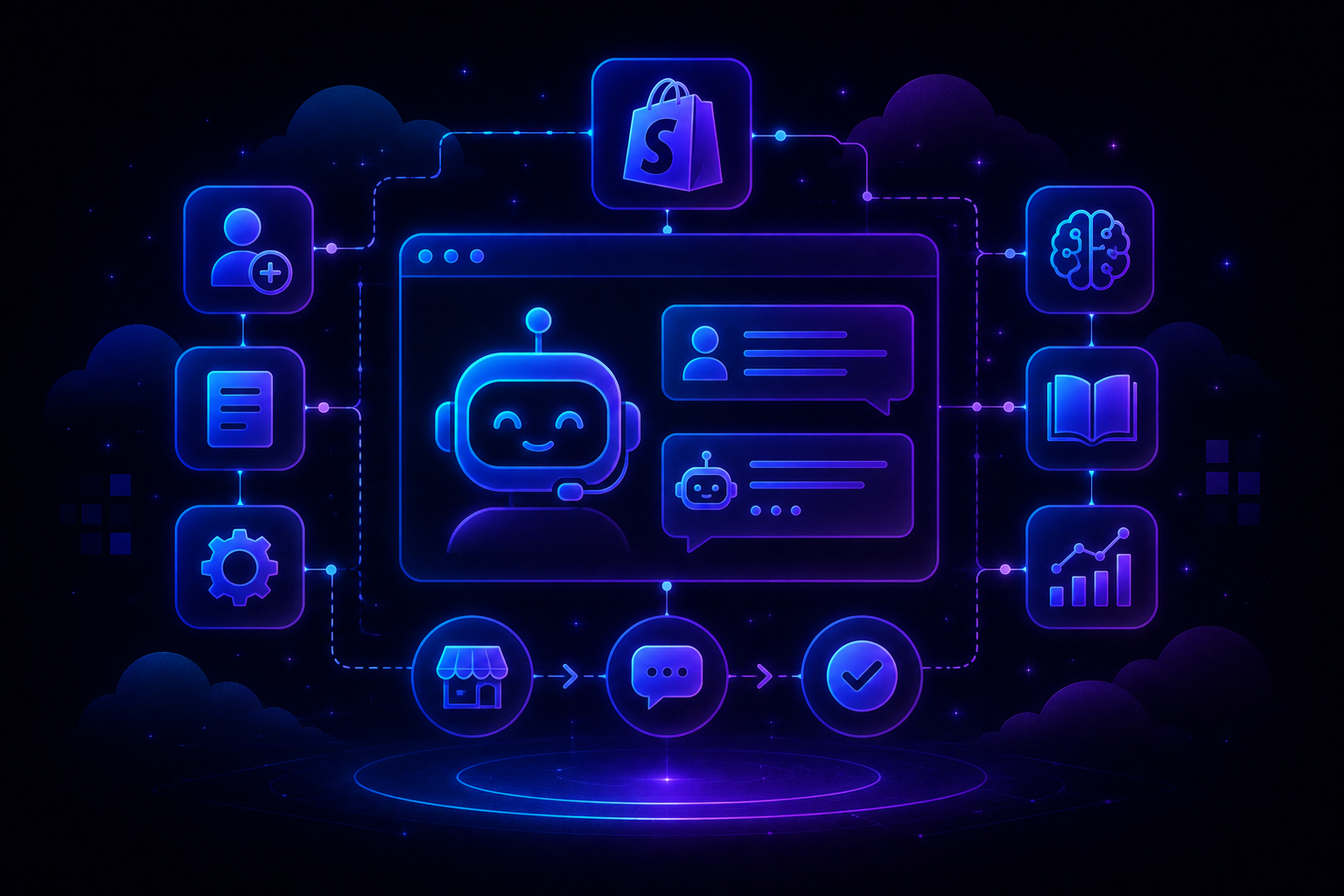
QuantumDesk is an AI-native customer service platform built to automate high volumes of L1 queries while equipping agents with intelligent tools for complex escalations across every major support channel.
It is built for D2C brands, ecommerce customer service operations, and SMB to mid-market teams that need embedded AI automation without enterprise pricing barriers or complex implementation timelines.
Teams choose QuantumDesk over Sprinklr specifically because support automation, agent copilot, and omnichannel routing are built into the core platform rather than requiring a full enterprise CXM investment just to access them.
Key Features
- Quantum AI functions as a dedicated AI Customer Service Agent, resolving repetitive L1 queries like order status and refunds instantly without touching the agent queue.
- AI copilot for agents provides drafted responses, conversation summaries, intent detection, and next-action suggestions directly inside the agent workspace.
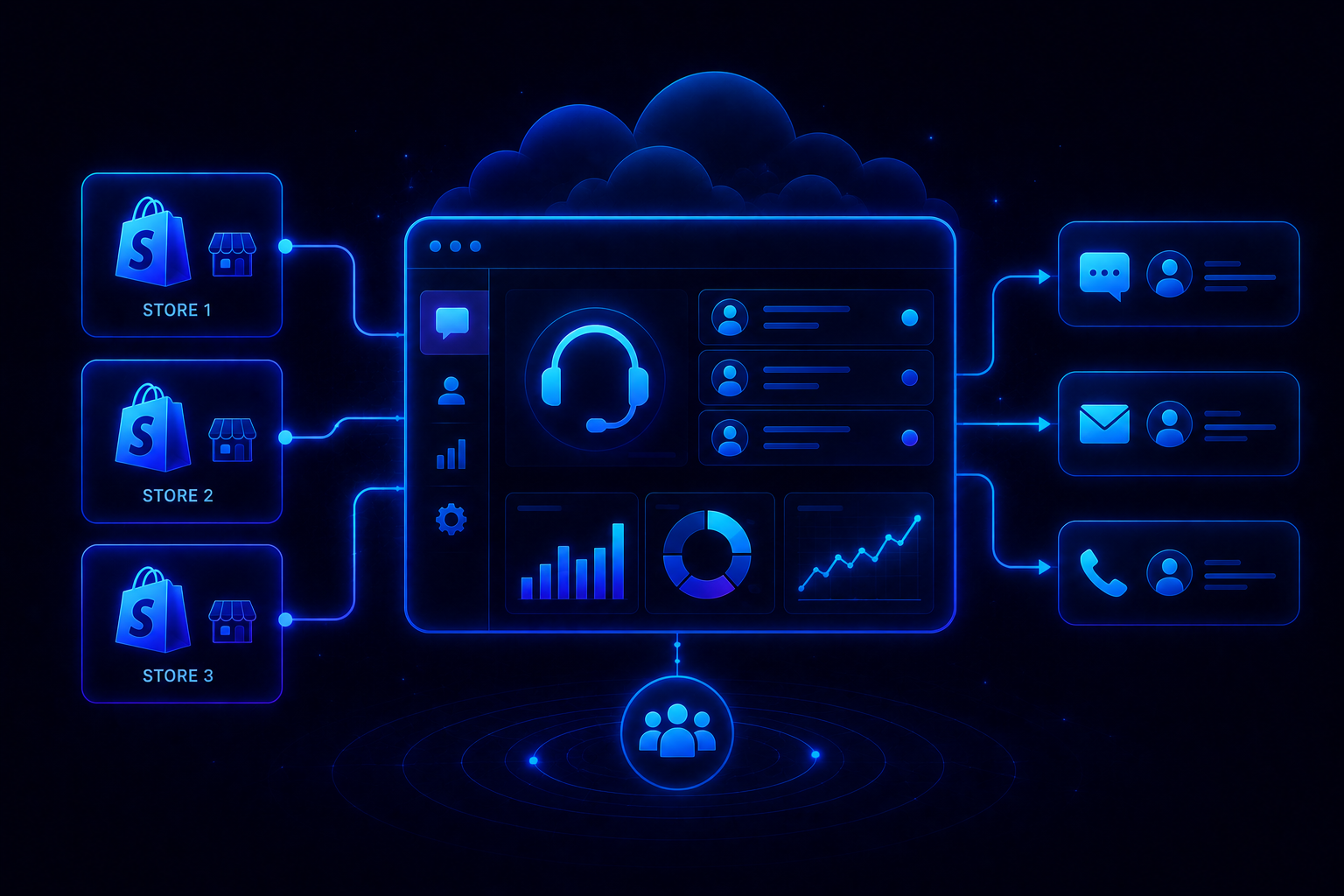
- Unified customer support inbox manages email, live chat, WhatsApp, and social in one workspace without per-channel fees or separate tool subscriptions.
- AI-Curated Inbox prioritizes incoming conversations by urgency, sentiment, and intent automatically, reducing manual triaging and operational overhead.
- Admin Analytics delivers real-time visibility into AI resolution rates, escalation patterns, and customer satisfaction trends without a separate analytics add-on.
Why Choose QuantumDesk Over Sprinklr?
- Sprinklr requires enterprise contracts starting at $50,000 annually. QuantumDesk offers custom pricing aligned to actual team size and conversation volume without a minimum seat commitment.
- Sprinklr's implementation complexity delays time to value by weeks or months. QuantumDesk is designed for faster deployment without dedicated technical onboarding resources or a statement of work.
- Sprinklr's platform breadth spans social, marketing, service, and insights. QuantumDesk focuses entirely on customer support, delivering deeper AI resolution quality for service-focused teams.
Pros
- AI-native architecture means automation is embedded from day one, not purchased as a separate enterprise module or billed per resolved conversation.
- Unified omnichannel inbox removes channel-switching overhead and consolidates conversations from email, chat, WhatsApp, and social into one workspace.
- Custom pricing lets smaller and mid-market teams access AI-native support depth without paying for social, marketing, or intelligence modules they do not need.
Cons
- Ecosystem and partner networks are newer than long-standing enterprise platforms like Sprinklr or Zendesk.
- Best value is realized at mid-to-high ticket volumes. Very small teams may not fully activate the AI resolution depth that the platform provides.
Customer Review
Reviewers highlight QuantumDesk's ability to resolve repetitive queries automatically, cutting agent workload while maintaining consistent resolution quality as ticket volumes grow.
Pricing
QuantumDesk uses custom, quote-based pricing aligned to ticket volume and team size. There is no published minimum seat commitment or per-conversation AI billing model.
2. Sprout Social - Best For Social Publishing and Unified Customer Care
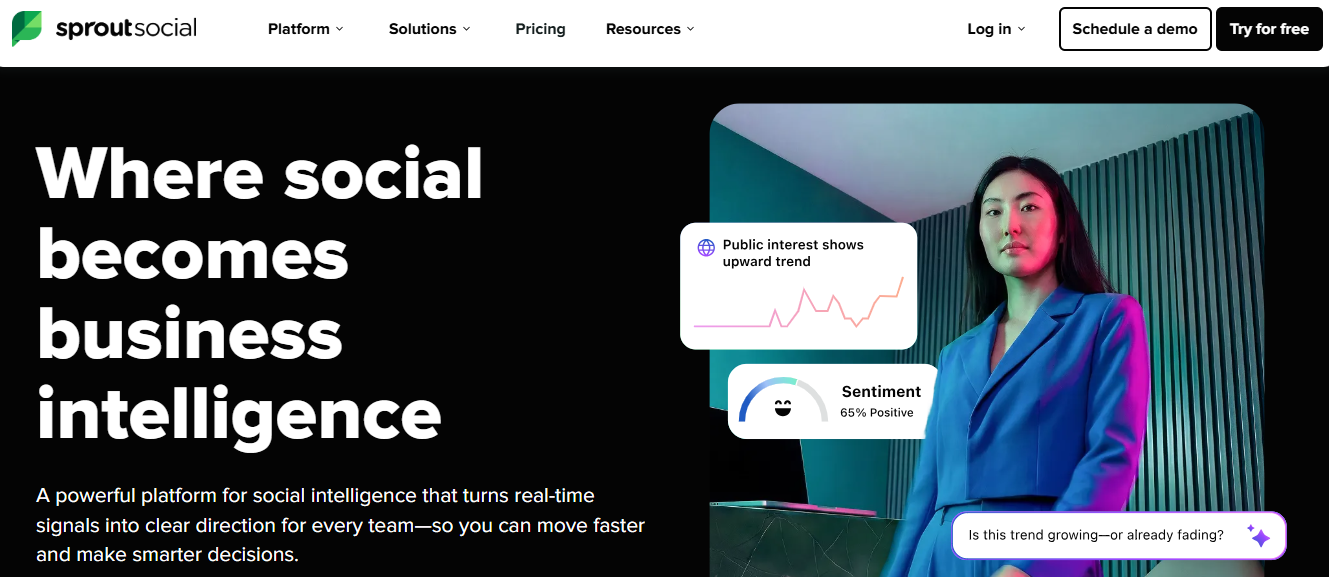
Sprout Social is a social media management and customer care platform for publishing, engagement, listening, and analytics across major social networks.
Built for mid-market to enterprise social teams needing transparent pricing and faster deployment than Sprinklr allows. Teams choose Sprout Social when social publishing and care are the primary operational needs without enterprise configuration complexity.
Key Features
- Smart Inbox consolidating mentions, messages, and comments across Facebook, Instagram, X, LinkedIn, and TikTok into one collaborative workspace.
- Publishing and scheduling with approval workflows, content calendar management, and multi-account support across channels.
- Analytics and reporting with engagement metrics, audience insights, and competitive benchmarking across all connected networks.
Pros
- Transparent pricing from ~$249/seat/month removes the opaque evaluation process that Sprinklr's enterprise model requires.
- High ease-of-use ratings on G2 reduce onboarding time and training requirements for mid-market social teams significantly.
- Strong unified inbox consolidates engagement across major social channels in one collaborative team workspace.
Cons
- Does not cover customer service ticketing or consumer intelligence at the depth Sprinklr's full four-product suite provides.
- Per-seat pricing grows significantly at enterprise scale once multiple users and premium add-ons are included in the contract.
- AI support automation is limited compared to platforms built specifically for service resolution and agent productivity workflows.
Customer Review
G2 reviewers consistently praise the clean interface and unified inbox quality, with larger teams noting advanced AI automation and analytics depth fall short at high enterprise volumes.
Pricing
Sprout Social starts at around $249 per seat per month. Enterprise tiers with advanced listening and analytics capabilities require a custom quote.
3. Emplifi - Best For Unified Marketing and Customer Care
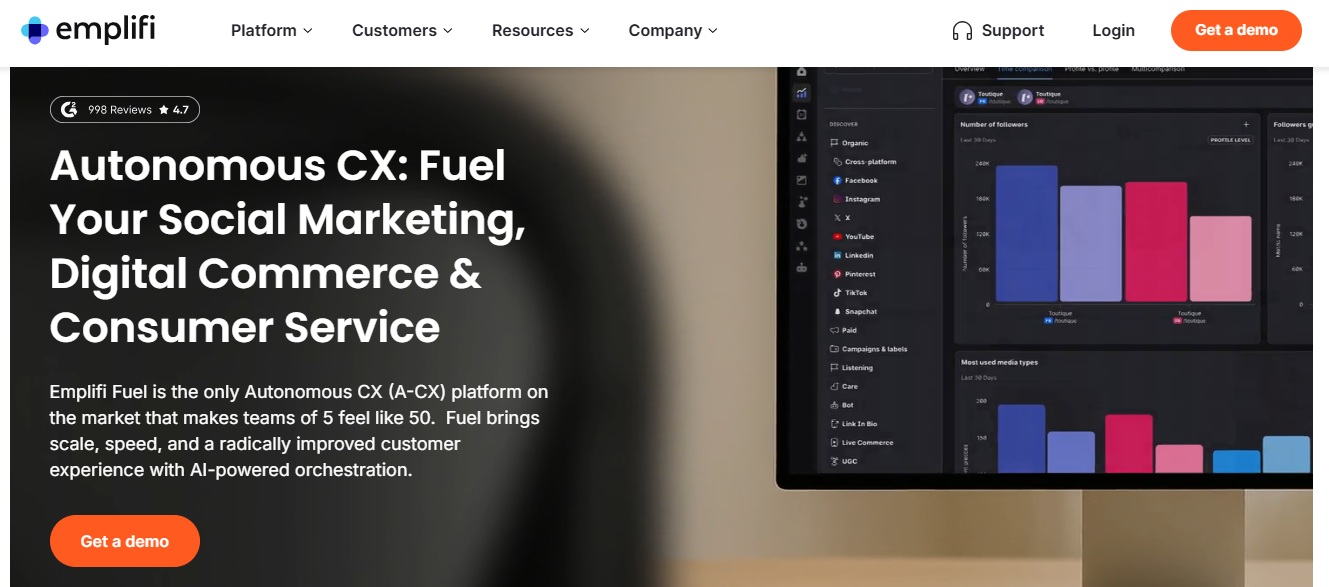
Emplifi is an enterprise platform unifying social marketing, customer care, and commerce for enterprise marketing and CX teams.
Built for enterprise teams managing social engagement and customer care together across brands. Teams choose Emplifi over Sprinklr for faster deployment and tighter marketing-care integration without activating the full four-module suite.
Key Features
- Unified care console managing customer conversations across social, messaging, and digital channels in one shared agent workspace.
- Social marketing tools for publishing, engagement, and campaign management with team collaboration and approval workflows.
- Commerce tools including shoppable UGC, product reviews, and influencer management for D2C and retail brands specifically.
Pros
- Purpose-built for the intersection of social marketing and customer care, delivering specialized depth in both areas simultaneously.
- Faster deployment than Sprinklr for teams activating marketing and care without needing all four platform modules from day one.
- Commerce features like shoppable UGC and review management make it a stronger fit for D2C and retail brands.
Cons
- Consumer intelligence depth falls short of Sprinklr Insights for global brands with enterprise-scale monitoring and benchmarking requirements.
- AI-native support automation is less developed than platforms built specifically around service resolution and agent productivity.
- Pricing is opaque and requires a sales conversation before teams can evaluate total cost of ownership independently.
Customer Review
Emplifi reviewers on G2 praise the unified care and marketing view, with enterprise teams noting faster setup compared to Sprinklr while flagging analytics depth as an area for improvement.
Pricing
Emplifi uses custom enterprise pricing. Plan details are not publicly available and require a sales conversation before full cost visibility is provided.
4. Hootsuite - Best For Broad Social Channel Coverage at Scale
Hootsuite is a social media management platform covering publishing and scheduling across 35-plus social networks for large teams and agencies.
Built for enterprise social teams and agencies needing broad channel coverage with transparent published pricing. Teams choose Hootsuite over Sprinklr for faster activation, lower evaluation friction, and easier onboarding without a mandatory sales cycle first.
Key Features
- Broad channel coverage across 35-plus social networks for publishing, scheduling, content calendar management, and team collaboration.
- Social listening with keyword alerts, sentiment detection, and conversation tracking across major platforms.
- Analytics and benchmarking covering engagement performance, audience growth, and content effectiveness across all channels.
Pros
- Broadest channel coverage in the market, connecting to 35-plus platforms without custom integrations or professional services.
- Transparent published pricing allows teams to evaluate and forecast cost without entering a sales cycle first.
- AI tools for caption generation, best-time-to-post suggestions, and content ideation built into the publishing workflow.
Cons
- Customer service automation is not a core strength. Teams needing structured support ticketing will outgrow Hootsuite quickly.
- Listening and analytics depth falls behind Sprinklr Insights and Brandwatch at enterprise-level monitoring volumes.
- Engagement management tools are lighter than Sprinklr's Care Console for teams handling large inbound social conversation volumes.
Customer Review
G2 users consistently praise scheduling capability and channel breadth, noting that reporting depth and engagement management fall short at enterprise scale.
Pricing
Hootsuite starts at around $99 per month on the Professional plan. Enterprise plans scale with users and features, requiring a custom quote.
5. Agorapulse - Best For Mid-Market Teams Wanting Pricing Simplicity

Agorapulse is a social media management tool with strong inbox management, transparent per-user pricing, and high usability ratings.
Built for mid-market social teams wanting clean workflows and pricing clarity without enterprise complexity. Teams choose Agorapulse over Sprinklr when reliable social management with a lower learning curve is the operational priority.
Key Features
- Unified social inbox managing mentions, comments, and messages across Facebook, Instagram, X, LinkedIn, and YouTube in one workspace.
- Publishing and scheduling with approval workflows, content queues, and visual calendar management across multiple accounts.
- ROI reporting connecting social activity to business outcomes including ad performance, content effectiveness, and campaign impact.
Pros
- Highest ease-of-use ratings among social tools on G2, reducing onboarding time significantly for mid-market social teams.
- Transparent self-serve pricing gives full cost visibility at every growth stage without a mandatory sales conversation required first.
- Strong inbox management built specifically for social teams rather than a secondary feature of a broader enterprise suite.
Cons
- Enterprise governance features, multi-brand management, and complex approval hierarchies are limited compared to Sprinklr at large scale.
- Listening and analytics are less advanced than Sprinklr Insights for high-volume global monitoring and competitive benchmarking needs.
- Does not cover customer service ticketing, AI-native support automation, or consumer intelligence workflows at any meaningful depth.
Customer Review
G2 reviewers consistently highlight the clean interface and pricing transparency as standout differentiators, with enterprise teams noting governance and scalability as limiting factors.
Pricing
Agorapulse starts at around $99 per month. All plan details are published, with Pro and Advanced tiers scaling with team size and feature requirements.
6. Brandwatch - Best For Consumer Intelligence and Deep Social Listening
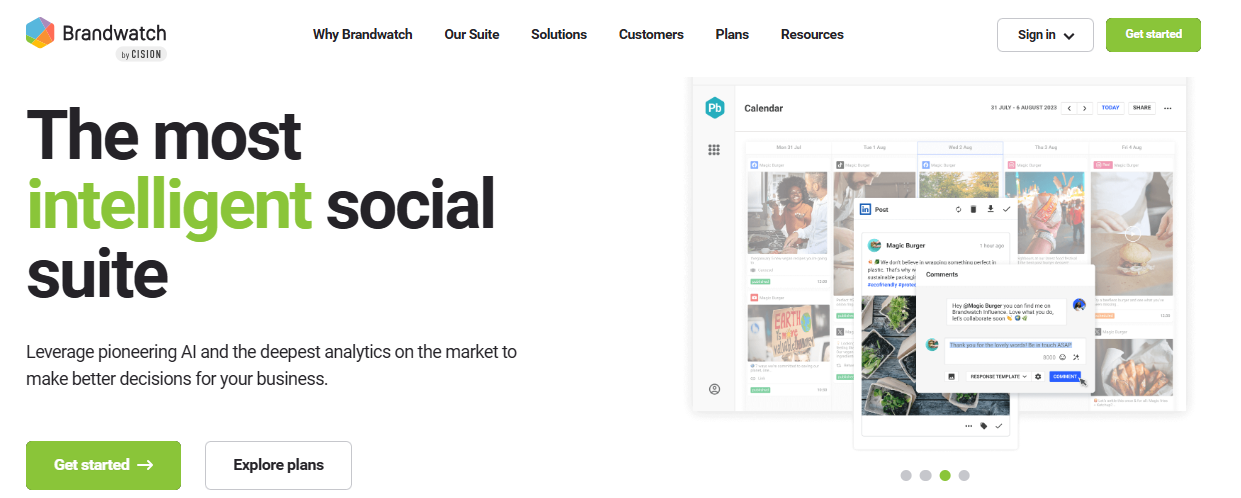
Brandwatch is a consumer intelligence platform specializing in sentiment analysis, trend detection, and deep social listening across global data sources.
Built for enterprise insights and research teams prioritizing deep social listening over publishing or care. Teams choose Brandwatch over Sprinklr Insights for stronger analytical depth and faster configuration for research-focused use cases.
Key Features
- Consumer intelligence with deep sentiment analysis, trend detection, and audience segmentation across millions of sources globally.
- Iris AI for automated trend identification, anomaly detection, and intelligent summarization of large conversation data sets.
- Competitive benchmarking comparing brand performance against competitors across sentiment, volume, and engagement metrics over time.
Pros
- Deepest social listening and consumer intelligence capabilities available, purpose-built for research workflows rather than publishing or support.
- Iris AI reduces manual analysis time by surfacing trends and anomalies from large data sets automatically without human review.
- Broad data source coverage spanning social, news, forums, and review sites beyond the social-network focus of most competitors.
Cons
- Does not cover social publishing, customer service ticketing, or campaign management. Additional tools are required alongside it.
- Pricing is opaque and requires a sales conversation, creating the same evaluation friction as Sprinklr's enterprise model.
- Configuration effort is needed to get the most precise outputs from custom intelligence workflows and audience segmentation.
Customer Review
G2 users praise the listening depth and AI-powered trend detection, with insights teams noting faster time to value compared to configuring Sprinklr's broader platform for intelligence use cases.
Pricing
Brandwatch uses custom enterprise pricing. A direct sales conversation is required before cost details are visible to the buyer.
7. Khoros - Best For Community and Care-Led Enterprise CX
Khoros is an enterprise engagement platform combining community management, digital care, and social publishing for brands with active peer communities.
Built for large enterprise brands managing online communities and high-volume social care workflows simultaneously. Teams choose Khoros when community management is a primary CX investment, not a secondary platform feature added to a broader suite.
Key Features
- Community platform for building and managing branded online communities, forums, and peer support networks at enterprise scale.
- Care console managing high-volume social customer service across Facebook, X, Instagram, and major messaging channels.
- Analytics and reporting tracking resolution rates, community health, agent performance, and social engagement metrics.
Pros
- Community management is a genuine product strength, not a secondary feature, unlike most enterprise CXM platforms including Sprinklr.
- Care console handles high-volume social customer service effectively for enterprise teams at scale.
- Journey mapping connects community and care data for CX leaders who need a unified view of the customer experience.
Cons
- Pricing is enterprise-grade and opaque, creating the same evaluation friction that Sprinklr's contract model produces.
- Implementation complexity is comparable to Sprinklr, requiring significant technical resources for deployment and ongoing configuration.
- Does not match Sprinklr's breadth across AI-native support resolution, consumer intelligence, or campaign management at scale.
Customer Review
Khoros users highlight community management depth as a strong differentiator, with enterprise teams noting that setup complexity and pricing remain significant barriers to faster adoption.
Pricing
Khoros uses custom enterprise pricing. A direct sales conversation is required to access plan details and evaluate total cost of ownership.
8. Zendesk - Best For Structured Support and Service Ticketing

Zendesk is an enterprise customer service platform built for structured ticketing, routing, and SLA management at mid-market and enterprise scale.
Built for support teams needing a dedicated helpdesk without social or marketing overhead. Teams choose Zendesk over Sprinklr when omnichannel customer service ticketing is the primary need, not a full CXM suite spanning social, service, and marketing simultaneously.
Key Features
- Omnichannel ticketing management support from email, chat, voice, social, and messaging with SLA enforcement and queue management.
- Advanced routing with skills-based assignment and conditional rules across multiple teams, queues, and global regions.
- Integration marketplace connecting with hundreds of third-party tools across CRM, analytics, and operations without custom development.
Pros
- Purpose-built for support with mature ticketing, routing, and SLA management for mid-market and enterprise service operations.
- Broad integration marketplace covers nearly every tool category a support operation might need without custom development investment.
- More transparent pricing than Sprinklr, with published plan rates allowing teams to evaluate cost before entering a sales cycle.
Cons
- Per-seat pricing with AI add-ons pushes total cost well above published entry rates for most real-world mid-market deployments.
- Requires dedicated administration and configuration, adding overhead for lean support teams without dedicated technical resources.
- Does not cover social publishing, community management, or consumer intelligence that Sprinklr teams manage from one platform.
Customer Review
Zendesk users praise configurability and ecosystem depth but consistently flag unexpected cost growth from layered add-ons as a recurring frustration as deployments scale.
Pricing
Zendesk Suite starts at around $55 per agent per month. Deployments with AI and advanced routing often reach $115 to $169 per agent monthly with annual billing.
9. Genesys Cloud CX - Best For Contact Center and Call-Heavy Operations
Genesys Cloud CX is an enterprise contact center platform for voice, digital support, and workforce management at large-scale operations.
Built for enterprises running contact-center-heavy operations combining voice, digital, and workforce management. Teams choose Genesys over Sprinklr when telephony infrastructure and call center routing are the core operational requirements, not social or marketing workflows.
Key Features
- Omnichannel routing across voice, email, chat, and messaging with AI-powered queue management and skills-based assignment.
- Workforce management covering scheduling, forecasting, adherence tracking, and performance coaching for large agent teams.
- AI-powered predictive routing matching customers to the best available agent based on intent, history, and skill data.
Pros
- Best-in-class contact center infrastructure for voice, digital, and blended support operations at enterprise and large mid-market scale.
- Workforce management tools go significantly deeper than any social or CXM platform, including Sprinklr's enterprise suite.
- AI-powered routing is refined specifically for high-volume blended call and digital operations rather than general CXM workflows.
Cons
- Designed for contact centers, not social publishing, consumer intelligence, or campaign management use cases.
- Implementation is complex and expensive, often requiring specialized professional services for deployment and enterprise-scale configuration.
- Does not address social listening, brand publishing, or community workflows that Sprinklr teams regularly handle from one dashboard.
Customer Review
Genesys users rate contact center capabilities highly but flag implementation complexity and cost as significant factors, with smaller teams consistently noting the platform is overbuilt for their actual needs.
Pricing
Genesys Cloud CX starts at around $75 per agent per month on the CX1 plan. Full-featured plans with AI and workforce management reach $155 per agent monthly or higher.
10. Buffer - Best For Small Teams Wanting Social Publishing Simplicity
Buffer is a lightweight social publishing and scheduling tool built for small teams, creators, and growing brands.
Built for small businesses and solo operators wanting simple publishing at accessible prices without enterprise overhead. Teams choose Buffer over Sprinklr when content scheduling is the only requirement, without enterprise governance, listening, or customer care needs.
Key Features
- Social publishing and scheduling across Instagram, Facebook, X, LinkedIn, TikTok, and Pinterest from a minimal, fast-to-learn interface.
- AI assistant for generating captions, repurposing content, and suggesting posting ideas directly within the publishing workflow.
- Team collaboration with draft review, approval workflows, and multi-user access for small team publishing management.
Pros
- Most affordable social publishing available, with transparent per-channel pricing and a free tier covering up to three channels.
- Minimal interface is fast to learn with no dedicated platform administration or technical implementation resources needed.
- Free plan lets small teams start with up to three social channels without any monthly cost commitment upfront.
Cons
- No social listening, consumer intelligence, or customer service capabilities. Buffer is a publishing tool, not a CXM or care platform.
- Not suited for enterprise teams needing governance, multi-brand management, or complex approval hierarchies at scale.
- Analytics depth is limited compared to every other alternative on this list, including Hootsuite and Agorapulse.
Customer Review
Buffer users consistently praise simplicity and pricing accessibility, with growing teams noting they outgrow its capabilities once listening, engagement management, or customer care become operational priorities.
Pricing
Buffer offers a free plan covering up to three channels. Paid plans start at $6 per channel per month, scaling with channels and user count.
How to Choose the Best Sprinklr Alternatives for Your Business
1. Define Your Primary Use Case Before Shortlisting
Identify whether your team's core need is social publishing, customer support ticketing, consumer intelligence, or an integrated combination before evaluating platforms.
Teams evaluating Best omnichannel customer support software often shortlist tools built for very different workflows, leading to misaligned purchasing decisions and wasted evaluation time.
2. Pricing Transparency and Total Cost of Ownership
Sprinklr's enterprise contracts and opaque pricing make total cost of ownership difficult to forecast before completing the full sales process.
Look for platforms that publish their pricing, offer monthly billing options, and allow teams to evaluate real monthly spend without a mandatory sales conversation or annual contract commitment first.
3. Deployment Speed and Onboarding Requirements
Sprinklr's setup involves significant configuration, training, and often professional services before the platform delivers operational value to the team.
For teams researching how to scale customer support quickly, deployment speed matters as much as feature depth when choosing a platform to replace Sprinklr.
4. AI Depth for Support and Automation Workflows
Evaluate whether AI is embedded in the platform's core or added as a separate paid module before committing to a contract or evaluation.
Platforms where AI resolution, agent copilot, and smart routing are foundational rather than optional deliver lower per-ticket cost as conversation volume scales over time.
5. Team Size and Platform Complexity Fit
Sprinklr is designed for large global enterprises. Teams with fewer than 20 agents, or without dedicated platform administrators, often pay for features they never activate.
Match platform complexity to actual operational scale rather than purchasing for a future state that may require a completely different platform as the business matures.
Why QuantumDesk Is a Strong Alternative to Sprinklr
QuantumDesk is built for D2C brands, ecommerce operations, and SMB to mid-market support teams that need AI-native customer support without Sprinklr's enterprise pricing structure, platform breadth overhead, or multi-quarter implementation requirements.
Core strengths:
- AI-native architecture: AI resolution, agent assist, routing, and analytics are built into the core product, not sold as enterprise module add-ons or billed per engaged conversation.
- Quantum AI for customers: Resolves repetitive L1 queries instantly with full context preserved and seamless escalation when agent involvement is needed.
- AI copilot for agents: Provides drafted responses, conversation summaries, intent identification, and next-action suggestions directly inside the agent workspace.
- Unified omnichannel inbox: Manages email, live chat, WhatsApp, and social in one workspace without per-channel fees or separate tool subscriptions.
- Admin performance visibility: Delivers real-time insights on resolution rates, escalation patterns, and satisfaction trends without a separate analytics add-on.
Where Sprinklr requires enterprise contracts, multi-module configuration, and significant onboarding investment, QuantumDesk delivers ai native customer service benefits with support automation active from day one. The platform is built for teams that need AI embedded in every support interaction, not accessed through an enterprise suite designed primarily for social and marketing operations.
Teams evaluating the best customer service software for ecommerce brands consistently find the strongest long-term fit with QuantumDesk when their primary need is customer support automation rather than a unified social-marketing-service suite.
If your team is evaluating Sprinklr alternatives with stronger AI support depth and more predictable costs, explore how QuantumDesk can support your growth → Book a Demo
Frequently Asked Questions About Sprinklr Alternatives
What are the top Sprinklr alternatives?
The top Sprinklr alternatives include QuantumDesk, Sprout Social, Emplifi, Hootsuite, Agorapulse, Brandwatch, Khoros, Zendesk, Genesys Cloud CX, and Buffer.
The right choice depends on your primary use case. QuantumDesk is strongest for D2C teams needing AI-native support and automation, while Sprout Social and Hootsuite are stronger for social publishing.
Is Sprinklr suitable for large-scale use?
Sprinklr is built for large enterprises managing social, service, marketing, and insights at global scale with complex governance requirements.
However, enterprise contracts, opaque pricing, and implementation timelines make it difficult for teams outside enterprise procurement cycles to evaluate and forecast total cost confidently.
How does QuantumDesk compare to Sprinklr?
QuantumDesk focuses entirely on AI-native customer support, with resolution and omnichannel routing embedded in the core platform without enterprise pricing barriers.
Sprinklr covers a broader suite but requires significant enterprise configuration. QuantumDesk is the stronger fit for support-focused teams that need AI active and operational from day one.
What is the best free alternative to Sprinklr?
Buffer and Hootsuite offer free or low-cost starting points for small teams managing social publishing without enterprise platform features.
For teams needing customer support automation, QuantumDesk's custom pricing avoids the cost and complexity cliffs that come with scaling past free-tier publishing tool limitations.
Which Sprinklr alternative is best for mid-market teams?
Sprout Social and Agorapulse are the strongest mid-market alternatives for social-focused teams, with transparent pricing, high usability ratings, and fast onboarding timelines.
For mid-market teams whose primary need is customer support, QuantumDesk delivers AI-native resolution depth without requiring an enterprise-level implementation investment to get started.




.avif)